Category Archives: WINTER TOURS

Exploring via planes, trains and automobiles when JUANONA is sleeping in her winter berth (wherever that may be)

SE Asia: PART VIII

Hue

Thursday-Friday, February 18-20

An early morning flight via Vietnam Air brought us halfway down the coast to Hue, another World Heritage Site and the capital of unified Vietnam from 1802-1945.  The cool, gray weather followed us south but didn’t deter us from exploring this city and the environs.

Our friend Carol whom we met in Luang Prabang had provided us with several recommendations for restaurants, so we unpacked our bags and went on the hunt for one of them, the Golden Rice . And, we weren’t disappointed. Like the other ones she suggested in Luang Prabang, this one also offered delicious meals. So much so, we went back for dinner that night.

With full stomachs a walk was in order so we headed down to the Suong Huong (Perfume River) and checked out the main draw of Hue:  the Citadel, where the emperors ruled from the early 1800s until 1945 when Ho Chi Minh convinced the last emperor, Bao Dai, to abdicate.

Located on the southern side of the river our hotel was only a few blocks away from the waterfront. The broad avenues and large parks bordering the river were deserted except for the occasional hawker for dragon boat rides and sellers of pet birds and fish from sidewalk stalls. We crossed to the north via one of the large, connecting bridges and made our way towards the Citadel.

Screen Shot 2016-03-18 at 11.08.30 AM

As in most of the cities we’ve explored in SE Asia entrepreneurs beckoned us into their shops. Loads of branded merchandise covered tables and hung from walls… from North Face jackets to RayBan glasses to Kipling bags, someone interested in picking up bargains would be in heaven; yet, in spite of Vietnam manufacturing many products sold internationally, you can’t always be certain what you’re buying is authentic. But, hey, if it looks good, feels good, and the price is right, who cares?

Thinking we didn’t have enough time to actually explore the Citadel we did a u-turn and crossed back to the south side of the river via another bridge.

hue bridge

Friday, February 19

Yahoo! Sun was out, which meant warmth and sunscreen and a motor scooter adventure. We had arranged to rent one the night before, and at 9am we donned our helmets, mounted the bike and headed northeast towards the coast. A narrow island several miles long serves as a barrier between Hue and the South China Sea, and it was this stretch of land we rode down with a lagoon on one side and the sea on the other.

Hue environs Map

Passing shrimp farming framed by wooden fences

Version 3

and vegetable gardens carefully plotted out

IMG_5856

we came upon a boat yard. Seeing two other tourists wandering around we opted to stop to do the same.

IMG_5805

Allowed free rein to roam we did just that, peering at the various stages of boat building and repairs. Not speaking Vietnamese and the builders not knowing English, we pantomined our interest and were received with smiles and chuckles.

IMG_5779

The yard was pretty self-sufficient, including its own sawmill.

IMG_5817

IMG_5784

Marveling at how much work is done by hand with limited mechanical tools, we watched the the use of fire to shape planks…

IMG_5812

the fitting of a plank to a new hull…

IMG_5804

IMG_5803

caulking…

IMG_5807

and an old woman cleaning up the yard.

IMG_5828

We also noticed a stand with remnants of burnt incense by the launching area. I don’t know if this was left over from a Tet celebration or if the ritual related to the launching of boats.

IMG_5824

IMG_5823

Having  poked around the yard enough, as we headed towards our scooter Max noticed some numbers written on a door. They appeared to be some sort of measurement conversions, yet we couldn’t figure them out. But, every time I see construction, whether for boats or buildings, it reminds me of my brother’s and sister-in-law’s (Cam and Carmen’s) business, and the adage measure twice and cut once. Just wish we spoke Vietnamese…

IMG_5830

We had read religion doesn’t play a part in most Vietnamese’ lives, especially since the communist government declared the country an atheist state. For those that do practice, the folk religion, a blending of Buddhism, Confucianism, and Taoism, is the most predominant. Whatever the belief, it obviously involved pink incense sticks.

IMG_5841

IMG_5839

As we rode down the small backbone of this coastal island, we passed a large number of colorful tombs nestled in and on top of the dunes on the ocean side

IMG_5857

IMG_5853

IMG_5847

IMG_5848

Having someone explain the significance of the carvings and illustrations, such as the one espied inside,

IMG_5851

would have been great but just seeing the elaborate architecture honoring the dead made a strong impression.

The only way we really got a sense of location was watching for schools since they included the village name; yet, even then we weren’t exactly certain where we were but felt content just to be lost as beeping scooters overtook us and we overtook bikes (a definite pecking order to the traffic around here).

IMG_5883

Throughout our ride we got a feel for country living as we saw farmers planting crops in orderly rows

IMG_5880

and water buffalo bathing in the lagoon…

IMG_5874

then crossing the street to feed on hay.

IMG_5865

A side road took us to a fleet of fishing boats, which we most definitely had to inspect.

IMG_5858IMG_5862

Continuing on we began searching for a lunch spot and finally found one where we inhaled the traditional, beef noodle soup:  Pho Bo, crouched on surprisingly comfortable in plastic chairs.

IMG_5877

Waving goodbye to the family who cooked and served us lunch,

IMG_5879

we got back on the bike for our return to Hue. (FYI:  this is how we were welcomed during most of our travels in SE Asia. Pretty wonderful.)

But, we weren’t going to leave the coast until we at least touched the ocean, which supposedly was lined with “stunning sandy beaches and dunes” as per the Lonely Planet guide. Since the dunes block one’s view of the ocean we finally found a little lane through a few houses that led to the beach and our anointment by the Gulf of Tonkin which flows into the South China Sea.

IMG_5885

With butts getting sorer by the mile, it was definitely time to get back and enjoy more tasty Vietnamese dishes. Our adventure in the countryside ensured we wouldn’t be leaving this country without an appreciation for the beauty and the warmth of the coastal-scape and people, a scooter ride  we will remember for a long, long time.

IMG_5852


SE Asia: PART VII

HALONG BAY

Monday-Wednesday, February 15-17

A mini-bus picked us up Monday morning for our three-hour ride to Halong Bay, a UNESCO World Heritage Site comprised of over 3,000 limestone islands jutting out of the Gulf of Tonkin. Having heard others rave about the dramatic scenery we knew we’d be remiss not to add this to our destination list. So, we signed on for a two-night sleepover on one of the multitude of wooden boats or junks carting tourists around and about this bay.

About halfway to the coast we halted at a rest stop, which happened to be a factory store for crafts and souvenirs manufactured on the premises by disabled Vietnamese. The most impressive were the huge stone monoliths created outdoors…

IMG_5770 (1)

out of a huge junk pile of stones.

IMG_5769

Marveling at the techniques we also understood that regulations regarding workers’ health didn’t appear a huge priority as we watched jackhammering without ear protection

IMG_5772

and grinding without eye protection.

IMG_5767

IMG_5773

Wondering how on earth they expected foreigners to purchase one of these statues for their homes, we noticed a large display board listing shipping details to major destinations per country. And, no, we didn’t buy a jovial Buddha for our garden…

IMG_5775

Arriving at the cruiser port at Halong City we joined the other tourists milling about as skiffs exchanged their loads of previous boaters with new ones such as us. Within fifteen minutes we landed aboard our ship and headed out to cruise around the impressive vista of rugged rocks, many studded with green vegetation.

IMG_5631

What we hadn’t really counted on was how cold it was. For some reason I kept expecting the weather to be hot and humid because that’s been my perception when contemplating traveling in SE Asia. Even knowing there’d been unprecedented freezing temperatures in northern Vietnam’s mountains I still held onto my expectations of heat and sun. It’s also how I made a mistake in telling Max there was no need to pack his long underwear…

But, just as our time in Laos proved my climate prediction false, so did our boating excursion. Not only was it not hot, it wasn’t even warm. And, throughout our cruise we found ourselves huddling with others in the seemingly unheated lounge ordering hot coffee and hot tea. Fortunately our rooms had heaters with our tour leader instructing us on how to turn them on and up.

Yet, the views were mesmerizing, in part due to Vietnam maintaining the pristine nature of this site. Other than the large number of cruise boats, the bay’s occupants consisted of a few floating fishing villages, oyster farming for food and pearls

IMG_5628

and persistent women selling snacks and souvenirs to tourists.

IMG_5643

To keep passengers entertained the cruising company organized several group events, one being a visit to Hang Sung Sot (Cave of Surprises). Discovered in 1901 the cave’s first tourists were allowed into the space 1993 after the constructing of safe paths and openings. The large interior, secure walkways, and lighting ensured this was my kind of spelunking.

IMG_5653IMG_5661

Yet, I’m always thankful to be out from under rocks; and, like the other tourists we posed for a backlit portrait looking out over the bay (you had to climb a bit to get to the cave opening):

IMG_5670

When asking our guide how Halong Bay was created he said it was complicated. He tried to make it as simple as possible, which I’ll relate here:  over the past 500 million years the sea ebbed and flowed with underlying teutonic plates pushing and shoving, causing flooding, erosion and mountainous limestone build-up of over 3,000 feet thick. From 67 million to 9,000 B.C.E. mountain-forming and erosion created the features seen today in Halong Bay including the caves caused by water seeping through cracks in the mountains.

In the past 1,000 years the water’s become saltier and coral grew with the end result being a karst topography, which I’ve since read is landscape formed by the withering away of soluble rocks. If only time-lapsed video was available 500 million years ago… or, our friend Joanne U., a geologist who could explain all of these wonders.


Tuesday

The next day those who were staying for a second night went kayaking. Thinking of getting into a tipsy watercraft on a cold, gray day didn’t exactly engender feelings of ‘oh boy! what fun!’; however, since this was one of the primary reasons we signed on for two-days, I knew I’d regret not doing so. So, our great guide (Dan Dang Tran, who had taken over from the first one), Max, two honeymooners from New Zealand, and I plopped ourselves into two-person kayaks and pushed off from the mothership.

And, what a great way to spend time on this bay! Because our cruise took us a bit further than most other boats and due to our guide’s getting us up and out fairly early, our paddling took us through open-ended caves into deserted coves and back out again.

IMG_2449

In one we spotted monkeys (later found out to be macques) foraging for their breakfast and sea eagles riding thermals.

monkeysIMG_5752

Eventually we were joined by other kayakers enjoying splashing about as we all tried to coordinate strokes with our partners. After several hours it was time for our next jaunt, which was visiting Halong Pearl Farm, a saltwater pearl grower.

I was interested in seeing just how cultured pearls were created, especially since a friend of ours, Leighton Reeve, started a jewelry company featuring a range of beautiful items using pearls and semi-precious stones (http://www.theislandpearl.com). Pulling up to a floating platform

IMG_5711

IMG_5688

we were led through the process for saltwater pearl farming:

A two-year-old oyster is harvested…

IMG_5683

seeded (implanted) with a small shell bead,

IMG_5694

along with a piece of donor mantle tissue (the organ which makes the shell) from another oyster…IMG_5691

and, returned to the water inside a net (protecting it from predators), which is when the real waiting starts. For the oyster to graft (grow) a pearl can take from 18 months to five years depending on the size; and, this farm raised three different sizes (two shown below).

IMG_5684

IMG_5686

IMG_5707

Basically, a foreign body (parasite, fish scale, piece of shell but never grains of sand) gets into the soft oyster’s body, which causes it to protect its soft innards by forming a blister or sac around the irritant. The oyster begins secreting nacre (a mineral composed of crystalized calcium carbonate) and conchiolin (a natural proteinto adhere the first layer of nacre to the foreign body). As the oyster grows, more nacre layers are added until you harvest the oyster and remove the pearl.

Okay, I’ll stop with the nature lesson but I do love the fact that mother-of-pearl is literally nacre, which is the birth mom of a pearl.

Even with this careful planning and planting there’s no guarantee a cultured pearl will form or be round enough for sale. Considering how rare a natural pearl occurs (roughly 1 out of every 2,000 oysters), being able to fake an oyster to produce a pearl is pretty good. Even then it’s only about a 10% success rate with the remaining sold as food.

This delicate process obviously requires a deft touch by a trained technician.

IMG_5699

IMG_5698 IMG_5695

IMG_5693

To get an idea just how delicate, check out this site:  grafting oysters. No need to read it, only scroll through the list. No wonder they call it surgery.

Naturally there was a store as part of the tour, and Vietnamese are exquisite salespeople. They just don’t take no for an answer but keep coming up with reasons for purchasing their products.

And, they have all the displays ready to ensure you’re getting top quality:

IMG_5706

These natural gems have popped up in other travels we’ve done. In Hyderabad, India, when we were fortunate enough to join one of our friend Noel’s tours (http://bodatravels.asia/newtrips.php) and in Doha where they use to pearl dive before SE Asia began their pearling.

And, no, we didn’t purchase any pearls to go with the un-purchased grinning buddha; but, Max did insert a light bulb being the tallest one around. Unfortunately, it wasn’t in trade for a big fat pearl… :)  Leighton, here I come!

IMG_5702

During our day we got to know and enjoy our guide Dan and the young couple from New Zealand.

IMG_2452

IMG_5674

The Kiwis had just had a huge wedding in Auckland three weeks prior (we know about Indian weddings now thanks to Noel’s tours to India) and were returning home at the end of the week. In speaking with them we discovered the airlines (Malaysia Air) had lost her luggage on the initial flight from New Zealand. What a trooper! She’d been wearing almost the same items for two-weeks straight; no trousseau, simply sweatpants, teeshirt, flipflops (with socks), and a jacket she’d fortunately been wearing. She travels lighter than Max, which is saying something. It was only later that night they heard her luggage had been located.

In addition to the Kiwis we met another couple back on the mothership. They hailed from northern India, and the six of us had wonderful conversations–from engineering a marina on a remote Fiji island to establishing long-term care philosophy in India–

IMG_5744

as we watched the chef create a sculpture out of an apple

IMG_5741

then produce a dramatic cloud when steaming fresh prawns for dinner.

IMG_2311

Another six-degress-of-separation moment occurred when the Kiwis and Indians discovered each had ties to Fiji with the Kiwi bride’s family hailing from Fiji and the Indian doctor’s nickname derived from her spending some of her childhood there.


Wednesday

Returning the next day to the mainland we passed by some ships waiting for smaller boats to unload their cargo. Whenever we see tankers and freighters we think of our friends Joanne and Rod who are involved in the shipping industry. They also had just been in this part of the world recently; and, some other friends from home, Sharon and Dave, we’d actually rendezvous with with later. Halfway around the globe and we see familiar faces. Pretty amazing.

IMG_5736

The day also happened to be the one sunny sky of our three days on Halong Bay. Isn’t that typical?

IMG_5726 (1)

IMG_5728

But, no matter, because what really counted is rarely affected by weather, only by one’s company. The connections we enjoy always give me hope that conversations begun out of curiosity about others’ worlds will lead to a broader exchange of friendship and understanding. And, in Halong Bay as in all of our exploring, the people–hosts and fellow travelers–have been spectacular.

Soon to come, a step back in time to Vietnam’s Imperial court.


SE Asia: PART VI

Hanoi

Thursday-Monday, February 11-15

Figuring the celebrating of Tet would be winding down we entered Vietnam to begin exploring this country north to south. Flying on Vietnam Air, now a favorite of ours due to its reasonable fares and efficient service, we landed in Hanoi Thursday night and walked into an airport sparkling with newness and the buzzing stream of travelers.

Thanks to a recommendation from our friends Marcia and Steve we had arranged to stay in the same hotel they did, located in the Old Quarter and close to many key sites. We felt immediately immersed in the culture as we stepped out of the cab onto a sidewalk populated with numerous small storefronts, stalls selling street food, and the ubiquitous scooters zooming through the streets. Yet, as soon as we walked through the hotel door, a calmness settled around us and we knew we’d find a welcome oasis upon our return from upcoming days of touring .

Friday morning we had arranged to meet with a friend of Laurie’s. Duyen (the ‘D’ pronounced as ‘Z’) had met her when he attended graduate school in St. Louis. With a background in finance, which he had parlayed into tourism, he helped us plan our trip through Vietnam. In addition to giving us practical information we also learned how he came to study in the U.S.

With the Vietnamese government recognizing the value of tourism, jobs in this industry offered an opportunity to earn a decent living. Duyen wanted to practice his English, and one of the simplest and cheapest ways involved speaking with English tourists. Seeing a foreigner in a park, he approached her and asked if she’d speak with him. No money or gifts were wanted, only the opportunity to learn a language that promised a better living. From that initial meeting, Duyen made a lifelong friend. They communicated over the years and eventually Duyen, having completed his studies in Vietnam, travelled to Missouri for graduate school. His story – consequential foreign connections developing from chance encounters – is one we heard several more times, including from an Austrian staying at our hotel.

After meeting with Duyen we left for our first destination:  Hoa Lo Prison Museum, known as the “Hanoi Hilton” by Americans.

IMG_5473

IMG_5475-2

I don’t know too many people of my generation who haven’t been touched by the Vietnam War; but a lot of my contact with this war was through the media and campus protests. Walking through the doors of this complex changed that. And, throughout our time in Vietnam I felt the echo of this war trailing us as we toured other sites associated with the deaths of so many on both sides.

First used as a prison by the French beginning in the mid-1800s, there were displays of Vietnamese men…

IMG_5483

and women…

IMG_5481

incarcerated for crimes against the colonists. A guillotine used for executing prisoners added to the gruesome feeling one got walking through these rooms.

IMG_5516

Other visitors had told us about Vietnam’s framing of the war, which positioned it from their eyes. No surprise considering it’s their country and, as another friend said, winners write the history books. However, the displays at this prison and elsewhere turn fiction into ‘facts’.

We saw the ‘rescue’ of John McCain from Truc Bach Lake along with his flight suit…

IMG_5496 IMG_5497

and a pensive portrait of captured pilot Jeremy Denton (someone I remembered from growing up in Va. Beach) who had alerted the U.S. military of POWs’ treatment by blinking ‘TORTURE’ in morse code during a 1966 Viet Cong propaganda film.

IMG_5510

I’m not saying the U.S. is innocent of atrocities or Vietnam is alone in demonizing their enemies. Far from it. All one has to do is turn on the evening news or browse articles by credible journalists reporting from around the world. But, in watching a film on continuous loop amidst the photographs taken at this prison I had to stifle my disbelief. It was then I began snapping shots as words appeared on the screen:

IMG_5507IMG_5506IMG_5504

IMG_5509

IMG_5503

Wow.

To clear our minds of the horror found in the now-sanitized cells of Hanoi Hilton we exited the building in search of much lighter fare. Walking towards Hoan Kiem Lake, which was close to our hotel, we found a restaurant perched above a rotary and treated ourselves to refreshments as we gazed down on a typical Hanoi view of today.

IMG_5539 IMG_5536

Saturday we opted for Ho Chi Minh’s Mausoleum, which was an easy cab ride from our hotel. We hopped out only to find ourselves being directed to a very, very, very long line that streamed down at least a half of a mile from the entrance. Being the last weekend of Tet, this revered figure’s grave attracted a lot of tourists, us being only two amidst tons of others, the majority being Vietnamese.

Yet, the line moved quickly and within thirty minutes we were being ushered through security (dropping off our camera and knapsack). Becoming part of a hundred-leg centipede we shuffled under a covered walkway into an open space and finally spotted the massive gray structure hosting the embalmed hero of Vietnam’s independence from foreign powers.

IMG_5551

We continued as part of the procession, snaking our way up the steps and into the darkened room featuring Ho Chi Minh.

We were fortunate his body was actually on display. Evidently he’s sent to Russia for several months of maintenance each year (and that’s as much detail as I need on that topic). No photos were allowed so we happily took some shots of the white-clad guards both standing and goose-stepping.

IMG_5540IMG_5558

Max being Max had to defy the regulations by dipping a toe into the no-entry zone.

IMG_5548

Must say the site was lovely with its gardens, grandiose buildings (including the Ho Chi Minh Museum and Presidential Palace along with Ho Chi Minh’s stilt house where he lived off and on from 1958-69). Instead of touring those we left the square and headed back to retrieve our checked backpack*.

*The camera surprisingly was perfectly timed to match our exit from the mausoleum; as Max pointed out they must have some conveyor belt sending visitors’ cameras underground to this specific checkpoint; pretty impressive.

On our way we noticed a woman recycling all the plastic water bottles discarded by visitors. We were thinking what a great example of being environmentally conscious. We didn’t realize just how much they were into saving the earth’s resources until we saw she was actually emptying out the water from the individual bottles into one giant jug.

IMG_5570

In search of more war remnants we walked down tree-lined boulevards past relics of French colonialism.

IMG_5577 IMG_5575

Our meandering path took us to Truc Bach Lake, site of John McCain’s crash, where we saw folk enjoying the afternoon paddling swan boats.

IMG_5584

Continuing on we found Huu Tiep, another pond in which a B-52 had crashed during the 1972 “Christmas Bombings”. Another sobering casualty of the war.

IMG_5592

Grabbing a cab we headed across town to the Vietnam Museum of Ethnology. We’d heard this museum was well-worth a visit and we totally agree.

mus 2

Yes, it was overwhelming in the amount of information provided on three levels (how could it not be with 54 ethnic groups?); but, strolling through the displays, we couldn’t help but absorb some knowledge of this country’s rich tribal heritage. Unfortunately, no photography was allowed so we just meandered and peered until our eyeballs glazed.

mus 4

We had heard one of the best ways to see some of the country’s traditional lifestyles is to visit Sapa, a former French hill station close to the northern border.  Boasting stunning country vistas and offering beautiful trekking, this mountainside town is home to several tribes still dressing in traditional clothes and melding traditional lifestyles with modern ways. Our friends Jack and Zdenka (who just finished their sailing circumnavigation this spring!) gave us the name of a Hmong guide in case we made it to this town. We wish we had but not enough time and the forecast of continued cold and damp weather kept us heading south and along the coast.

By now we were ready to rejuvenate ourselves in A/C and some liquids–which we could at least pretend hadn’t been slurped before–so back to our hotel.

Sunday was our day of simply walking around Hanoi culminating with watching a Water Puppet Show, an art originating in northern Vietnam and dating from the 11th century. With communal ponds a common feature in many towns and villages, this puppetry provided entertainment for locals.

The lacquered wooden puppets are manipulated by puppeteers standing in waist-deep water behind the curtain. It’s confusing to envision just how these puppets work, but here’s a site that explains it a bit more: http://www.sagecraft.com/puppetry/traditions/Vietnamese.html.

In spite of the narration being in Vietnamese, the show enveloped you in its playful drama. As Max’s son Chris told us the music alone is worth hearing even if one can’t understand the puppets’ tales. (You can just make out the narrator and musicians and singers on the left and the puppeteers in the water stage after the hour-long performance.)

IMG_5610

That night we wandered once more along the lake becoming part of the hustle and bustle of locals and tourists. We had learned how to cross oncoming lines of scooters with steady determination, thanks to Marcia and Steve’s advice.

Our time in Hanoi was coming to a close. Not having known what to expect from a country where we were once considered an enemy, we rarely felt animosity or resentment from the Vietnamese. Just the opposite. Only government propoganda, a common communication tool of most countries, appeared to stigmatize foreigners. However, the Vietnamese are focused on looking ahead, not backwards; and, their strive for excellence thrummed throughout a country striding purposively into the future.

Next, our first glance of the coast!


SE ASIA: V

Heading North

NONG KHIAW

Sunday, February 7

I had mentioned sharing information among fellow travelers, which is how we ended up on a side-trip to Nong Khiaw, a four-hour van-ride north of Luang Prabang.

This riverside village had quickly grabbed onto tourism, and the result exploded into guesthouses and restaurants popping up like mushrooms to capture backpackers, trekkers, and tourists wanting to see the more remote areas of Laos. Of course, because there were backpackers, trekkers, and tourists flooding the area, I can’t say it felt remote, more like a fairly rugged holiday spot alongside the Nam Ou River, a river one guide called the most beautiful in SE Asia (another reason we headed north).

After a fifteen-minute walk from the bus station and across a bridge connecting the older and newer town areas we located our guesthouse. In spite of no heat (and, it was freezing at night), light hot water, and gruff hosts, the best thing about our room was its location: river views and porch neighbors Sandra and Chris from Ottawa. These inveterate adventurers were taking sabbaticals from their government positions to explore this part of the world. We agreed to meet back for the sunset view from our perch along the river bank, which we did,

IMG_5215

being welcomed back with cold Beerlaos compliments of our friendly Canadians (actually, I don’t think there’s any need to add ‘friendly’ to ‘Canadians’ as aren’t they all?).

IMG_5197

As the temperature dropped we decided to find a restaurant with heat, if possible. Sadly, there was no heat and almost all eateries were open-air. At the most, they had one side enclosed. But, the company and the spicy Indian food we inhaled helped stave off the chill. We trundled back to our rooms where warm blankets and wearing all of our clothes enabled us to get a toasty sleep.

Monday, February 8

Waking up to mist rising from the river…

IMG_5217

and a woman’s scratchy voice over a loudspeaker. We later asked the owner of a tour office what she was saying. The young man said he didn’t really listen; however, he mentioned it was some government propaganda (my word not his) but every now and then he learned something. Don’t know if that was for my benefit in case speaking totally against the mornings’ speeches wouldn’t sit well with any authorities. We were careful not to probe as, unlike them, we can quickly exit. Later, we heard others speaking out against their government’s communism; however, this was more so in southern Vietnam.

We had signed up at this tour guide’s office the day before since we wanted to see some more of the countryside. The day trek promised a knowledgeable guide, river rides, village visits, and a stroll in another backpacker haven, Muang Ngoi, that had sprouted further up the river.

As we left our room we looked across and saw boats loading up with Chinese tourists here for the Tet holiday week. Throughout our five weeks we ran into Chinese tourists; and, at our guesthouse we noticed parked cars with China license plates. It was a du-uh moment when we realized we were only a car-ride away from that huge country to the north.

IMG_5220

Helen, a solo traveller from France, accompanied us and the three set off with our guide. He had grown up in the Laotian capital of Vientiane.  His father had worked in the US embassy office hence our guide and his siblings studied and learned English. After working in the city he ended up in Muang Ngoi running tours, which is where he met and married his wife. He said he still missed this smaller town and was obviously well-known and liked measured by the greetings he received when we were there.

The temperature was still brisk as the three of us huddled in the wooden skiff as it motored up the shallow waters.

IMG_5328

Laos, like Vietnam, has a wide variety of ethnic tribes. Our first stop was Ban Houahoy, a village set aside by the government as an example of a traditional tribal ______ .

IMG_5228

At first it seemed more like a display for tourists but not to the extent where we felt we were in Laos Disneyland. As we walked down the dirt road our heads swiveled as we absorbed the traditional sites.

While heading towards the primary school a little boy left his mother’s side and ran towards us.

IMG_5237

Before I knew it a wee hand crept into mine and hung on as Helen showed him photos she’d taken of him and his mom spinning. We continued our stroll to the school where we peered into a classroom.

IMG_5239

IMG_5244

Back to the boat where it was docked among smaller fishing boats

IMG_5312

and motored further up the river where we began a two-hour walk through rice paddies and bamboo forests to Ban Phayong. Here, two former warring tribes, the Hmong and Khmu, have been co-existing peacefully for a long time. Each tribe inhabits its own neighborhood within this small hamlet; and, instead of one chief, there are two, one per tribe. Decisions for the village are discussed and decided within a community house. Hmm… dialoguing in a group to arrive at a consensual agreement. Sounds like a good way to govern.

We stopped here for a Laotian lunch. Our meal wasn’t quite as expansive as the bike trek one but nourishing nonetheless and a welcome repast.

IMG_5277

Max opted to try the local firewater (my term), and our host only too happily enjoyed dosing him several shots from the bottle.

IMG_5280

We saw some young girls using the local water source as we walked through the village.

IMG_5297

Being a larger village we saw more prep for commerce, such as produce being weighed and loaded

IMG_5292

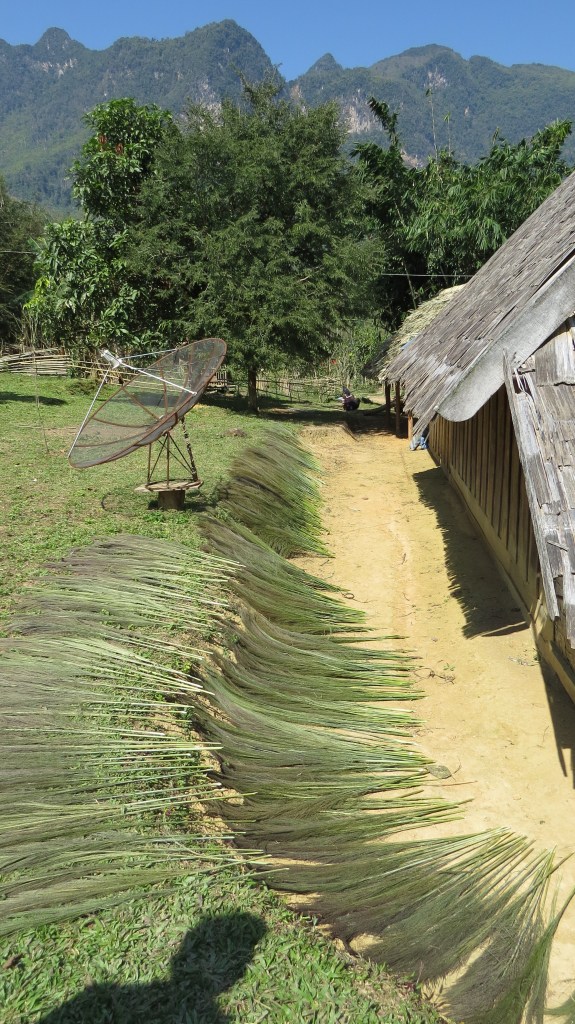
and stretches of drying brush.

IMG_5303

As we started our walk back we met a young girl with her pink cell phone carrying a bundle. She posed for us before turning and continuing her trip home.

IMG_5287 IMG_5288

We spotted this brush gathering and scattering in front of homes all over Laos.

IMG_5282

IMG_5283

Gathered by locals it’s dried and shipped to China for manufacturing into brooms.

During both visits we felt welcomed and unintrusive in spite of standing out as obvious foreigners. The children greeted us with shouts of ‘sabai-dee!’ (Hello!).  Whenever we asked the people graciously allowed us to take photos, including all the kids.

IMG_5301

IMG_5298

An hour hike back to the riverside through more gorgeous countrysides,

IMG_5262

including Max’s pose,

IMG_5306

brought us to our boat where we carried on to Muang Ngoi, a village with a hippy-ish feel.

Helen had arranged to be dropped off here, so after strolling up and down the one-street town we said our good-byes

IMG_5318

and returned down the river to Nong Khiaw and our Canadian Beerlao friends, passing local fisherman along the way.

IMG_5251

After another with the Ottawans we stopped at a bar showcasing a glowing fire. Ahhh! Heat! Then we heard a shout of ‘Max and Lynnie!’. It was Meghan, our Coloradian singlehander. She had arrived earlier that night. It was so great seeing her as we hadn’t really had a chance to say good-bye in Luang Prabang.

After twenty minutes of standing in the still-cold outdoors, we exchanged hugs and wished her best of luck in her continued travels.

Just a side note, our guide and others have told us this has been the coldest winter in history in northern SE Asia. Devastating freezes have killed people and livestock, created uncertainty regarding growing seasons, and contributing to concerns over the enroaching effects of climate change. We heard this repeatedly through our journeys around this part of the continent. And, only recently we read that the Mekong Delta is experiencing the worst drought and salt water intrusion in 90 years. Not good for those relying on their annual crops for a livelihood.


LUANG PRABANG

Tuesday – Thursday, February 9-11

Back in Luang Prabang after arranging for a shared van with eight others, we checked into a different guesthouse, one we had found before we left for Nong Khiaw. Being Tet, the Chinese New Year, SE Asia was loaded with Chinese vacationers. We had purposely stayed out of Vietnam where we had read a lot of the country shuts down for the week, which is why we opted to stay in Laos.  What we hadn’t counted on were those celebrating Tet would travel to neighboring countries such as Laos. The only issue we had was when looking for rooms.

Which is how we ended up in a guesthouse on the fancier side of town (closest to the tip of the peninsula). In spite of this, our room was similar to the less-expensive one the previous week, only this one would occasionally run out of water. However, the balcony view was lovely. It’s here we met Carol, a former US citizen whose first husband worked in the diplomatic services in Cambodia in the early 1960s. Currently living in France after having lived and travelled throughout SE Asia, she’s authored quite a few books on Vietnam, the most recent for Hue’s 1,000 anniversary.

IMG_5451

Another place we were looking forward to experiencing was the Elephant Village about 15 km outside of the city.  Instead of taking a formal tour, Max had discovered we could just catch a ride out there and explore on our own. So, we hailed a tuk-tuk and left for communing with these ancient animals.

Upon arriving we paid a small entrance fee and then another $1 per bunch of bananas to feed the elephants. And, man, can they eat! No sooner had we snapped a banana off a bunch, placed it in the groping trunk, than the elephant was back for more. I swear the animal ate ten bananas in less than two minutes. 

Billboards educated us on just why these animals are so magnificent, and we perused the facts as we made our way around the compound. Below is just a sampling.

  • Elephants don’t sweat except around their toes.Because of the flexible lower lip, which holds food and passes it into the mouth, makes them appear smiling.
  • An average adult elephant’s four molar teeth are each about the size of a brick.
  • The reason why they stuff their mouths at every opportunity is because they absorb vegetation diet poorly and must eat hundreds of kilos a day.
  • They can communicate over long distances often using a pitch too low for humans to hear.
  • There are only about 35,000 elephants in Asia versus approximately 500,000 in Africa.
  • and, one of the more interesting:  Thailand’s King Mongkut offered President Lincoln elephants to use in the civil war battles.

I may have mentioned this book in a previous blob blog but, if anyone would like to delve more into the magic of these animals, read ELEPHANT COMPANY by Vicki Croke, recommended to me by our friend Carol W.

We decided to look for the baby elephants across the river. With a short ferry ride and walk down a path we found two babies age 2+ years.

IMG_5390

Once again we enjoyed feeding these animals and, once again, were amazed at their food capacity.

IMG_5381

This village was begun by a German, Markus Peschke who, like Holgar of Hillside Resort, fell in love with Laos and settled, first opening restaurant in 1998, then “Tiger Trail Outdoor Adventures” (which we used for several of our day tours) in 2001, followed by the “Lao Spirit Resort” in 2003. It was during this time he opened an elephant camp due to the plight of working elephants who were losing their habitat as the jungle diminished and losing their value as the logging industry declined. In 2008 he sold his shares in Tiger Trails and the Resort and expanded the camp into Elephant Village.

In addition to his efforts regarding elephants Peschke wanted to preserve the virgin valley surrounding the Elephant Village, and in 2009 he received government approval on a proposal that protects the valley as well as other locals an alternative means of earning a living in a sustainable way. Since then this endeavor is a private business led by Germans and managed by Laotians.

The motto of the camp is simply “Saving elephants is our mission”, a perfect fit for a country once called Land of a Million Elephants.

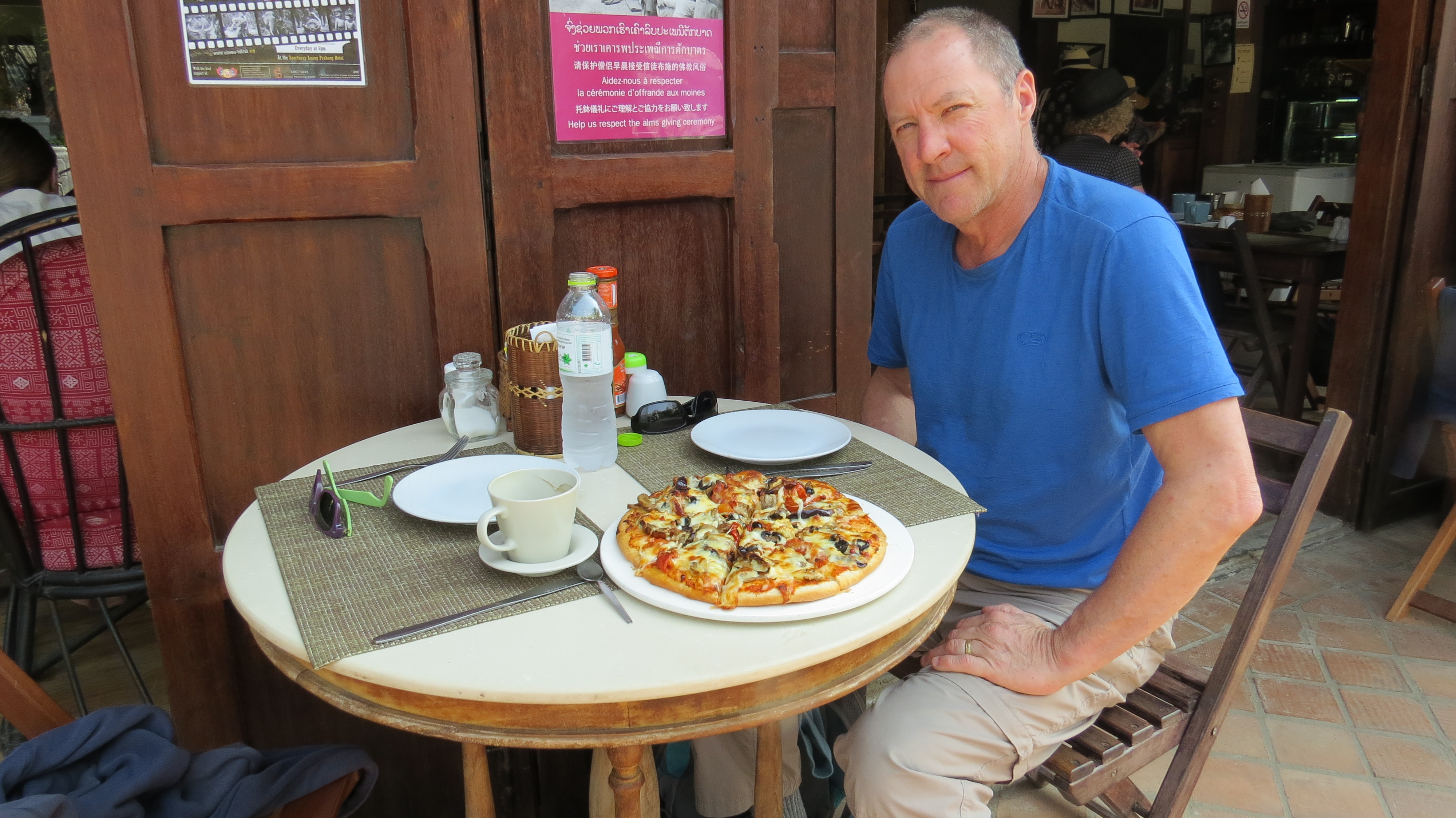
Back in Luang Prabang we enjoyed pizza at an excellent French cafe (sometimes one just craves a good, crusty disc :)…

IMG_5450

visited some Buddhist temples, some buildings storing a parade of statues…

IMG_5424

and later listened to monks chanting (please excuse the horizontal viewing; I haven’t done any editing on it).

Contemplating our leaving Laos, I realized I would miss it. Here is where we first interacted with fellow travelers, explored the countryside, shared fabulous meals, and absorbed the tranquility exhibited by a Buddhist outlook.

IMG_5449

I had fallen under the spell of this lovely country, and I promise:  I will return.


SE ASIA: Part IV

Laotian Countryside

Friday, February 5

With several more days in Luang Prabang we signed on for two more tours with the next one involving waterfall climbing. Thinking this could be a bit unnerving I wore my bathing suit under my clothes and took an extra set figuring a big body splash was in my future.

We joined three young women from London at the tuk-tuk pick-up stop for our day’s excursion. Soon Holgar arrived to escort us to the waterfall. Turned out Holgar, an expat from Germany, was our host for the day. Having arrived in Laos nine years ago he decided to stay after being seduced by this country’s natural beauty. He married a local and soon purchased a lodge about 15 km outside of town. He and his wife converted the lodge into an eco-retreat and settled into life with their son amidst the hilltop lushness surrounding their inn.

In exploring their surroundings Holgar happened upon a waterfall, which is kept as a secret location in an attempt to maintain its pristine and unspoiled nature. This was our destination followed by trekking to his hillside retreat.

Hopping out of the tuk-tuk we began our waterfall walk.

IMG_5121

It was lovely. And, surprisingly easy to stride straight up the limestone rocks. The sensation is a bit like defying gravity. With water rushing over our feet and knowing we had to scale some steep inclines I thought for sure I’d be tumbling down into the falls. But, no. Only a few slips occurred and those happened during the foraging of muddy streams.

Because it was winter (the dry season in Laos) the water level was a lot tamer than during the rainy season.

In spite of the sun beginning to peek out from an overcast sky, it was still cool enough to discourage all but one from diving into the milky blue waters. Yep, Maxman was at it again as you can see from the action shots.

IMG_5125


IMG_5127

IMG_5129


IMG_5139

We all posed for photos…

IMG_5120IMG_5143

with Holgar doing the honors, proving just how grippy the limestone rocks were…

IMG_5157

After three hours we made it to the top. But, here is where the untouched wilderness lost its purity for on one side of the falls the land had been stripped and the other had construction in the treetops. Another change were dams being built to provide hydroelectric power, one right above this waterfall causing the water to flow over land, which had been clear-cut.

IMG_5159

Holgar explained the land had been sold to a guy who professed wanting to support the environment; yet, his plans for the land were to build an eco-lodge complete with swinging bridges between the tall trees and luxurious treehouses as cottages for wealthy visitors.

Some of the bridges were already there along with preparation for future construction based on the trunks and stubs of vegetation we saw. I’m certain it’ll be thrilling to be staying in a treehouse but seeing how the owner was going about it didn’t inspire much confidence in his professed concern for the environment and eco-tourism.

At least the five of us with Holgar’s guidance had been amidst the splendor of a Laotian waterfall prior to reaching the top. And, having been the only ones around during the hike was truly a gift. Over the few years Holgar’s been in Laos he’s witnessed the influx of tourists. The country is building its tourism and endeavoring to promote it as environmentally sound; yet, seeing the construction and later reading a NYT article about the corruption and lax enforcement of conservation laws throughout Laos and neighboring countries, being able to monitor and maintain the country’s natural sites seems challenging at best.

We then trekked to Holgar’s lodge along a dirt road with school children returning home and the occasional scooter loaded with provisions keeping us company.

IMG_5161

Once at Holgar’s Hillside Resort we entered a hidden paradise complete with a tourquoise swimming pool set at the foot of wood, glass and stone buildings perfectly set amidst the lush foliage. After changing out of suits and into dry clothing his wife catered a typical Laotian meal, which we all devoured. With sated bellies and spirits we spread ourselves on the grass outside and conversed with Holgarin a desultory manner as butterflies floated by and Buddy, the family pup, kept us company. Ahh, life is good.

Saturday, February 6

I had mentioned it was in Luang Prabang that we finally met some kindred spirits, one being Laurie who was staying at the same guesthouse in Luang Prabang. She stopped her job as president of non-profit organization Children of the Eternal Rainforest in the fall and has been making her way around SE Asia. With her background in environmental projects she arranged to volunteer in some locations throughout her journey.

Traveling independently including taking motor scooters through northern and southern Laos, Laurie is what I call a singlehander, a nautical term for sailors who do solo sailing (not the easiest). We were lucky to have met her and even more fortunate to hear that she has strong ties to Maine since her mother grew up in Fryeburg. We’re hoping we’ll eventually meet up again once we’re back in the states.

We met other travelers throughout this trip who voyage the same way, many of them women of all ages. Another was Meghan who wanted to change jobs (she’d been working the past ten years in an NGO raising funds for breast cancer research). And Romney, a young Dutch woman who was taking a break from school. Through her we met Lisa from Germany and Celeste from Canada. Romney and her two friends had just met on the grueling thirty-hour bus ride from Hanoi, one we’d heard about but thankfully avoided.

All of the above joined us for a Japanese dinner and traditional dance show one night, recommended by a friend we met in Ipswich. Travelling really does feed the soul considering how many wonderful folk we meet along the way. But, I digress… back to our Saturday excursion.

During our morning conversations Laurie had mentioned a bike trip on Saturday. It sounded fun, so we signed on especially when hearing the route featured relatively flat roads and just a few hills. My type of biking.

There were five of us along with the head guide and his assistant. The guide was gentle, kind, and knowledgeable. He couldn’t have been more earnest in his desire to impart information about what we were seeing during our trip. The only issue with two of the stopovers (representing two tribes, the Hmong and the Khmu) was either no one was really around or they were enjoying quite a few beers at the little cafes dotted along our route. But, no matter, as we still saw silkworms munching away on their mulberry leaves (Laos is known for its beautiful silks)…

IMG_5168

and the traditional Sa paper being made, a paper made from the bark of a mulberry tree by beating the bark into pulp, wetting it, and pressing it onto a screen to dry in the sun. Dyes and sometimes flowers are added.

IMG_5173

Another Laotian product, one Max and I devoured anytime we saw it, was Kaipen or riverweed. This green algae is plucked from the northern rivers during the low-water season, enhanced with some seasonings including sesame seeds, tomatoes, and garlic then dried on screens. It was delicious, especially when lightly fried and served with a salsa.

IMG_5174

Just down the path from the drying riverweed was the Mekong River. To cross it we were paddled across by two women, one carrying our bikes and the other us. I could have done with a longer boat ride. Matter-of-fact I wouldn’t have minded taking it all the way back to Luang Prabang.

IMG_5176

Speaking of sumptuous tastes, when we were ready for lunch our guide led us to a mounted picnic table and then cut some huge banana leaves as a table cloth. He then proceeded unveiled a Laotian spread (some still warm and wrapped in banana leaves) from his backpack. Watching him reach in and pull out dish after dish was like Mary Poppins with her magic carpet bag from which she kept hauling out items that now way could fit inside a tote bag.

IMG_5188

All of us dug into some of the best green beans I’ve ever had as well as a tomato salsa, sticky rice (it really is sticky), fried egg mix, potatoes, and finished off with clementines for dessert. (Our friend Laurie is in the middle.)

IMG_5192

Mounting my trusted steed of a bike wasn’t very appealing after that feast. But on we went.

Seeing some little boys fishing by the side of the road we stopped to watch. It was only then we noticed how they were catching the fish:   with home-made bows and arrows (!).

IMG_5182

One of the kids proudly held up their catch while the others returned to the stream. Although how they shot those tiny fish I don’t know, but their bow and arrow resembled the handmade one at the Living Land Farm.

IMG_5185

By now my butt was getting extremely sore and, once again, I was the caboose. I couldn’t believe how out of shape I was, and many times throughout the trek I would fall further and further behind with just the poor young assisting guide treated treated to my sighs and “I can’t believe I’m so slow!” exclamations.

The last 10 km entailed roads crowded with trucks wheezing fumes and motor bikes scurrying past. To say I was ready to hop off this tin, two-wheeled torture vehicle is putting it lightly. Finally we reached the city limit and I saw an end in sight. Hallelujah, I’ve been saved.

What we discovered after the fact was we should have read the full description of the day trip, which said “This tour has been designed for fit cyclists wanting to ride a long distance to see a lot of countryside.” And, it was a “circuit of 60 km, approximately 65% paved, 35% dirt roads…”.

End of my cycling experience in Laos!  But, must say, like previous tours, the guide was wonderful meeting and I saw sights I probably wouldn’t have on my own.

Next, a trek using a boat and two legs versus wheels.


SE Asia: PART III

Rice Ballet

Wednesday, February 3

We had heard that Laos was a favorite for many visitors to SE Asia, and we understood why having stayed just briefly in this landlocked country. In Luang Prabang, a UNESCO World Heritage city located in northern Laos, we had our first experience of meeting fellow travelers. After whipping through two cities in two countries in six days, Laos began our slow-down traveling.

But, it’s also here we began a diverse group of daily tours, one of the most interesting being a half-day of learning about rice agriculture.

IMG_4993

The Living Land Farm was formed by two brothers, Laut and Si Lee, as a community enterprise suppling organic produce to local area restaurants. Employing Laotians who lack higher education and/or are from remote tribal areas, the farm grows chemical-free crops using traditional methods including their own hand-made tools. Our half-day rice tour provided a glimpse into this activity similar to one of those films where months are collapsed into minutes.

To actually experience rice from seed to table was amazing, primarily because I’m so removed from agriculture. And, to literally see brown husks transform into the kernels I purchase in the store was magical.

One of the co-founding brothers was our guide, an excellent and exuberant teacher who told us just to call him ‘Lee’ since he obviously realized most foreigners butcher the pronunciation of his first name, ‘Laut’.

IMG_5072

I’ll just run you through the 14 steps so you, too, can experience the transformation:

  1. Lee demonstrated the traditional seed selection method using an egg, salt, and pail of water. Tossing in salt until the egg began to float, thereby achieving the proper water density, Lee then poured some grains of rice from a previous year’s harvest into the pail. Those that floated like the egg would be used for feed while the heavier ones would sink. The latter are denser and filled with healthy matter, not just air.

IMG_5022

2.  Next, seeds are placed on wet mud where they germinate after 3-6 days.

3.  We moved to irrigated paddies where we tried our hand at tilling with Rudolph, one of the farm’s water buffalos. (You may recognize the guy behind the plow.) During plowing, the previous crop’s detritus is plowed into the soil to provide nutrients.

IMG_5012

4.  Then accompanied by Lee’s lilting song we planted seedlings. The field is kept flooded with water in order to help prevent weeds from growing (but not so deep as to cover the the rice shoots).

5.  The paddies are weeded, including picking snails to keep them from eating the crop. Northern Laos (where we were) generally has one rice crop a year while southern Laos’ rainier and hotter climate allows for two crops.

IMG_5020

6.  After about 10 weeks the paddies are drained and the stalks, heavy with ripe grain, are cut with a sickle then left to dry in the sun.

IMG_5030

7.  After 4 days or more the green stalks have dried to straw-colored branches. We then tried our hands at thrashing them to flush out the individual grains. This entailed repeatedly hitting a bunch of stalks against a slanted board forcing the grains to scatter across the ground.

IMG_5035

8.  To remove stray bits of debris from the thrashing the grain is fanned then swept into piles.

IMG_5047

9.  Showing how rice is transported for storage, Lee paraded three different carrying baskets as developed by different tribes. Seeds can be stored for two years and used either as seeds or in cooking,

IMG_5053

10. To extract the kernel from the thrashed grain a foot-powered sledgehammer is used for husking.

IMG_5055

IMG_5058

11. To finalize the separation of kernel from husk, we tossed the wicker tray resulting in billowing beige husks wafting from the creamy rice kernels.

IMG_5067

Out of this winnowing process any broken kernels are milled into rice flour using a granite grinder.

IMG_5103

Lee’s movements were so graceful and rhythmic watching him was akin to viewing a ballet. We all tried to mimic his actions but couldn’t even come close to his style. Think Mikhail Baryshnikov to Bullwinkle and you’ll get the picture.

12 & 13. To create Laotian sticky rice, the kernels are soaked before cooking…

IMG_5069

then steamed over a charcoal fire.

IMG_5070

As we watched we sipped fresh sugar cane juice extracted using a beautifully carved rosewood mill, still in use after 100 years.

IMG_5078

While waiting our final step we tried our hand at shooting arrows at a bulls eye.

IMG_5095


14. The end of our tour was a repast of various rice items including a potent saki that was surprisingly smooth in spite of smelling like nail polish remover.

I don’t think I’ll ever be able to eat a spoonful of rice without remembering the ballet Lee danced. His tutoring represented one of the richest learning experiences I’ve had in awhile. Rice ballet is definitely worth savoring.

IMG_5111


SE Asia: PART II

Another powerful kingdom

Saturday, January 30

After two days/three nights in Bangkok we flew on to Siem Reap, Cambodia, the city closest to Angkor Wat and surrounding temples. A tuk-tuk took us to our hotel located on one of the side streets of this busy tourist town.

Having picked up a chest cold I was happy just settling into our room and doing more sink laundry. With the intense afternoon sun right outside our room, the clothes dried in less than three hours draped on a balcony. Max, in the meantime, picked up more bottled water for the room and later explored a bit while having an early dinner around the corner.

Sunday, January 31

Ready to leave by 9 we had arranged for a guide, Yanso, to steer us around the two largest complexes:  Angkor Wat and Angkor Thom.

IMG_4860

And, the same guy who picked us up at the airport ferried the three us around in a tuk-tuk as we began exploring these former Khmer sites.

IMG_4982

The write-ups talk about the breadth and scope of Angkor Wat, and thát’s exactly what struck us the most, beginning with the size of the moat surrounding this 12th ce. Hindu temple. Constructed by Suryavarman II (ruled 1113-52) this temple has become Cambodia’s national symbol. No surprise considering ít’s impressive setting. Angkor Wat has also been in continuous use since it was built, resulting in a more manicured look than those sites that have been abandoned.

IMG_4819

Once we closed our mouths after viewing the moat and long causeway to one of the entrances, Yanso ushered us around and through the other visitors. He pointed out the rich detail of the carved sandstone as well as remnants of some of the bright colors, which used to adorn the walls.

IMG_4850

IMG_4854

We walked in and out of structures that began to blur together in spite of their magnificent details,

IMG_4846

such as the scene of Suryavarman’s troops marching off to war and the depiction of heaven and hell (just one side of an 800m-long series of bas reliefs).

IMG_4826

IMG_4836

IMG_4838

From there we rode to Angkor Thom, built by Suryavarman’s cousin, King Jayavarman VII (ruled 1181-1219). Crossing another moat, the bridge is decorated with 54 demons on one side and 54 gods on the other waged in a tug of war based on the Hindu story of the Churning of the Ocean of Milk.

IMG_4861

IMG_4866

Once through the gate we went straight to the highlight of Angkor Thom, the state temple of Bayan. This guy obviously loved his own reflection:  on the 54 Gothic towers featured at Bayon, the temple this Buddhist king built, 216 faces resembling Jayavarman VII peer at you from all angles.

IMG_4886

Fading fast and becoming templed-out, Yanso took us to some iconic sites, specifically from the 2001 movie Lara Croft:  Tomb Raider. Not having seen it, the trees smothering the walls reminded more more of the 1984 movie Indiana Jones and the Temple of Doom, which was also filmed in SE Asia (only in Sri Lanka).

IMG_4906

Yanso explained how the Cambodian government was delicately balancing the integrity of the temples with maintenance of ancient trees. As we saw throughout the site, humongous snaking roots threatened to totally destroy the buildings’ foundations and walls.

IMG_4901

Actually what was more interesting to me was hearing about Cambodia’s more recent history involving the Khmer Rouge. Yanso related how most of his immediate family escaped the Killing Fields due to his mother hearing about Pol Pot’s death squads. She along with other villagers hid in the forest, which is where Yanso was born in 1978.

During the four years of civil war 1975-79 Cambodia lost two million out of a population of just over seven million. Stopping by a memorial (a stupa filled with genocide victims’ skulls and bone) Yanso pointed to various skulls indicating how short spades or hoes were used to crack open prisoners’ heads either from behind or the side. 

IMG_4909

We then slowly walked around some worn billboards featuring photos of Pol Pot and his henchmen then and now. To think that someone such as our guide could easily have been killed during this brutal regime was another sobering reminder of the world’s injustice, thanks to humankind.

By now I was ready to go prone, which is what I did while Max found another place for dinner.

Monday, February 1

While I stayed in bed Max ventured out to more temple sites with the same tuk-tuk driver from the previous days. Located up to an hour away some of the most spectacular ones were:

Banteay Srei, possibly constructed by Jayavarman V’s tutor, a Brahman, and featuring some of the most elaborate carvings on stone with a pinkish tone…

IMG_4922

IMG_4924

and Preah Neak Poan or “The Water Temple.”

IMG_4950

Max also stopped by the Cambodia Land Mine museum. A former Khmer Rouge soldier, who as a teenager planted thousands of these devices, later saw the error of his ways and has spent the rest of his life in the tedious and dangerous task of locating and disarming them. Tens of thousands of them still remain, along with large numbers of unexploded cluster bombs dropped by the US during the “secret war.” In reviewing the history of the period the museum argues that US actions contributed to the rise of Pol Pọt.

IMG_4930

IMG_4931

Feeling a lot better by the time Max returned due to some pills from a local pharmacy, we headed off to the Phare, a circus troupe of young acrobats. The performers had been taught their skills at a circus school founded by an organization formed over 20 years ago. Nine children and their art teacher returned to Battambang, Cambodia’s second largest city, from a refuge camp. Wanting to share the art of self-expression they started a school for the arts that then led to a free public school, music school, theater school, and finally a circus school. Over 1,200 underprivileged students have attended the public school and 500 the alternative ones.

In 2013 Phare opened a performance center in Siem Reap. Ít’s become so successful they raised monies via crowdsourcing enabling them to switch from renting to purchasing their own site. Their new location opened this January, and ít’s here we were part of the packed house watching the amazing energy and personalities of these youngsters.

IMG_4966

IMG_4969

IMG_4971

Each performance lasts just over an hour and features a storyline illustrated by dialogue and acrobatics. The night we attended the performance was called “Chills” featuring a group of young campers overcoming their fears of some troublesome ghosts. As Max later said the ghosts could have been vestiges of Pol Póts brutality, which terrorized the people of Cambodia. Whatever the message, ít’s definitely worth seeing. These kids are amazing.

Tuesday, February 2

With a flight out late afternoon, we packed our bags and headed downstairs. The hotel staff’s hospitality continued right up to our final good-bye when they snapped a photo.

IMG_4980

Having seen our fill of magnificent temples and powerful realms in less than six days we were ready to slow down. Our destination was a quaint tourist city, Luang Prabang, known for its blend of southeast Asian and French cultures.

We were really glad to have toured some of the world’s stunning, historical sites. And, now we were just as happy to know our travels would be coming to a standstill. Well, not exactly a standstill but at least staying in one guesthouse for awhile.

Laos, here we come!


SE Asia: PART I

Bangkok Templedom

Tuesday-Wednesday, January 26-27

We left Ipswich in summer clothes for our 24-hour trip to Bangkok.

IMG_0094

It wasn’t too bad considering we had two flights, each roughly six hours (after a 3-hour bus from Ipswich to Heathrow). Stopping in Doha, Qatar, we looked in amazement as we walked around the airport terminal. Opened in 2014 this place was a lot different than the first and only time we were here in 2013 when travelling to see Max’s son Chris who was teaching for a year in Doha. Then you were fortunate to get a cup of tea or coffee and a packaged sandwich. Now, well, you could purchase luxury goods while sipping on a decadent latte (we didn’t do either).

IMG_0124

What intrigued us was a huge, ginormous teddy bear stuck in the crossroads of the gate terminals. Max got an explanation from one of the young women standing around a cordoned-off seating area. She said the queen purchased this canary yellow teddy for $6.8million at Christies. The largest of three editions created by the Swiss artist Urs Fischer, this ‘sculpture’ weighs 35,000 pounds, stands 23′ tall, is cast in bronze and used to reside in front of NYC’s Seagram Building (should have stayed). The queen wanted to decorate the airport with it. Personally I prefer Winnie the Pooh.

IMG_0122

Another feature that could have done with some focus group testing was the electronic display gate assignments. No sooner would you locate your outbound flight in English than it would quickly flip into Arabic, leaving you unsure what you just saw. Typically a group of foreigners, us being part of one, would stand in front of the board hypnotized by the flashing English-to-Arabic displays. Eventually you’d hear someone say ‘got it!’ and rush off to their gate.

IMG_0123

The next flight they said we’d been upgraded to the second level of the plane.  This was a ‘yahoo!’ moment until we discovered the seats weren’t any better, and we were crushed between two people on either side of each of us.

Luckily they were very interesting as the one next to me was from my hometown of Va. Beach and a retired Navy Seal commander (remarkably, he was a SEAL for over 30 years) who had once worked with General Petraeus in Iraq and was now an attorney working with the US gov’t on contracts. He was on his way to his wife’s sister’s wedding in Cambodia. Having missed his flights on Saturday due to airlines canceling flights because of the weekend blizzard, he was trying to get there before the two-day event ended.

He shared a few stories about his Seal days, one being his initial assignment as a ‘rookie’. Assigned to ensure no bombs were attached to a bridge in NYC where Kissinger was landing, he and a fellow Seal checked the structure underwater. Unfortunately, it was next to a sewage drain where eels congregated for feeding. He recalled being surrounded and gently attacked by these long white squiggly things. He said they didn’t really bite and were more annoying than dangerous. Still… no thanks.

Seated beside Max was a bone Doctor from Geneva doing volunteer work in Cambodia. He had had a few drinks on the plane and was a bit exuberant by the time we landed but a warm and friendly guy. I was glad I had the retired Seal on my side.

Arriving at Bangkok airport we received our on-arrival visas quickly and easily passed through immigration, grabbed our bags, and headed out into weather that really was pleasant, not the tropical heat I had expected (to come later, I’m certain). A cab to our hotel in Chinatown took about an hour. Upon checking in we were offered crystal cool glasses of geranium water (pretty good) and cool washcloths rolled into sushi-like forms which Max, who was hungry and a bit disoriented from 20 hours of travel, bit into.

IMG_0121

Unfortunately I didn’t see it for THAT would have been a great pic. Fortunately the desk receptionists didn’t either see it or were polite enough not to comment on this strange Maine custom of gnawing on wet washcloths. And, yes, it was a tad bit soapy according to Max.

After arranging for the complimentary tuk-tuk to the Grand Palace(which we later cancelled in favor of a boat ride) we were whisked up to our room where we unpacked and then headed out to walk the streets a bit. 

Knowing we should try street food we checked out a lot of places but thought maybe it wasn’t the best idea to snack on the road our first night and ended up with some, believe it or not,cringe-worthy KFC. We ate in our room so we didn’t disgrace ourselves in the lobby among more seasoned travelers.

History Sidebar
I’m completely unfamiliar with the history of these countries; yet, I wanted to get a sense of how these cultures evolved in order to provide a backdrop to our limited travels and extremely shallow dive into four countries’ civilizations.
So, to preclude getting myself muddled up I’ll be as concise as possible thanks to THE LONELY PLANET and the Internet.
10,000 years ago the inhabitants of the Mekong Valley and Khorat Plateau (the latter being a saucer-shaped tableland of northeastern Thailand) began populating SE Asia. As early as 4,000 B.C.Ẹ they were growing rice. Proximity to India and China influenced the region as well as trade with other cultures as far flung as the Mediterranean.
Confucianism, Taoism, Hinduism and Buddhism percolated throughout SE Asia along with knowledge of science and medicine and a writing system.
China becomes interested in its southern neighbors’ rice and coastal harbors, so an imperial delegate around 200 B.C.E. forms the kingdom of Nam-Viet (located around modern Hanoi in the north).
Separated by mountains and jungles the rest of southeast Asia falls under the Indian influence about 100 C.Ẹ due to coastal trading. At this point some royal dynasties take root, some Hindu, some Buddhist:  The Cham (roughly southern Vietnam); the Khmer (Cambodia); the Mon (in Thailand and southern Burma). By the 11th cẹ the Burmese and the Thais subjugate the Mọn.
The Khmer dynasty creates a capital in Angkor beginning in the 9th ce. Hindu temples are built by Suryavarman II (ruled 1113-52) at Angkor Wat who unified Cambodia. Later, Jayavarman VII(ruled 1181-1219) created Angkor Thom based on Buddhism. Called the Romans of Asia, the Khmer constructed a huge network of roads and irrigation systems. To give you an idea of the scale of Angkor, this capital had a population of over one million when London had a measly 50,000.
Nothing lasts forever, and warfare between rival kingdoms continued throughout the centuries. In the 13th and 14th centuries the Thai kings of Ayuthaya created the “Land of Rising Happiness.” As a growing power they threatened the Khmers next door.
The Khmers, however, found an ally in an exiled Laotian Prince being educated at Angkor:  Fa Ngum. Nicknamed The Conqueror due to his thirst for warfare, he established himself as king of “Land of a million elephants and the white parasol” by 1353.
Going east, the Chinese invaded Vietnam once again in the early 15th cẹ. Enter a wealthy philanthropist Le Loi in 1418 who won independence from the Chinese in 1428, establishing yet another dynasty, the Le.
At this point these countries fell into decline due to weak kings in Cambodia and Laos, with Thailand struggling against its northwest neighbor Burma and Vietnam fighting a civil war.
Backing up a few centuries we have the first European travelogue of this area by the Italian merchant, Marco Polo, in 1300. Following on his heels two hundred years later European imperialists arrive on the scene. The Portuguese exploration of a sea route in 1498 and the hunger for spices captivated the west. Soon the English and Dutch follow suit in the 16th cẹ with the Dutch East India Company ousting the English East India Company and holding a monopoly until the French begin to arrive in 1799. At this point the only area maintaining independence is Thailand. And, for those wondering like me: Thailand’s name was Siam (always think of Yul Bryner when I hear “Siam”) until 1948  when a vote officially changed the country’s name to Muang Thai or “Land of the free”.
I won’t go into modern history, but the above primer provides the background for our brief travels in these four countries. We only stepped into Thailand via Bangkok and touched Cambodia with a quick visit to Siem Reap and its temples at Angor Wat. Our Laotian travels were also fairly limited with a coastal Vietnam route ending our five weeks of adventure. A spin through SE Asia with our first day exploring Bangkok…

Thursday,  January 28

Upon waking we tried some instant coffee we purchased along with oranges but decided the coffee was pretty bogus; so, we opted for the hotel breakfast. Not the best value for meals so we decided to get better instant coffee the next day and possibly stick to our oranges. 

Instead of taking the complimentary tuk-tuk we walked to the river and hopped on the river taxi. Much better choice and good views. 

IMG_0063

The Wat Phra Kaew and Grand Palace was a mob scene (we later ran into some Canadians who live here and said they’d never seen such a horde of tour groups).

IMG_0065

We ended up with a guide, Cindy, who ushered us through the crowds to key sites:  

IMG_0073

The Temple of the Emerald Buddha (who gets dressed according to the seasons, as Cindy points out)

IMG_0072and past the actual Palace where the royal family resided from 1782 until fairly recently. Now used for ceremonies, the palace was closed at noon due to one of the Royal Princesses presenting a medical award to two people.

IMG_0082

The current King, Bhumibol Adulyadej (King Rama IX),  is much revered and the oldest living monarch to-date having ruled since 1946 following the death of his brother. Born in the US in 1927 while his father attended Harvard Medical School, the king speaks four languages, is a jazz aficionado, and has four children.  Being in his 80s, though, his son will most likely soon follow, and it’s unclear if he will hold the same sway over the Thais. We were careful not to do anything to mar our respect of the current king; and, since his image graces the currency we had read never ever step on it if a bill falls on the ground. 

We stepped in and out of our shoes wandering around so many temples and Buddhas I lost count of what was what; but, the decorations were still splendid.

IMG_0068

IMG_4654
IMG_0071

An imposing mural depicting the Hindu epic the Ramayana, the struggles of Rama to rescue his kidnapped wife, Sita. Painted during the reign of Rama I (ruled 1782-1809), 178 panels decorate the exterior of walls of Wat Phra Kaew.

IMG_0076

IMG_0079

I would have loved to have had a historian explain all the different panels. With limited time I settled for just a few shots of the intensely detailed paintings.

Dotted amidst the temples are stone statues. Our guide told us the Chinese figures had been used as ballast for trading ships to Siam. A variety of expressions grace their countenances and are scattered throughout both temple sites we saw during our two days in Bangkok.

IMG_0081

Cindy left us with instructions to view the dusty second floor of one of the museums housed in this complex. We quickly walked through the rooms not really knowing what we were looking at. The one interesting item to us was a 13th ce. grey stone throne discovered by Ramkhamhaeng, a noted king of Sukhothai. King Rama IV discovered it in 1933 during his monkhood and brought it to Bangkok for his coronation.

IMG_0085

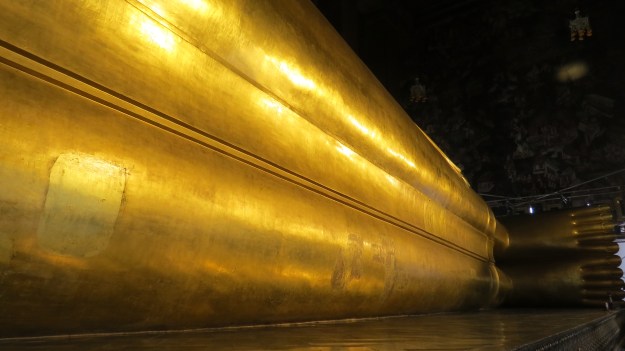
After two hours of pushing our way through the pulsing mass of humanity, many armed with selfie-sticks and others posing for individual photos, we were thankful to check this off our list and start walking back to our hotel via the Chao Phraya River. We were going to stop at Wat Pho to see the reclining Buddha but were told by some guides the site was closed for the day due to being a Thai holiday, so we just continued strolling.

Close to the site, though, were some great-looking street stalls where Max ended up with a 20 Baht (75¢) piece of meat on a stick. Best guess was chicken but it was cooked through and smelled good so all was fine.

IMG_0086

IMG_0087

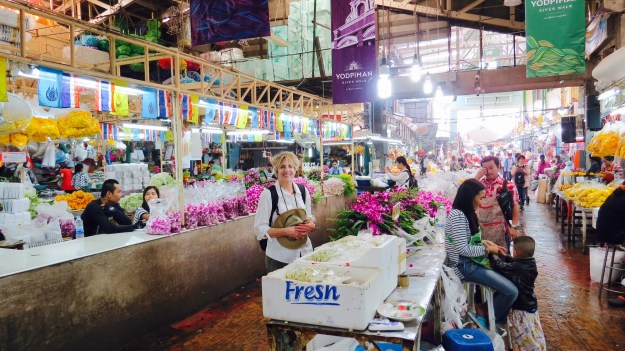
Wandering down the streets we entered a large warehouse which turned out to be the flower market. I just wish I could have scooped up the gorgeous orchids and carted them back home. Boas of yellow carnations decorated the stalls along with bags of rose heads and other flowers. Every now and then we’d get a whiff of a heavenly aroma but couldn’t find the source as we continued strolling down the aisles of flowers.

IMG_0090

Displays of luscious vegetables and a dizzying array of onions lined the streets as we slowly strolled back to our hotel.

IMG_0088

IMG_0089

We also crossed over the canals that criss-cross parts of Bangkok. Not the prettiest sites

IMG_0093

but the river made up for ịt

IMG_0091

Back in Chinatown we found some good instant coffee, bought more bottled water and some power bars, then made it back to our room where we collapsed promising one another we would take showers… which we finally did along with beginning the start of our nightly sink laundry. (FYI:  Anyone traveling like we do, I highly recommend purchasing a bungee-type clothes line like the one we purchased awhile ago. It works much better than the dental floss I had to use during other travels; and, with hooks as well as suction cups, it’s versatile enough to hang almost anywhere. Of course, when there’s nowhere to hook or suction cup the line there’s always other options.)

IMG_4974

Friday, January 29

Whoa… 11:28a we finally awoke after getting to bed fairly early but then reading until late. Half the day gone and we hadn’t done a thing but sleep. Up and at em, we made our instant coffee, had an orange and headed back to the river taxi to visit Wat Pho, the site of Thailand’s first university (today a traditional Thai medicine school).

IMG_0111

After yesterday we felt more in sync with Bangkok’s thrumming spirit. Within fifteen minutes we were on the dock awaiting the boat heading north on the river. We exited at No.8 for Wat Po and walked the short distance to the entrance. 

Of course, like the day before, one of the touts wanting our business tried to steer us away from the site again by warning us the entrance queue was extremely long so we may not want to go there just yet. Hah. Yesterday we had fallen for another tout’s untrue line that Wat Po was closed for a Buddhist holiday. He then offered us a multi-site tour for only a few Bahts more. Which was why we returned today.

Thanking the guy for letting us know about the line we continued on only to find it not only not long but extremely short. Purchasing our tickets at 100 Bahts each (FYI, $1 is roughly 35 Bahts) we then decided to hire Alek, a guide, to help us figure out what was what (believe me, we are so overwhelmed by the buildings, which all start looking alike, that we’d be going in circles). 

IMG_0108

 And, Alek was great. He explained how Wat Po was the site of an earlier temple, then was expanded by King Rama I who moved the capital from Thornburi across the river to Bangkok.In 1782 when he built the Grand Palace (our touring yesterday) he also began construction at Wat Po .  In 1832 King Rama III built the temple housing the reclining Buddha, one of the highlights of Wat Pós sites.

Easy to understand and very convivial Alek (not the Buddha) led us from the reclining Buddha (over 150′ long and 50′ high covered in gold leaf)

IMG_0099

IMG_0102

whose famous mother-of-pearl feet were being repaired

IMG_0104

to the other side of the Buddha where we purchased our 108 coins for 20 Baht, tossing them in 108 bowls (donations to help keep up the temple, and keep us in good karma)…

IMG_0106

to the main temple where 394 Buddhas posed…

IMG_0115

To the standing Buddha…

IMG_0118

To the sitting Buddha…

IMG_0113

To finally the exit. 

In addition to the coin toss the Thais created another form of donation based on the cremated ashes of folk. Those who wanted to be buried on the grounds had several choices:  under one of the stupas at 150,000 Bahts (he showed us the name plaques and where you’d crack open a door to shove them in);

IMG_0112

or under a sitting Buddha for 300,000 Bahts. In both instances the families also took on the monument’s maintenance costs. Not a bad way to help offset these temples’ upkeep.

From there we decided to see another part of Bangkok, so we took a tuk-tuk to the central station for the Sky Train. From there we strolled around the Sukhumvitan ex-pat and major shopping area and then returned via the subway. 

Both the Sky Train and the Subway were amazingly clean and extremely efficient. Even better the attendants standing by the trains couldn’t have been more helpful in ensuring we got on the correct train and made the right connection. 

Having experienced the mass transit systems we truly felt comfortable finding our way around this city. Until we tried to walk the fifteen minutes back to our hotel. An hour later and once again due to the kindness of a man enjoying his dinner with his family,

IMG_0120

we finally reached our destination. So much for feeling we knew our way around.

Tomorrow, Cambodia to see Indiana Jones and Lara Croft temples.

https://login.skype.com/login/silent?response_type=postmessage&client_id=580081&redirect_uri=https%3A%2F%2Fblu174.mail.live.com%2Fdefault.aspx&state=silentloginsdk_1455274795208&_accept=1.0&_nc=1455274795208&partner=999

Our Winter Ride: FINALE

Monday, December 14 (continued…)

SALISBURY

In spite of being a bit cathedraled-out we nonetheless felt the need to see this city’s famous building. And, we truly lucked out when we met John O., a guide who answered our questions and offered a tour. With him this cathedral became illuminated with treasures and connecting points to other historical facts and figures.

IMG_4480

As one would expect of a building this size, the grounds on which it sits ensures the cathedral maintains a prominent position in the city.

IMG 4513 1

When approaching the entry both Max and I noticed the face carvings that on closer inspection displayed tortured contortions. Welcome to Medieval Christianity.

IMG 4442

IMG 4444

IMG 4445

IMG 4448

Once inside, the cathedral opens up into a huge central area (nave) leading to the choir area (quire) and ending at the altar with Trinity Chapel behind it. Sitting in the middle of the nave between the north and south transepts (perpindicular to the nave) is the spire, the largest of all of Britain’s cathedrals.

Salisbury

For the holiday season a huge tree stood at the entrance to the nave, which made the space less austere in its Gothic grandeur.

IMG 4466

Before we met our guide we began looking around and noticed a detailed model of the cathedral under construction. The display provided an excellent lesson on the coordinated activities required for each construction phase, helping us understand how these remarkable medieval craftsmen could create such a magnificent cathedral with relatively simple yet clever tools.

IMG 4471

We wandered towards the center of the aisle to a large modern fountain. The plaque identified it as a font commemorating the 750th anniversary of the cathedral in 2008. And, this leads to the truly astonishing fact that this impressive structure was built in only 38 years (1220-1258). What a feat considering most cathedrals at the time required up to 100 years.

IMG 4457

The font also provided a great photo op.

IMG 4473

When we met up with John we began our informative tour at the medieval clock, considered to be the world’s oldest working mechanical one (1386) and still running today. It keeps time by only striking the hour (no clock face with minutes is displayed).

IMG 4455IMG 4456

From there we saw the tomb of William Longespee (1176-1226), the first person to be buried in the cathedral.

Wl tomb 1Wl tomb 2

It retains some of its original color, painted over 800 years ago.

IMG 4501

IMG 4502

What’s more interesting, though, is Longespee’s history. As the recognized illegitimate son of Henry II (the one of Dover Castle and husband to Eleanor of Aquitaine… the 1968 movie THE LION IN WINTER provides an interesting take on the history of these two), Longespee’s half-brothers were King Richard I aka Richard the Lion-Hearted (ruled 1189-99) and King John (ruled 1199-1216).

Through his marriage to the Countess of Salisbury, he became an Earl (3rd one of Salisbury). He served under both of his half-brothers, fighting alongside Richard in Normandy and later holding appointed positions under John. He was John’s advisor during the 1215 Magna Carta negotiations and one of the reasons one of the four original copies resides at this cathedral.

Magna Carta British Library Cotton MS Augustus II 106

In spite of John’s putting his seal on the Magna Carta June 15th 1215, he renounced clause number 61, which provided 25 barons the power to over-rule the King. This set in motion the First Barons’ War (1215-17) to which the French added their two cents. John died during the war and his son, Henry III, was crowned King. I won’t go into any more detail but the lead-up to the Barons’ rebellion is fascinating. As one writer put it, there was a perfect storm composed of land, power, women, religion, and money (http://www.thamespathway.com/chapter9/runnymede-and-magna-carta.aspx).

William Longespee supported the young king and continued to wield influence both in administrative and military positions. He was rumored to have been poisoned by Hubert de Burgh (as chief political and justice official for Henry III perhaps he was jealous of Longespee’s influence over the young king?) and upon opening his tomb in 1791 remnants of a rat was found inside his skull carrying traces of arsenic. Lovely story but could be just a story as opposed to a true story.

During our time in the cathedral a boys choir was rehearsing,

IMG 4465

and, at one point, John asked us to sit and just listen to the singing. He mentioned it was his favorite carol, “Abide with me”, one of Max’s favorites as well.

Continuing on we entered a small chapel where the only remaining carved symbol (the pomegranate and the rose) of Katharine of Aragon and Henry VIII still rests on the ceiling (all others in the country were replaced by Anne Boleyn’s falcon). Tucked away in a little side chapel evidently it wasn’f found by Henry VIII’s smashing squad.

IMG 4494

There were other tombs such as the Shrine Tomb of St. Osmund, the first Bishop of Salisbury, who died in 1099 and was made a saint in 1457),

St osmund tomb

the tomb of John, Lord Cheney (1442-99, served as bodyguard to Edward IV, Richard III and Henry VII during the War of the Roses),

IMG 4462 1

and Edward Seymour (1561-16120 and wife Lady Catherine Grey (1540-68), younger sister of the nine-days-queen, Lady Jane Grey (both Grey stories are tragic). I won’t go into Catherine’s life story here but did discover there’s an Ipswich connection:  because she married Edward secretly without her cousin Queen Elizabeth I’s permission, Catherine tried to get help in pleading her case. The place she did so was in Ipswich (!) when the court was on progress (when a ruler toured his/her realm).

Dsc00167

Our tour with John ended in the Chapter House where Salisbury’s original copy of the Magna Carta resided.

IMG 4506

IMG 4508 1

John also pointed out the intricate needle-pointed cushions sitting atop the stone seats against the walls , several of which were created by his wife.

IMG 4510

We left the Chapter House walking out into the open-air corridor surrounding the Cloisters, the largest of the British cathedrals and designed for processions.

IMG 4503

Must say our tour of Salisbury Cathedral was another major highlight of our Winter Ride thanks to the considerable knowledge and warm welcome we received at the hands of our gracious guide John. He certainly added some wonderful Christmas spirit to our December in the UK.

Our Winter Ride finale ended with candlelit singing in St. Martin’s Church, reputedly the oldest building in Salisbury (mentioned in a 1091 document). Named after the earliest settlement of Salisbury, the Sarum Voices choir beautifully highlighted ethereal notes with their a cappella singing. sarum voices

May there be peace on earth and joy in everyone’s lives.


Our Winter Ride: PART IV

Sunday, December 13, 2015

BATH

We left Stratford-upon-Avon and headed to Bath, another historical city. On the way we noticed an English Heritage sign touting the Roman Cirencester Amphitheatre. Thinking it’d be worthwhile to stop, we did, but not before driving right past the poorly-marked location. However, it was worth the hunt just to chuckle at the site’s opening hours.

IMG 4312 1

By the way the only remnants were literally the earthwork.

IMG 4314

So, back in the car towards our original destination. Locating a parking spot in this crowded city was quite a feat, but find one we did and began our brief tour of Bath.

IMG 4353

While waiting for the Bath Abbey to open with its angels climbing Jacob’s Ladder:

IMG 4323IMG 4326

we wandered around the square off of which stood the Roman Baths (expensive so we looked at the posted diagram and called it good enough)

IMG 4329

and the Christmas shoppers (jam packed through the holiday stalls).

Soon the Abbey opened its doors and in we went.

IMG 4333

Like many of these church buildings the present Bath Abbey (dating from 1499) actually stands on a former religious site, a Norman cathedral. A plaque lists not only the Christian leaders from the 11th century but also those from as early as the 7th century when abbesses led the local community.

IMG 4336

One of the key historical events that took place here was the 973 C.E. crowning of the first king of “All England”, Edgar, by the Archbishop of Canterbury, an event depicted in one of the stained glass windows:

IMG 4341

Must say of all of our Bath touring the most fascinating was a busker posing as a silver-clad, wind-blown cyclist.

IMG_4317.jpgIMG_4320.jpg

Returning to the car we saw a notice stuck on the windshield. Sure enough, the parking space we gleefully squeezed into was evidently not a valid one. We had checked the other cars to see if any paid & displayed parking stickers (no); checked any parking signage (yes, touting no fees for Sundays).

IMG 4346

Evidently we don’t know what to look for because, in spite of our scouting out parking requirements, we still got a ticket. Anyhow, Max as a Bath (Maine) native son has emailed Bath (UK) parking powers-that-be to plead our foreign innocence. We’ll see what comes of it as we were able to get another ticket earlier this year revoked.

Then we were off further south to Salisbury where we landed, once again, in a parking lot scrounging for a spot only to discover it was for day trippers only (no overnighters, which is what we needed). Great.

This time, however, parking gods bestowed upon us a gracious and kind shop owner. He must have noticed our frantic ‘what-now?!’ looks when he said the lot was truly only for day trippers for he then told us to use his personal space behind his shop (he was leaving for the night and would return at 9a the next morning). A true gift.

We lugged our backpacks to our hotel and settled in.

Monday, December 14

STONEHENGE

Knowing it’d be a good time to view Stonehenge due to fewer visitors at this time of year we hopped in the car for the thirty-minute drive north.

Too late we realized guaranteed entry was only via online, advanced booking; but, since it was off-season, we lucked out. And, with our English Heritage membership entry was free. (FYI:  this is a great organization to which we belong. By visiting just a few sites your membership fee is easily covered and then some. There are even short-term membership fees available depending on the focus of your visit to the UK)

The first mention of Stonehenge or “Stanenges” was in a 1130 C.E. archaeological study by Henry of Huntingdon. By 1610 “Stanenges” morphed into  its current name “Stonehenge”. By the beginning of the 20th century more than ten excavations had occurred. Fortunately, an effort was made to ensure the protection of this historical site with the lobbying of the site’s owner, Sir Edmond Antrobus, by the Society of Antiquaries. With funds for preservation, this landmark was ensured longevity; and, a new visitor center opened in 2013 hosted us as we wandered through the various exhibits.

IMG 4433

There’s a jitney taking visitors to the actual stones 1.5 miles away; so, we hopped aboard for the short jaunt. We probably should have gone the full ride so we’d be the first of only four tourists at the site; but, we opted to walk the last half of the trip.

However, the bonus of walking (through what turned out to be a cow field) was our gaining a broader view of the area’s offerings via a large plaque.

Neither Max nor I realized the existence of extensive earth and stone structures built in addition to Stonehenge. During the Mesolithic period (8,500 to 7,000 B.C.E.) pine poles had been erected in the area, possibly used as totem-poles. These holes are called Aubrey holes after the 17th century antiquarian who found them.

During the Neolithic or New Stone Age (4,000 – 2,300 B.C.E.) and Bronze Age (2,300-800 B.C.E.) people used this location for both burials and pilgrimages, with Stonehenge being the most prominent.

Archaeologists defined the constructions as cursus (rectangular enclosures with an external bank and internal ditches) and barrows (earth-covered burial mounds). I won’t go into the definition of henge except to say, when applied to this monument, it means hanging – as in suspended – thus ‘hanging stones’ or Stonehenge.

Their chosen location, now called Salisbury Plain, would have provided a prominent view of any monuments due to the wide open space.

You can see the red dot positioning us on the map below.

IMG 4360

We walked through the cow field that contained some of the Bronze Age burial sites called the Cursus barrows.

IMG 4369

This is how historians believe these burials appeared when in use:

IMG 4397

The first and last time I had visited this iconic formation was in 1971. This 4,500-year-old site happened to be part of an American Youth Hostel biking tour, which a high school friend, Annie Bommer, and I joined (it was during that trip I envied dogs whose heads stuck outside their owner’s four-wheel vehicles as they whizzed by our two-wheel mounts). Forty-five years ago one could picnic on the stones, which we did along with tossing frisbees about.

No more. After reading about the limited access I feared we’d be peering at these monolithic stones from way far away; but, happily we could get to within 100 feet or soAnd, due to being winter, we were some of the first and few people there compared to summer traffic when as many as 5,000 visitors daily tour this site.

IMG 4376

IMG 4377

During its use as a monument, Stonehenge went through various reshufflings of two types of stones:  smaller blue stones from the Welsh Preseli Mountains (150 m. NW) weighing about five tons each; and, larger sarsen stones (local sandstone blocks, 20 miles north) weighing over 27 tons each. What we currently see is the last of three stages of stone formations at the site.

IMG 4374

Stonehenge 1

IMG 4423

By zooming in we could see how the lintels (horizontal pieces) joined to the standing ones with ‘bump’s to hold them in place:

IMG 4392

A 1.7-mile road called Stonehenge Avenue connected Stonehenge to the River Avon.

IMG 4373

Although we didn’t walk it we saw faint outlines of it once we arrived at the stones themselves.

IMG 4388

The Heel Stone (formerly upright) was part of the sight-line for the winter solstice sunset and summer solstice sunrise:

IMG 4387

With only a week to go until December 21, winter solstice, we checked out the markers supposedly used for celebrating the lengthening days.

IMG 4399

By the time we had finished touring the site and the center the sky was beginning to spit rain, so we scurried back to the car for a picnic lunch prior to returning to Salisbury.

Whatever the purpose of these megaliths, staring at those huge stones sitting in the middle of a hilly, windswept plain is pretty awe-inspiring.

As a darkening, overcast sky began sweeping across the plain, I recalled again my visit 45 years earlier in the sun and warmth and realized how today’s weather felt more like the true dressing for these majestic stones.

IMG_4385.jpg

Onto more history!