Category Archives: Europe

The Lion’s Tale

IEPER (Ypres)

November 2016

The sculptors stood next to a stone lion composed of two blocks forming a regal pose. The older man leaned against the immobile flank poised for the next chisel. The younger appeared in mid-stroke as he glanced up at the camera while an assistant seemed to be measuring the plinth. A second lion, serving as part of the sculpting process, completed the tableau.

A black & white photograph captured this scene, one which caught my eye as I waited for a glass in the breakfast room of our inn, Demi Lune.

peters-grandad-1

When Greet, one of the owners, returned I asked her about this large photograph, and she began to tell me a story that her husband, Peter, finished the next morning.

Most visitors know this town as a landmark of WWI, one completely destroyed and later reconstructed based on historical plans. Yet, Peter spoke of a much older history of this area beginning with the Romans raiding the Belgae people during the 1st century. By the way, the town’s name came from the Belgaes’ word “Iep”, their name for the elm trees, which grew along the banks of the river “Ipre” or “Iepere”; so, it was a natural progression to name the settlement along the river:  Iper, which was altered by the Romans to “Ypra”, the latin derivation.

Located along key transportation routes including easy access to the coast and England’s wool, Ieper began a lucrative trade in textiles. By the 13th century, it became the third largest city in Belgium after Ghent (Gent) and Bruges. Guilds formed to support the trade resulting in the construction of the magnificent Lakenhalle (Cloth Hall), a dominant feature of this medieval town (Ghent and Bruges were the only other Flemish cities featuring this symbol of prosperity).

Ypres old

Built of stone, Ieper’s Lakenhalle provided a safe storage for both imported wool and the finished cloth stowed for export. However, the stone building also provided a habitat for those furry animals called rats. To help reduce the rodent population cats were introduced. This created another problem at the end of the season when no wool or cloth was stored resulting in a heavily reduced rat population and an over-abundance of felines. So, a tradition began that occurred on the last day of the annual fair (Cat Wednesday): cats, also considered evil spirits, would be bundled into burlap bags and tossed from the hall’s bell tower by the city jester.

Thankfully, this tradition stopped in 1817 only to be reinstated in 1930, but the meowing sack is now replaced with a furry, inanimate object.

Cat parade jester

If you’re interested, you can experience this festival every three years (next one is 2018).  And, if you’re wondering about cat karma, just think of how the bubonic plague spread.

Ieper experienced an economic decline in the late 1300s due to the annihilation caused by the Bubonic Plague roaring through Europe and to the effects of a devastating siege in 1383 waged by an English bishop (yeah, really, he was a ‘holy’ man). But, I’m only mentioning this decline because of that ‘the world is a small ball’ moments:   In 2014 I saw a special door at Canterbury Cathedral for the Flemish weavers who headed over to England and started a competitive cloth trade. Due to the economic benefits of these immigrants, the rulers and religious heads allowed them to open a church in the underbelly (crypt) of the cathedral.

Canterbury wallooon church

Another example of how the threads of history weave together, the warping and wefting of time flow through the loom of life, lives intertwine amidst the carpet of the earth…  Okay, I’ll stop.

Ieper attracted the attention of power-hungry forces way before the Germans tried to take it in 1914. Eventually earthworks morphed into stone fortifications, some built under the direction of the famous French military engineer, Seigneur de Vauban, after King Louis XIV (1638-1715) invaded and overtook the city in 1678. Below is a mock-up commissioned by the French king in 1701.

ieper1701

Unfortunately, we didn’t visit the remaining walls but we did stand on the site where the eastern road led to the town of Menin, and, so we return to where I began this tale…

Peter, who can trace his ancestry back 16 generations, told me how the sculptors were his great-great-grandfather and his great-grandfather, Alphonse and Josef Pollee. He pointed out how the work was being done on top of the gate to avoid any difficulty placing the lion in its final position when completed. Peter also mentioned how his great-grandfather took off on a new motorbike to see the coast only to be fired upon his return. The reason? His father felt his son should have been marching in the May 1st Socialist Parade.

This lion isn’t to be confused with two carved in the 17th century holding Ieper’s coat of arms. Those stood guard at the gated, eastern entrance to the city. Eventually the gates were dismantled in the mid-1800s but the lions, placed on plinths, remained on either side of the Menin Road, the road on which thousands of WWI soldiers marched on the way to the Salient and, in many cases, towards death. (Many may know this already, but a salient is a military term for a battlefield bulging into enemy territory resulting in being surrounded on three sides by the enemy.)

Menenpoort pre1914 300

The two lions survived the shelling with some damage but intact enough to maintain a regal presence. In 1936 these limestone sculptures were donated to the Australian government in gratitude for the sacrifices that country made during WWI. They were placed in the Australian War Memorial and later repaired in the late 1980s based on historical photographs. In 2014 they were loaned to the Canadian War Museum in Ottawa along with the 1927 painting of the Menin Gate Memorial by the Australian war artist, Capt. William Frederick Longstaff who served in WWI (this painting is at the top of this post). In 2017 the lions will be returned to Ieper for commemorating the 100th-anniversary of the Battle of Passchendaele.

Menin gate lions

I found it quite astonishing that we were meeting the grandson of sculptors who had their hand in honoring those who had fallen during WWI. Their lion sat in repose atop Menin Gate, the memorial constructed in 1927.

menin-gate-lion

Yet, Max and I discovered even more of a connection between our hosts and the war:   the photographer of the iconic photo of Peter’s sculpting ancestors was none other than Greet’s great-uncle, Daniel Pynck.

As a young boy, Daniel lived with his family in Ieper. It was here, during WWI, where he lost his leg when a shell struck their home. His brother was killed and his mother and sister, wounded.

IMG 0382

Daniel was transported to a hospital on the coast to recuperate. An English nurse then took him to England while the war raged throughout his homeland.

While in England he learned the art of photography. As a young man he returned to the home of his birth, arriving on his relatives’ doorsteps speaking fluent English. He opened a shop on the main square, Photo Daniel,

IMG 0380

and began a successful career, being one of the few photographers in the area (we noticed his photo credit in an exhibit at the Flanders Field Museum).

IMG 0406

IMG 0407

The store only recently closed but the building still stands, yet another landmark in Ieper’s history.

Peter and Greet also shared with us the historical significance of Demi Lune, the name of their B&B. Demilune, french for ‘crescent’, has several meanings:  it’s the name for a crescent-shaped island standing in the middle of water that one has to cross to enter/exit a city gate (if you look again at the 1701 mock-up of Ieper you’ll see several of these demi lunes); it’s the shape of a half-moon, a time when one is suppose to sleep well; and, it means little croissant, one of those delicate, flakey pastries offered as part of your B&B breakfast. A perfect appellation for this inn.

Demi lune

Thanks to Peter and Greet, our understanding of Ieper’s history stretched way before the devastation of WWI. If anyone is planning a visit to this town, it’s definitely worth booking a room at this welcoming inn, Demi Lune (http://www.demi-lune.be). And, if you can spend some time with the owners, you, too, will feel the breath of history.

IMG 0378 1


MDT 3

French:  YPRES / Flemish:  IEPER

Thursday-Friday, November 3-4, 2016

Our final MDT (Max Disaster Tour) encompassed another key battle site, Ypres, a town destroyed or, more aptly described, obliterated during World War I.

Just a brief overview:  In spite of some advocating for peace and disarmament, such as the 1905 Nobel Peace Prize recipient, Czech-Austrian pacifist and novelist Bertha von Suttner (1843-1914), European countries were marching towards war due to… world powers struggling for (a) economic power, (b) gaps between the have and have-nots were expanding, and (c) nationalist feelings were soaring due to some international confrontations. [Yikes, I just reread this. does this sound as familiar to you as it does to me?] These ingredients created a bellicose soup with the opening salvo occurring August 4,1914 when Germany invaded neutral Belgium.

And, it’s where we found ourselves preparing to be horrified and goose-pimpled awed as we walked on and around some very hallowed ground.

The chilly raw temperature seemed appropriate for a gray November day spent touring another tragic area. Following in friends’ Marcia and Steve’s footsteps, we also made reservations for a guided tour. And, boy, did that turn out to be an informative way to hear about the war here in Ypres, formerly a fortified-medieval town where wealthy Belgians escaped the city streets of Brussels.

We joined a family of three from Glasgow (the daughter happened to be working for the Scottish government in Amsterdam), two Brits composed of a son-in-law taking his father-in-law to various war sites, and a young Polish woman studying in Amsterdam, all of us being led by Jacques Ryckebosch of Flanders Battlefield Tour. Friendly and extremely knowledgeable, you immediately know you’re in the hands of someone who wants to ensure you, as guests at these sites, understand why those who fought here deserve our respect and honor. And, his manner is such that you, too, feel respected by this kind soul.

IMG 0360

NOTE:  Woven into the narrative below is information obtained from a visit to the Ypres’ Flanders Field Museum the next morning. 

Over the next four hours Jacques guided us to seven sites. He introduced us to this part of the world with a light-hearted anecdote:  The allied soldiers changed Belgian town names to creative nicknames:  Ypres became “Wipers”… Etaples became “Eat Apples”.  Our wry smiles quickly turned to somber faces as he told us all, and I mean all, of Ypres’ buildings and streets are only 80 to 90 years old.

2016 11 04 20 15 58

WWI had left this fortified-medieval town

IMG 0392

menin-pre-wwi

and its pastoral surroundings…

a town blown to bits
ypres-town-hall

and a muddy, cratered desert after four years of artillery shelling and trench warfare.

western-front

The Salient (a battlefield created by one army being surrounded on three sides by the opposing troops) is a term you hear when discussing the fighting at Ypres. Similar to WWII the Allied forces needed to keep the Germans from gaining access to key seaports, such as Calais and Dunkirk. This would protect the Allies’ flow of supplies while preventing Germans access to an easy-to-defend new front, one that would include harbors.

The front lines stalled around Ypres, trenches were dug, and hundreds of thousands would lose their lives here. In some instances enemies were within shouting distances of one another as they survived (or not) fighting from these filthy and disease-ridden ditches. A soldier’s rotation of duty typically entailed four days at the front, which could include a night patrol or a stint in no-man’s land, followed by a tour as a reserve further from the front lines, and, if lucky, some time when they were billeted even further from the front.

IMG 0399

WWI witnessed the transition from cavalry and imprecise canon shots to tanks and accurate, rapid-fire machine guns, artillery that created shrapnel and carried a much greater range than in prior wars. WWI also led England to create a large infantry force, having previously relied on their navy; and, in the Flanders Museum we saw a vehicle used by England’s Minister of Defense, Lord Kitchener, for recruiting volunteers (aka, canon fodder).

IMG 0393

The Germans had a slight elevation advantage, even though higher ground might mean just a few feet, and in driving to the various sites Jacques was quick to point out when we were on an incline. Yet, the allies managed to hold Ypres during the war with the exception of one day, October 7, 2014, when the Germans made it into the town before being expelled.

The Germans managed to gather excellent intelligence on the Allies. I don’t remember any of the specific examples quoted by Jacques, but it was uncanny. I’m not sure how it was communicated, but we did see a photo of one of Britain’s ‘signal companies’, which included Radio telegraphy, telephone, and carrier pigeons (!).

IMG 0400

The Salient has the dubious fame of being where the first poisonous gas was used. This occurred on April 22, 1915 with the French and Algerians being its first victims followed by the Canadians two days later. Use of a chemical weapon broke two Peace Treaties signed 1899 and 1907, causing the Brits to retaliate with the same on September 25, 1915. Ironically, the creator of this chemical weapon was the German chemist Fritz Haber (the one pointing in the photo below), who happened to be Jewish.

Haber WarCriminalcxd

In 1918 he was awarded the Nobel Peace Prize (?!). His legacy lived on with this same gas later used in the Nazis’ gas chambers. At least one of the Habers realized the Pandora’s box he had opened:  On May 2, 1915 Fritz’s wife Clara Immerwahr, a pacifist, committed suicide.

Clara

Live gas canisters are still being found today along with all the other unexploded ordinances (about 240 tons are collected and safely detonated each and every year). Jacques and a friend of his, an archaeologist, were documenting a gravesite in 2007. The next day Jacques got a call from his friend saying he was at the doctor’s due to a huge, nasty blister appearing on his forearm. Come to find out it his friend’s forearm and hand had come into contact where the gas had seeped from its 100-year-old-container.

One of the first sites we visited was Essex Farm (again, non-local soldiers called their battle locales by names familiar to them). Here, there were bunkers serving as an Advanced Dressing Station (ADS). Here, on December 8, 1915, the Canadian Dr. John McCare (1872-1918) wrote the famous poem, “In Flanders Field” just a few days after one of his good friends, Lt. Alexis Helmer, died. And, since I can’t speak of WWI without also offering his words, here they are:

In Flanders fields the poppies blow
Between the crosses, row on row,
That mark our place; and in the sky
The larks, still bravely singing, fly
Scarce heard amid the guns below.

We are the Dead. Short days ago
We lived, felt dawn, saw sunset glow,
Loved and were loved, and now we lie
In Flanders fields.

Take up our quarrel with the foe:
To you from failing hands we throw
The torch; be yours to hold it high.
If ye break faith with us who die
We shall not sleep, though poppies grow
In Flanders fields.

Another famous doctor serving in WWI was an American professor of neurosurgery, D. Harvey Cushing (1869-2939), an eye witness to the third battle at Ypres (July 3, 1917 – November 10, 1917). It was when working at a French military hospital he experimented using magnets to extract shrapnel from brain tissue. In addition to doctors, there were nurses, many who sacrificed their lives as they treated the wounded, and the Flanders Museum shows a well-done video with actors portraying Dr. Cushing and several nurses as they speak of this war and its affects on humanity. One recollection that Max noted hearing during the video was “Can one grow used to death? Is it unsafe to think of this? For if death becomes cheap, it is the watcher, not the dying, who is poisoned.”

Jacques would mention some conversations he’s had with this war’s veterans over the years. Several of these recollections, in particular, stood out due to contradicting some general assumptions about this battle, and I paraphrase: One veteran strongly disagreed with the phrase ‘all quiet on the western front’… if anything, it was a continuous hell; and, another hated when he heard people say there were ‘five battles at Ypres’… he felt there was nonstop fighting with battles killing and maiming thousands.

While death and destruction wasn’t limited to a particular fight, one location became synonymous with the wanton wastefulness of human life on the Western Front:  “I died in hell, they called it Passchendaele”, a battle fought in 1917 to capture a ridge held by the Germans.

battle-of-passchendaele

The last site we visited was Sanctuary Woods Hill 62. The woods still have some of the original trenches that have been reinforced to ensure they don’t deteriorate over time, and trees have grown up where once the landscape was a quagmire of filthy mud.

IMG 0374

Jacques told us that most veterans he’s had the honor of guiding here refused to enter the trenches. I can’t really imagine how it must have been standing in one of these trenches with shells exploding and bloodied soldiers being carted into bunkers. Especially knowing you may get an order to ‘go over the top’.

IMG 0373

On March 3, 1918 the war ended on the Eastern Front, but it wasn’t until eight months later on November 11, 1918 that fighting ceased on the Western Front. Soon after Winston Churchill suggested Ypres remain in ruins as a reminder of the horror of war; but, the residents, all who had to forsake their homes, proclaimed a decidedly forceful “NO”, and with that Ypres began to rebuild itself using plans drafted by an architect extremely knowledgeable about all the original town’s buildings.

It’s no surprise most of the sites we toured had either a cemetery or were right next to one. Jacques told us the entire area is one big graveyard with bodies, like unexploded shells, still being unearthed. Nineteen have been discovered this year alone.

IMG 0366

Fortunately there is an organization, the Commonwealth War Graves Commission (CWGC), headquartered in Maidenhead, England, whose purpose is honoring the soldiers who died during WWI and II. Working in partnership with local groups, they maintain existing cemeteries while ensuring any found body from the war is identified (if possible through a DNA match) before being buried. When a body is unearthed, a funeral is given by the CWGC. To give you an idea of just how much the residents still think of those times and those who died there, the services for these soldiers are packed by locals in spite of never being advertised.

The CWGC even cares for the German cemetery, Langemark. Over 40,000 Germans are buried here including 3,000 from a German Student Battalion. These inexperienced soldiers fought against battle-tested and professional British soldiers during the first battle of Ypres, with the Germans’ death called the “massacre of the innocents”. These young soldiers played a part in WWII’s propaganda when Hitler visited the cemetery in 1940 to promote German bravery.

IMG 0348

Hitler had also fought near here during WWI and a big “what if… we had seen his name on one of the gravestone?” popped into, I’m sure, a lot of our heads.

We viewed a 16th-century cross from the plague years, which had been erected near a memorial for the French soldiers killed in the first gas attack.

IMG 0340

We also saw other memorials such as the famous ‘Brooding Solider’ in honor of the Canadians who held a key piece of ground despite being gassed two days after the French.

IMG 0350

IMG 0356

We drove by the Welsh one, which stands where their soldiers fell versus where they were buried.

IMG 0342

One of the largest memorials was the Menin Gate with names of 55,000 fallen soldiers carved on its wall. Later a Wall of Remembrance was placed at Tyne Cot cemetery with 35,000 more names listed.

At Menin Gate there’s a ceremony that Seppe told us about; so, at 8:00pm Max and I witnessed this moving tribute, one that’s been occurring every day since 1927. It continued during WWII in England then returned to Ypres September 6,1944 the day the Polish forces liberated the town. A bugle is sounded playing two traditional tunes: , first is the “Last Post”, a final salute to the fallen, followed by “Reveille”, the wake-up call and celebration of the living. After a moment of silence, relatives of those whose names are on the walls may lay wreaths.

2016 11 04 19 34 41

In spite of this WWI guided tour and excellent exhibits at all the war sites we’ve seen these past there days, I’ve only grasped a cursory understanding of the events at Waterloo, Bastogne, and Ypres. Yet, one doesn’t have to see too much to know war is a curse on humanity.

After touring the Flanders Field Museum the next day, I believe both of us were ready for much lighter fare. We headed to Ghent for our last Belgium stop of our road trip.

But, before we left this area, there’s one more story to be told.

Until next time…

MDT 2

WATERLOO

Thursday, November 3

Once again I’m astonished at just how interesting I found another one of Max’s Disaster Tours, and this MDT 2 covering the Battle of Waterloo fell into that bucket of ‘whoa, this is well done!’.

From what others had mentioned, we thought we’d be trotting on a section of the battlefield and reading a few displays about what occurred, then we’d be out of there; but the museum captured our interest from the get-go and the expected 60-minute visit turned into a four-hour tour.

Memorial 1815, the museum site, combines a hilltop panorama (as well as a mural housed in the circular building below) with a modern, underground museum (just visible to the right of the strollers), all excellent tributes to this battle.

IMG 0305

Similar to the one in Bastogne, Memorial 1815 enhances a visitor’s experience by using a mix of visual and audio tools. After sitting through a ten-minute film with 3-D glasses, Max said he got a good idea of just how it might feel to be an infantryman charged by a cavalry. Based on the progression of exhibit experiences, I wouldn’t be too surprised if in the next ten years (or less) I’ll actually be able to take part in a historical event though virtual reality (NOTE:  I’d opt out of France’s Reign of Terror and chopped heads, and many more, no doubt).

For two hours we walked chronologically through rooms explaining…

the background of Napoleon’s rule (French Revolution and Age of Enlightenment, aka Age of Reason)…

some interesting aspects of his time as emperor:  he honored the Italian scientist Alessandro Volta (1745-1827 ) with the title of count due to Volta’s work in electricity; he championed beet sugar production in answer to the British blocking the Caribbean sugar cane trade; and, one of his most influential legacies:  he authorized the creation of the Napoleonic Code, a modern legal code with no religious content and written in language people could actually understand…

Napoleon

as well as a brief primer on all the forces escalating against Napoleon:  his enemies sat on many thrones, so this Corsican’s rise to power based on merit and not on inheritance sent shivers throughout all of Europe and Great Britain. The museum Id’ed the prominent rulers opposing this upstart:

Francis II, the last Emperor of the Holy Roman Empire (1768-1835) – detested any whiff of constitutionalism and waged war against France in 1792-97, and fought in subsequent battles against Napoleon; to his family’s dismay his daughter, Marie-Louise, later became Napoleon’s second wife and mother of Napoleon’s only legitimate son.

Francis ii emperor

Maria Carolina, Queen of Naples and Sicily (1752-1814) – pushed out of Naples by Napoleon (whose brother Joseph was then made King of Naples, then later replaced by another Bonaparte sib, Caroline); oh, and Maria Carolina was one of Marie Antoinette’s sisters… need I say more?

Maria Carolina dipinto del Landini 1787

Frederick William, Prussian Duke of Brunswick and Wolfenbuttel (1781-1815) – was humiliated by Napoleon’s crushing defeat of the Prussian army in 1806 and looked forward to retaliating.

Black duke

John VI, King of Portugal (1767-1826) – his country was invaded by the French and the Spanish during Napoleon’s rule with the royal family escaping to Brazil in 1807; interestingly, Britain under the command of Arthur Wellesley (who becomes THE Duke of Wellington) restored the Portuguese throne in1808.

John VI of Portugal

Williem I, Stadholder/Governor of the Netherlands (later King when Austrian Low Lands, now Belgium, was added to the Netherlands) (1772-1843) – his country was invaded by Napoleon (Napoleon’s brother, Louis, ruled the Netherlands 1806-10).

Willem 1

Ferdinand VII, King of Spain (1784-1833) – first sought out Napoleon for protection from his father, Charles IV, then was taken prisoner by Napoleon who installed his brother, Joseph Bonaparte, as king of Spain (the latter was so ineffective as King of Naples, big bro Napoleon made him King of Spain instead; go figure).

Ferdinand VII

Louis XVIII, King of France (1755-1824) – brother of the beheaded French king and hoping to take back his family’s throne.

Louis18

Quite a club, eh? Would have loved to have been a fly on the wall if all of them ever got together in one room. Actually, I’d rather be someone at the table for I can only imagine the food feast served.

With Napoleon invading so many of his neighbors, you wonder who wouldn’t rise up against him? Add the fact he made himself Emperor (so much for abolishing despots) and populated squashed countries’ thrones with his siblings, one would have to be a dummkopf (aka, blockhead) not to realize this was poking a hornet’s next with an extremely short stick. Scratch that:  change ‘poking’ to ‘whacking the hell out of’.

Actually, Napoleon was just continuing the tradition begun with the first (1792-97) of seven Coalition Wars when monarchies tried to stifle the French Revolution. During that time Napoleon was proving his military genius as he ascended from soldier to general to commander of France’s army. Six more coalition wars were fought with the seventh in 1815, ending with the vanquishing of Napoleon at Waterloo.

Oddly the museum used historical paintings to cover earlier battles fought by Napoleon. It was fascinating from an artistic perspective but not too clear regarding the chronology leading up to this auspicious battle. However, one that caught my interest depicted a ball in Brussels given by the Duchess of Richmond, the Commander of the Reserve Troops’ wife, on June 15, just three days before the fight.

Waterloo ball

She invited top dignitaries, including Wellington and his commanders.  Although the French had already begun preparations for battle, the Duke ordered his officers to attend in order to stave off any panic their absence might have caused.

When we got to the museum’s area covering the actual battle, a timeline adorned each side of a long hallway while soldiers marched towards the battle. Here the information was so detailed you could press a button on your audio guide to hear about soldiers’ belts and other minutia. Must admit I skipped a lot of those for my eyeballs were starting to spin in my head.

Prussian officers led by Field Marshall Gebhard Leberecht von Blucher (1742-1819) were instrumental in winning the Battle of Waterloo;

Blücher nach Gebauer

as were those led by Willem I, King of the Netherlands (mentioned earlier). Without the Prussian and Netherland troops, the French would have won the Battle. FYI:  I’ve seen so many conflicting numbers of troops per army I won’t even begin to try to figure it out. Suffice it to say, the French were outnumbered.

It was a singularly bloody fight with Wellington aptly saying “Believe me, nothing except a battle lost can be half as melancholy as a battle won.”

While the actual, June 18th squirmishes didn’t attract my attention too much some specific incidents related to this Battle did, such as…

  • a painting of the capturing and looting of Napoleon’s military carriage (we actually saw his battlefield hat in Berlin’s German History Museum);I later discovered the carriage was shipped to England’s Prince Regent (later King George IV), eventually landing in Madame Tussaud’s Wax Museum (!) where it was destroyed by a fire in 1925;

img_0277

  • sketches by Sir Charles Bell (1774-1842), a surgeon and anatomist who visited the battle field 10 days later to document some of the wounds, possibly to use as part of his medical teachings;

img_0274

  • hearing Napoleon went to Mal Maison, the manor he had shared with his ex-wife, Josephine, seven days after escaping capture on the battlefield (and, which Max and I visited with Betsy just before New Year’s Eve in 2014);

img_3899

  • and, due to the heroics and victory at the Battle of Waterloo, veterans received free beer for a long time at any British pub.

With all of the information provided several categories seemed to be missing: the personal lives of the main characters; and, the period of Napoleon escaping Elba only to return to lead the French back into war. But, we were definitely ready for a break and some fresh air, so we headed to a key battle site:  Hougoumont.

A short shuttle bus landed us at the site where at 11:30 a.m. on the morning of June 18, 2015 the first shots were fired. This walled farmhouse stood equidistant between the two lines of engagement, and, for that reason Wellington positioned his troops there. Supposedly, when asked what his orders would be if he died in battle, he said “hold Hougoumont.”  And, they did,  but not without a lot of fighting as the French tried over and over to win this piece of land.

IMG 0308

At one point during the fight, the French caused the buildings to burn. Later, the French managed to push in the gate and storm the grounds. Several soldiers then rushed to the wall and, in a heroic moment–one of many, i’m sure–closing the gate, thus keeping their enemy out. This action is credited with ensuring Hougoumont remained in the Coalition’s possession.

Remarkably, a chapel remained intact after this horrendous fighting. What was deemed a miracle was a 16th-century Flemish crucifix in the chapel actually starting burning but mysteriously stopped at the feet. Some writers whose names I recognized visited this site:  Lady Shelley, friend and confidante of Wellington, travelled there in September 1815;  the following year Lord Byron scrawled his name on the wall (not there now); and Victor Hugo must have been there for he included the manor’s well in Les Miserables.

img_0303

Since then the crucifix has gone through a theft of a leg and several restorations.

IMG 0304 1

IMG 0289

Both Max and I found Hougoumont particularly interesting, and moving when you consider the bravery of the few who held this vital site. Where once a woods stood three trees remain, left by the owner, Chevalier de Louville, after the battle due to the heavy damage incurred. Not only humans but nature, too, is befouled by war.

But, time to catch the shuttle back where we both walked up the numerous steps to look across the battlefield; however, I with my shuddering fear of heights climbed up step by step while talking to myself to tamp down my nervousness. Once atop I quickly scooted my backside along the base of the monument only to rush back down the numerous steps, talking to myself with catch-and-release death grips on the metal hand railings.

Do you see the dot in the middle of the picture way down below? That’s moi feeling oh so much better.

IMG 0322

Meanwhile Max took in the view and snapped a diagram of the lines of engagement.

IMG 0319

Lastly we drove to the Waterloo Inn where Wellington stayed during the nights of the 17th and 18th. Here we saw where he slept and wrote his report of the Battle. More interesting, we saw some of his handwritten field notes.

IMG 0326

Other than seeing his room and his orders, this Wellington Museum didn’t offer a lot of information unless you were into weapons of that time. (I had actually seen the chair in which he died, or so they say, with my friend Carol in southern England.)

And, with that our MDT 2 was over, and I was ready to head home to our Belgian Family. Yet, like I mentioned at the beginning, Museum 1815 and Hougoumont are definitely worth exploring if interested in the Battle of Waterloo.

Tomorrow, our MDT 3…

A weekend stretched into a week

AMSTERDAM

Friday, October 28

A wonderful surprise came by email in October. Some friends from Maine were heading to our neck of the world and would be visiting Amsterdam beginning October 28. Not only were we going to be in the Netherlands but also in Amsterdam for an appointment on that very day.

Arranging to meet at a cafe in the Rijksmuseum we managed to find one another quickly and hugs abound.

2016 10 28 16 44 02

Marcia and Steve are inveterate travelers and generally rent apartments while immersing themselves in the culture and everyday-doings of the local inhabitants. We’ve corresponded with them on several trips, exchanging information on various destinations. Since they had just hopped off the plane and checked into their airbnb accommodations mid-morning, we all decided to stretch our legs while locating a place for lunch. Which we did find while walking and talking and dodging the ubiquitous cyclists.

After lunch we strolled back towards the train station, taking them through the Beguinhof, the oasis we had visited the prior weekend. During our walk Marcia exclaimed that some bags hanging outside a shop were designed by a company from Massachusetts, one with which she was very familiar considering she owned at least three of their designs.

2016 10 28 15 39 36

And, a backdrop providing a perfect opportunity for a photo-snap.

2016 10 28 15 39 21

With some trial and error on our part (still get lost in this city) we located the Red Light District. This neighborhood surprises one because the surroundings appear like many other parts of the city until you notice what the shops are selling, and some narrow alleys that boast plate glass windows with semi-clad females posing. (Two days later they enjoyed a fabulous meal thanks to the suggestion of Deborah who used to live in Amsterdam.)

Since they’d basically been awake for 24 hours we all decided to head to our respective berths, and we parted company as they meandered their way back to their apartment and we, to the train station and Hoorn. Hoping our paths would cross again during their visit, we invited them to Hoorn; yet, with only two more days in Amsterdam (and plenty to see there) before visiting Belgium sites then ending in a favorite haunt of theirs (Paris), we at least knew we could communicate in the same time zone via email.

We bade them good-bye but not before Max took a photo documenting this reunion of Mainers.

2016 10 28 16 43 50 HDR

Seeing friends from home when we’re on JUANONA is such a gift to us. With all of their traveling we hope to see Marcia and Steve again in the not-too-distant future. It’s hard to say good-bye when we just said hello.

HOORN

Saturday-Monday, October 29-31

The Belgians are here! The Belgians are here! We obviously didn’t cry out loud with this news but we eagerly awaited a visit from our Belgian Family.  In May they had come up for a visit when our nephew Rudy was aboard, so they were familiar with Hoorn.

This family of five are quite easy to have aboard being content to while away the days with talking, laughing and just catching up on everyone’s news. Max had made a delicious chili for dinner. Actually he had made two batches, the first being too spicy due to following the recipe exactly, which called for a quarter-cup (!) of chili powder. Even when cutting the hot spices more than half, it still was on the verge of scalding one’s taste buds.  But, maybe the chili gave us the impetus to play charades, a first on JUANONA.

IMG 0277

With an empty aft berth we had asked if one of the kids would like to sleep aboard. Frieke opted to try it, and she adapted to our slow-morning tempo of waking, making coffee, then heading back to the berth for online newspaper perusing (a behavior our friends Ellen and Carter know well from when we’ve stayed with them).

After 48 hours they needed to head back to Belgium on Monday. We took a photograph before we let them go…

(From the left:  Koen, Frieke, Max, Seppe, Wannes, Ta)

IMG 0186

but, this time we knew our good-byes would quickly be followed by hellos due to our heading to Belgium the very next day.

MDT 1:  BASTOGNE

Wednesday, November 2

As I mentioned above, we took a road trip starting Tuesday. Knowing we needed to complete another step in our application for temporary residency, we decided to combine it with, what my sister has aptly termed, “Max’s Disaster Tours” (MDTs). This tour would entail visiting three battle sites, beginning with Bastogne, a key location in WWII’s Battle of the Bulge, followed by the 1815 Battle of Waterloo, and ending with Ypres (Ieper), a site of WWI trench warfare and decimation.

Fortunately, we offset the sobering realities of horrific wars with the comfort of being with our Belgian Family in the town of Bolderberg, situated between Bastogne to the east and Waterloo and Ypres to the west.

The next morning five of us bundled into Ta and Koen’s car to head to the Bastogne War Museum, opened in March of 2014. This modern museum provided a full afternoon of immersion into one of the bloodiest and most desperate battles during WWII.

img_0253

To begin your tour you’re greeted by four people who actually lived and/or fought in Bastogne:  a young boy of 13, a young woman in her early 20s, an American soldier, and a German soldier. Each subsequent event was narrated by one of the four, providing a real-life glimpse into the brutality and tragedy associated with this battle.

img_0194

A multi-media experience awaited us with videos, narrations, photographs and text capturing our attention as we slowly toured this museum with our audio guides.

For background, Belgium was invaded by the Germans in May, 1940 with the Belgian King Leopold III (1901-1983) surrendering. He is placed under house arrest and the country begins its five years of occupation by the enemy. (FYI:  Leopold’s surrender cost him his kingship and, in 1951 he abdicated, passing the throne onto his son, Baudouin (1930-1993.)

Bastogne is located in the Ardennes forest, and on December 16, 1944 this area on the western front became the site of Germany’s last major offensive. The Germans wanted to push the American front line to northwestern Belgium and, in so doing, created a bulge, hence the name “Battle of the Bulge” (aka “Battle of the Ardennes” and “Operation Mist”).

img_0213

They mounted a surprise attack but were halted by the American sector in this particular area. During three weeks of intense fighting in the fierce cold and with fewer and fewer resources, the allies defended Bastogne but not without paying a heavy price in terms of casualties (approximately 75,000). At one point Bastogne was entirely surrounded by the Germans. Which led to a famous exchange between the Germans and U.S. General McAuliffe, acting commander of the 101st Airborne Division. When asked by the Germans if he would surrender, his delivered, typed reply was:  “To the German Commander:  Nuts!  The American Commander”. Evidently there was a lot of head scratching on the German side when trying to decipher just exactly what “Nuts!” meant…

img_0209

Fortunately, a change in the weather allowing air reinforcements and General Patton’s arrival from the south meant the 101st Airborne would hold onto Bastogne. By January 1945 the Americans had regained all of the ground they had previously lost in the fight.

With the pressure of waning supplies and manpower, this battle is actually the site of USA’s first, desegregated fighting troops as all soldiers were used to fight the Germans. Shamefully, it still took four more years for the military to formally end segregation. Even the willingness to sacrifice one’s life for one’s county didn’t crack the ugliness of America’s racism.

black-soldiers-ardennes

Bastogne was only one of the many towns decimated by the fighting in this area.

img_0231

Residents of other Ardennes towns (Malady, Houffalize, La Roche-en-Ardenne and Saint Vith) were also caught in the crossfire of the savage and destructive warfare.

The Battle of the Bulge was instrumental in crippling Germany’s ability to continue the war. Hitler’s orders were to push through the Allies’ line in just a few days in order to reach the deep-water port of Antwerp. To do so required moving many of Germany’s soldiers and equipment from the eastern to the western front (the weakened eastern front made it easier for the Soviets to take Berlin in April 1945). Several German commanders tried to argue against such an unreasonable plan but to no avail. Subsequently, they never really recovered from the losses of troops and gear while the Americans were able to draw on more resources.

In one of the exhibits a copy of a newspaper some of you may recognize was displayed, with a map showing the bulge:img_0220

My recollection of military battles is not the best, but anyone who’s watched HBO’s excellent “Band of Brothers” series knows how this particular military engagement played out. If you haven’t seen it, do so. It’s well worth the time, and, I’ve been told, an excellent re-enactment of the actual battle. Max and I saw it a few years ago and plan on doing so again having been in one of the key sites. Frankly, it’d be worth watching again just to hear General McAuliffe’s famous exclamation :)

We actually know a veteran of this battle, Dr. Philip Sumner. I believe he has visited this area where he fought; and, it would be interesting to hear what he would say if he returned to the Ardennes.

Leaving this museum you take with you the horrors of war but also the unimaginable bravery and sacrifices individuals made, all in the hopes of making the world a safer place.

img_0205

Although many died, we discovered at the end of our tour our four narrators survived.

Exiting the museum we first visited the impressive memorial, shaped in a star with the names of all 50 of the USA states carved on its pillars and walls.

img_0244

Climbing a spiral staircase to the top provides a 360º panoramic view. At several points of the star, maps indicate sites where the Battle of the Bulge took place over seventy years ago.

img_0252

The somberness of the war was lightened due to seeing the bronze statue created by American artist Seward Johnson. One of the four he sculpted depicting the famous victory kiss published in LIFE Magazine

the-kiss

was on temporary exhibit at the Bastogne War Museum. This statue illustrates perfectly the exuberance we all must feel when a war ends.

img_0239

If only it had been the last one ever fought.

MDT 2 and 3 coming soon…


A Weekend in the Netherlands

HOORN

Friday, October 21, 2016

Did I say we were lucky to be here? Well, three of the reasons why are our friends Deborah, Thijs, and Tika. And, a fourth reason was our time spent with them at the beginning of the weekend. Only a 20-minute walk through the center of town landed us on their doorstep just in time for koffie and morning nibbles.

We met the new household residents, Emma and Tommy, and got a tour of their enchanting home, totally renovated when they moved in some years ago.

IMG 0142

Having been fortified with coffee and good nibbles we headed for Deborah’s art studio out back. Standing at the end of a lovely wild garden, the robin-egg-blue cottage with its welcoming white interior appeared to me to be the perfect spot to sit and gaze back into the greenery, while sipping another cup of coffee.

But, that wasn’t why we were here. We had offered to help with prepping the studio for Deborah to paint it while Thijs would concentrate on doing the same on roof trim and come help us afterwards.

IMG 0143

In just a few hours and a wonderful lunch interlude, we finished the washing and lightly sanding of the cottage. Mission accomplished.

IMG 0144

Not only did our friends provide us with an easy and fun day but also the use of Deborah’s old bike, including its adornment of flowers. Thanking them for such a perfect loan for spending time in Hoorn, we stopped at a used bike shop on the way back to JUANONA to see if we could find a second one.

IMG 0156

In spite of the owner not speaking English and our not speaking Dutch, Max pantomimed his question and the owner pantomimed back; and, before we knew it a bike was purchased and prepped for sale,

IMG 0152

a bike sister Judy would appreciate since it’s painted in one of her favorite colors.

IMG 0160

Second mission accomplished. Then, the two of us toodled back to home, feeling we blended into the local town scene a wee bit more as we navigated the cobblestone streets on our two wheels.

2016 10 28 17 56 34

And, arrived home without mishap, which was even better.

AMSTERDAM

Saturday, October 22, 2016

After a brief appointment in the morning we headed to two sites in Amsterdam, both located in Spui, a central square known as the cultural books neighborhood.

IMG 0163

One was Begijnhof or ‘beguine house’. Beguine refers to a Catholic lay group of single women who performed good deeds as nuns do but without being secluded in a convent and without the dictates of a religious mother-hen nun or big-papa Pope. Thus, the Beguines could live together in a compound (termed beguinage) or individually, didn’t take a vow of poverty, could own their own property, and even had the freedom to leave in order to marry or return to husbands who had gone off to war. By not belonging to any specific religious order, the Beguines made up their rules by which to practice their form of Christian spirituality. (FYI:  male counterparts were called Beghards.)

Originating in the aristocratic ranks of women in the late 12th century then embraced by the middle-class, this group supported themselves through nursing, lace- and cloth-making, farming, and other commercial activities; and, here in Amsterdam, they formed this elegant and tranquil beguinage.

Sadly, the Catholic Church with capital “Cs” felt threatened (oh, Quel surpris), and these independent-minded women were persecuted, with one even burned at the stake in Paris in the year 1310.

Although persecution by the Catholic authority forced many Beguines to become nuns and monks in France and Germany, the lowlands continued to protect them. Even when the country converted from Catholicism to Protestantism and no public praying by Catholics was allowed from 1578 to 1795, this enclave remained and carried on its traditions. Part of this protection derived from the Beguines owning their own homes and, technically, their homes weren’t part of a religious order.

The current buildings date from the 17th and 18th centuries with one of the old wooden houses from the mid-15th century restored after the two horrific fires in Amsterdam in 1421 and 1452. in the midst of the courtyard is a Gothic Church (consecrated on October 7, 1419) and later given to the English in 1607.

In the church is a stained glass window over the altar. It documents the fact that Puritans worshipped in this church and depicts pilgrims boarding a ship. Evidently a sister window exists in Massachusetts showing the Pilgrims landing.

Beguinhof window

Vincent Van Gogh worshipped here on Sundays when living in Amsterdam documented by his writing: “Tomorrow morning I am going to the English church; it lies there so peaceful in the evening in that silent Beghijnhof among the thorn hedges, and seems to say: In logo its dabo pacem: In this place I shall give peace, says the Lord. Amen, so be it.”

Here, in Amsterdam the last beguine died in 1971; yet, the tradition of single women living in this lovely oasis remains.

IMG 0167

And, while penning this I just read off the photograph of the sign I took that taking pictures in the courtyard was prohibited. Yikes, talk about an UAA (ugly american act). I’ll do some penance. I promise.

Just through another courtyard door we entered an alley leading to our second destination of the day:  Amsterdam Museum.

IMG 0170

Here we looked forward to gathering an overview of the city’s history, adding to the little knowledge we have of this city named for damming of the River Amstel.

Housed where the city’s orphanage operated for 400 years, the museum greets you with a large hallway dotted with portraits both old and new and paved with a diversity carpet created by artist Barbara Broekman. To celebrate the multi-ethnicity of this city she created 184 carpet squares, each one representing a specific identity associated with a particular country.

IMG 0174

Mesmerized, I stood and stared at the floor wanting to soak up the bright hues swirling at my feet, only to look down the hall and spot a huge statue dwarfing Max. This gigantic wooden statue of Goliath used to entertain 17th-centrury strollers in a pleasure garden.

IMG 0200

Uncannily, his eyes move (!) thanks to mechanical engineering.

IMG 0203 1

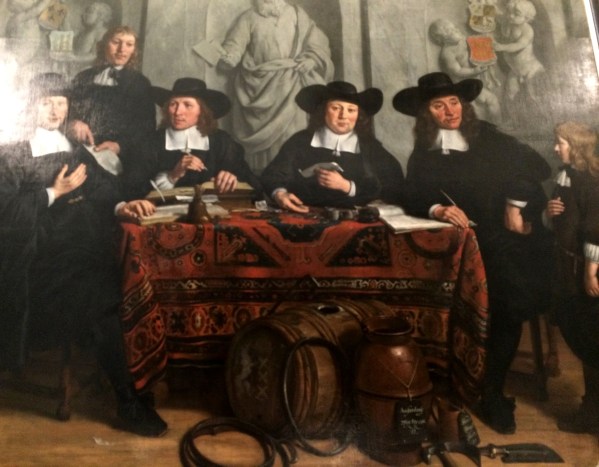
I made my way past familiar portraits from the 17th centuries, familiar only because we’d viewed lots of these civic paintings in other museums during our Netherlands explorations, this one featuring the governors of the Coopers and Wine Rackers Guild

IMG 0195

juxtaposed against startling modern ones, such as the 2001 “Amsterdam Civic Guards”, with the Maid of Amsterdam, holding a joint in one hand and carrying a tattoo of Rembrandt on her breast, surrounded by prominent historical figures, such as Anne Frank and Alfred Heineken. (FYI:  “Mokum” is a nickname for Amsterdam. Derived via Yiddish from the Hebrew ‘makom’ meaning ‘place’, the nickname was bestowed by the Ashkenazi Jews from Eastern Europe in the 17th century.)

IMG 0227

These two paintings really sum up the country’s, as well as this city’s, history. Commerce has been the underlying force since the founding of the city with just a few hiccups along the way due to foreign rule:  Hapsburg’s Philip II of Spain, which led to the 80-year war of Independence (1568-1648); France’s Napoleon and bro Louis Bonaparte (1795-1813); and, the Nazis (1940-1945).

With no sovereign or religious head posing as an absolute authority, Amsterdam and the Netherlands focused their energy on trade. By doing so, they developed a more tolerant view of others since any and everyone could be a potential customer. And, as we walked through rooms describing the life and times of the city’s residents, we realized just how much this city was built on civic dreams.

The overwhelming sense of the importance of commerce is inherent in:

the portraits of wealthy merchants and their families versus none of any king or queen… the painting of the ‘new’ city hall, constructed during the country’s golden age (below) and capturing the moment when Louis Bonaparte is given the keys to the city in 1808…

IMG 0223

the accruements of daily living, such as a plate displaying the initials (VOC) of the Dutch East Indies Company…

IMG 0215

and a painting showing Amsterdam in 1600 with the surrounding countryside composed of polders (reclaimed land).

IMG 0251

As population grew, city inhabitants took over more and more land. Urban planning helped direct the expansion with one of the major developments being the ring of canals, construction of which began in 1613. The methodical layout makes for a wonderful stroll throughout this city. (Although, I have to say, everytime I see this photo, the colors remind me of rare roast beef. Not appealing when out of the context of sitting on a plate with roasted veggies and salad.)

We discovered some surprises in this city’s history, one being the Miracle of Amsterdam. I tell you, this is bizarre and pretty unbelievable to even think this a miracle but, for the sake of history, here’s the story, and I quote:  “In 1345, in a house on Kalverstraat… a priest had given a man the last rites. The patient was so ill that he coughed up the sacramental wafer. The nurse threw the vomit onto the fire, but – a miracle! – the wafer remained unscathed. After the Pope recognized the miracle, Amsterdam became a pilgrim city.”

Yes, really.

And, of course, where there’s a way to do a goofy pose, I’m there. As is my husband who, as I’ve said often, puts up with me.

img_0255

Our visit was relatively short (just a few hours) but well-worth obtaining an overview of the city, one reminding us of how wonderfully liberal Amsterdam can be (the first gay marriage in the world occurred here on April 1, 2001) and just how steeped in civic leadership (history of the guilds and lack of a dominating ruler or religious head).

Back to Hoorn where, alas, no roast beast dinner awaited us. But, another wonderful weekend does!

Stay tuned… :)


Row, Row, Row Your Boat

BROEKE OP LANGEDIJK

Sunday, October 16

Well, punt is more like it, which is how farmers in Broeke op Dijk tended their fields (actually islands) using boats to navigate the manmade waterways to their manmade islands ; Prior to the 17th century residents lived next to a boggy marsh and raised cattle. However, the land for grazing was constantly under the threat of flooding, which, combined with a cattle plague, created an unpredictable return on their investment. Somehow, someone or two thought to dredge the marsh to build islands for growing crops. In a relatively short time over 15,000 of these islands appeared and a more stable livelihood evolved thanks to the raising and selling of potatoes, onions, carrots, and cabbage. LOTS and lots of cabbage. I mean TONS:  at one point over six million heads of cabbage were harvested and sold here.

But, I’m getting ahead of myself. First let me explain how we even got to Broeke op Langedijk. To quickly retrace our steps:  on October 10 we flew from Maine back to Enkhuizen, Netherlands where JUANONA had been patiently awaiting our arrival since we left August 7. Two days later we did our final sail to Hoorn

img_0016

espying the 1532 tower, which we first saw back in May with our nephew Rudy, and which now welcomed us back. Or, at least, it didn’t shudder and collapse at seeing two Mainiacs turning into its harbor.

img_0038

Tieing up to one of the guest pontoons we felt we had reached home, one we hoped would be our place of residence for awhile.

img_0044

The following Saturday, October 15, our friends Thijs, Deborah, their daughter Tika, and Thijs’ father Jan joined us for lunch, which included kibbeling, a delicious meal of delicately fried cod.

img_0057

We had last seen them late July when the five of us met up in Hindeloopen on the east side of the IJselmeer, the manmade lake created by the building of the Zuiderzee Dyke.

And, just a quick mention of one of our favorite Netherlanders who is Tika :)  She has taken on the thankless task of trying to help me learn some Dutch. Being an excellent teacher she had created a beautifully illustrated book presented to us when coming aboard. I now can practice the various sounds while, no doubt, making very unusual facial contortions. And, yes, she’s a dear one!

img_0180 img_0181 img_0182


Okay, back to Broek op Langedijk, which we visited the next day (Sunday) via train to Alkmaar and then bus to the waterways with a short walk to the Museum Broeker Veiling.

Looking around the area as we strolled the half-mile to the museum from the bus stop, Broek op Langedijk seemed pretty nondescript. I wondered just how interesting it would be to tour. But, hey, it was a beautiful day to be outside enjoying the blue sky and sun while stretching our legs.

Yet, like many of the destinations we’ve explored in the Netherlands, this country has the knack of expanding the history of a place into a fascinating tale of living, the Museum Broeker Veiling being no exception. Comprised of several buildings (a new one, housing an overview via an 8-minute film and some artifact, and the original 1887 auction house and storage sheds), an outdoor display of how farming families lived, and a boat tour of the waterways through the remaining islands.

With audio guides we began our tour learning how these ingenious folk had turned a lemon (boggy land) and converted it into lemonade (productive, arable acreage). Not only was the land fertile but also generally protected from freezing with the surrounding water (one to two degrees warmer than the land) providing some insulation from night frosts. This set-up allowed farmers two crops a year leading to a competition on who could harvest the first potatoes (called ‘the Langedijker first’). During radio days the winner even received recognition over the airwaves.

With the dredging of the marsh, the landscape evolved into what is called “The Realm of a Thousand Islands” with over 15,000 islands (each island and canal named by the various owners) separated by numerous waterways or canals. Approximately 75 of these islands were inhabited with steep, short bridges tall enough to allow water traffic through. We walked one of those bridges in the open area display next to the museum (followed by two chickens!).

img_0098

The farming families lived on the Langedijk (Long Dyke). As the population grew, residences were built on the opposite side of the dam. With so many houses clustered around this watery community one can only imagine the quality of the water. With one source (the canals) used for drinking, washing dishes, laundering clothes, making bread, and sewage outlet, I’m sure there was a distinct flavor added to the water.

Although it’s rare to see today, farmers punted to and from their crops in wooden flatboats. These were engine-less until the 1920s and were all wood until the 1930s.

Version 2

Another common form of transportation was the tjalk, a sailing barge used to by the farmer to take his produce to the market.

Version 2

However, by marketing their produce themselves, farmers typically sold their harvest in bits and pieces versus in one lump, which meant one wouldn’t necessarily sell all of his crops and/or at decent prices. This form of commerce created a lot of uncertainty regarding the amount of income each farmer would derive from his produce. In 1887 this changed when a local trader came up with the idea of an auction. With an auctioneer setting an initial, agreed-upon price then offering it to bidders, the farmer was able to not only get a fair price but also sell all of his produce in one fell swoop.

Unlike auctions where the bidding starts low then increases as buyers vie for the item, the Dutch auction system starts at a set price named by the auctioneer then decreases until a buyer bites. In other words, instead of going from low to high, the bidding goes from high to low.

In 1903 a clock numbered 99 to 1 was used as part of the process with the auctioneer naming the initial price and setting the clock on that price. As the clock ticked clockwise and the auctioneer yelled out the decreasing price a bidder would press a button at his chair that would stop the clock on the price he was willing to pay. A number in front of the buyer would light up indicating clearly who was the buyer and what price (by kilo or piece) he was paying. The farmer, therefore, could offload all of his produce at once versus in straggling lumps.

The original mooring halls housing the produce

img_0069

and the auction house

img_0106

still stand and are incorporated into the museum, which the then monarch, Queen Beatrix, helped preserve in 1979.

Auction day would begin at 6:00 a.m. with merchants inspecting the individual harvests by walking through the mooring halls. At 8:00 a.m. the excitement would start and for 2-1/2 hours two to three hundred lots were auctioned off.

img_0107

A unique feature of this auction house was how the auctioned items were conveyed:  the auction house featured a small canal right through its center. The boats were steered  between the buyers while the bidding on that lot took place.

img_0105

Sold merchandise was loaded onto barges, later via trains and trucks, for transporting to various destinations.

Version 2

The MS Westfries, seen below, was used for over 50 years as part of this conveyance of sold produce to greengrocers.

Version 2

What makes this tour really interesting is visitors participate in a live auction held in the same building where this occurred until the auction relocated in 1973.

img_3222

Of course we had to bid on some of the items being offered up by the auctioneer, and my husband, endowed with a generous competitive spirit, managed to win a bag of local apples for 1.30 euros :)

img_3223

A 30-minute boat ride took us through this watery world of canals and one of the two small dels or lakes (initially formed when low parts of the landscape were flooded by the sea). Nowadays many of the canals have been filled in creating larger plots of land. The area is in conservation under the control of a government agency; yet, roughly 80% of the islands are still being farmed, primarily as a hobby with two being professionally managed by market gardeners.

img_0085

img_0086

One rule applies, though:  cultivation must be purely biological, i.e., organic. Thanks to this requirement medicinal herbs are grown here by the manufacturer VSM and waterfowl enjoy a wonderful habitat for breeding.

img_0091Although not all fowl are wild, which we noticed as we passed some of the islands’ habitants.

img_0087

And, remember when I said cabbage was a bounteous crop?

img_0093

Well, evidently it created a rather odiferous aura due to rotting, outer cabbage leaves, which found their way into the canals. Of course, I would think eating lots and lots of cabbage would also contribute its own unique smell to the air…

To maintain the water level (3.3to 4 feet in the canals and 5 to 6.6 feet in the dels) the locals built 14 windmills.  Two remain, which we spotted in the distance on our boat tour. (You can just make out the spear of one of the blades in the top right corner of the photo below).

img_0078

Disembarking, we finished wandering through the various buildings and outdoor exhibits listening to our audio guides explain how the occupants of this Realm of a Thousand Islands creatively found a way to create a healthy, sustainable community.

Retracing our route we landed back in Hoorn and enjoyed some of the local cheese (no, we didn’t eat all of this at once, nor did we eat any cabbage)

img_0048-1

and, once again, looked at one another and said how fortunate we are to be doing what we’re doing.

img_0052


“Wherever you go becomes a part of you somehow.” ― Anita Desai

MEDEMBLIK, then ENKHUISEN

Friday-Tuesday, July 29-August 3

Having gone bow-in through silty mud to rest at our mooring in Hindeloopen we now were backing out without the least bit of noticeable resistance (possibly our keel plowed a trench on the way in?). In this Disney-movie-set-of-a-town we had savored our time spent biking, walking, training (as in locomotives), and being with friends while meeting new ones.

Craving one last anchorage before we headed to Enkhuizen, we opted for a cove off a nature reserve, one our friend Thijs had suggested. We crossed the IJselmeer watching the depth as most of this large lake averages between 10-12 feet, a bit disconcerting when JUANONA draws six-and-a-half feet.

Our approach to our anchoring spot took us through three fleets of racing boats. We managed to snap some photos on the downwind leg of the race with colorful spinnakers puffed out like rounded bellies as the boats screamed through the water.

IMG_9648

Later we discovered we had landed next door to a Regatta Center hosting the World Championship of the “29er” class of boats. [If you want more info on those, please google as I’m completely ignorant of them except to know it takes two people–typically young and very fit (du-uh)–to sail one boat… the boats aren’t huge… they are fast… and, I’d love to be on one, as a passenger….]

As we entered the cove we slowly inched our way forward passing red-buoy markers, touching bottom once, until reaching a comfortable depth for anchoring.  Here we breathed a sigh of contentment as we gazed around, mentally sending thanks to Thijs for his recommendation of this pastoral anchorage.

For four days we stayed on the hook, rowing into the public dock for walks into town, scrubbing and waxing JUANONA’s hull and deck, and simply relishing being our own little island surrounded by nature. We even enjoyed hearing the thunder booms from an incoming storm, one of the few we’ve experienced this entire summer.

IMG_9674

Yesterday we pulled up anchor to sail the 10 miles to Enkhuizen where JUANONA will stay while we head home for a bit.

Our 2016 summer cruising may be coming to an abbreviated end, but with so many rich memories. Being in more populated regions than last summer, we saw numerous museums and other really fascinating cultural sites; and, of course, the wildness of Norway’s coastline and islands and the tamed beauty of the Netherlands captivated us.

Yet, the most memorable times involved the wonderful folk with whom we’ve had the pleasure of sharing time, even if only for a little while.

Paul and John, two Brits who were cycling to Prague and whom we met at Haarlem’s windmill demonstration
IMG_6579.jpg
Haarlem’s Downtown Coffee manager-owners Linda and Daren who kindly helped us register our Museumkaarts (unfortunately, no photo but may be possible in the near future)
Our guide at the Corrie Ten Boom Museum, who was a child here during WWII, and just radiated warmth and love
IMG_6548.jpg
Tara at a great hostel-inn, HELLO I AM LOCAL, where we hung out using their wifi while sipping coffee and beer at their cafe
IMG_7498
The wild and crazy crew we met in Amsterdam at the Liberation Day trivia quiz:  a German Couple, Ilse and Werner, and three, thirty-year-old locals who had grown up together, Erik, Ditske and Koen
IMG_0119
Fellow sailors, Henk and Kiki, whom we met tied along Hoorn’s town wall and who continue to send us helpful advice for navigating these Dutch waters (as well as later meeting his son, daughter-in-law, and grandchildren cruising at Vlieland when we were prepping for our Norway passage) and one of our wonderful nephews, Rudy
IMG_7763.jpg
Another fellow sailor, Thijs, his wife Deborah and young daughter Tika, whom we initially met in Hoorn and had the good fortune to meet up again in Hindeloopen
IMG_7765.jpg
Our “Belgium Family”–Ta, Koen, Seppe, Frieke, and Wannes–who made the trek over to see us along with Rudy
IMG_7797.jpg
The guys from Norway’s Rescue Organization, Redningsselskapet, docked behind us at our first port of call in Norway (Egersund) who gave Max a diesel additive (again, a missed opportunity for a photo)
Skudneshavn rafting neighbors on our third night in Norway:  two Norwegian lads, Lars and Oddbjoern, and two Brits, Judy and James
IMG_8258.jpg
A surreal, serendipitous meeting of a fellow Mainer, Paul, who later hosted us in his hometown, Stavanger
IMG_8399.jpg
There but for the kindness of strangers:  the guy who helped us fill up with diesel in Skudneshavn, using his credit card in case ours wouldn’t work
IMG_8434.jpg
The lovely Dutch couple who, along with us, were the only other non-Norwegians in the tour of the Barony Rosendal

IMG_8481-1.jpg

Marit and Even, a Norwegian cruising couple with whom we wish we had been able to share an anchorage
IMG_8562.jpg
And, because of Marit we met Irene in Bergen and had a delightful coffee break discussing her project resulting in a book, WORD BY WORD, ROW BY ROW
IMG_8910.jpg
Two lovely, wonderful people, Elisabeth and Gunnar of Os, who treated us like lifelong friends
IMG_0972.JPG
And, because of them we met Vibeke, who along with her husband Peter, runs a successful art gallery on the island of Lepsoy

IMG_8611.jpg

Hildegunn, our bus driver on the island of Sotra, who drove us to Televag when she knew we had to wait several hours for the next bus
IMG_9010.jpg
Dag, to whom we regrettably had to turn down his invite for coffee at his home but said we hope to change that to a ‘yes’ if back next summer
IMG_9066.jpg
Eoin from Ireland who also happens to be the OCC Port Captain in Stavanger and who made my tummy ache from laughing so much
IMG_9303.jpg
Max’s Norwegian Family–Oddbjoern, Bjoern, Sylvie, Antonia, and Kelly–who gave us a magical experience and a true appreciation for Max having family in Norway
IMG_9371
And, those we met upon our return to the Netherlands and, unfortunately, lack photographs:
Nick, our friendly neighbor at Vlieland Marina… Danielle and Henk who helped us with our lines docking at Hindeloopen (and gave the good advice of rev it up to get through the mud)… Kitty and Paul with whom we had fascinating conversations as well as plenty of laughs… Lena and Henk with whom we spent a wonderful evening soaking up their knowledge of cruising the Danish and Swedish coastlines… and, fellow OCCer, Peter, who graciously drove an hour to meet us today before we fly back to the states.

I’m not religious but I do appreciate what the universe may provide, and for all the human reasons above, we definitely feel ‘blessed’.

Thank you to all who made our 2016 summer aboard JUANONA so absolutely special.

IMG_9029.jpg


FYI:  The reason we’re stopping our cruising so early is due to a visa regulation. As non-residents we are juggling two restrictions dictated by the EU and Schengen, the latter being a treaty signed by the EU and Scandinavia.

In the UK US citizens are allowed to visit up to six months at a time. To reset the visa, you can do so by simply exiting the UK and then returning. This six-month visa allowance (and the ease to reset it) was one of the primary reasons for our staying in England these past two winters.

All Schengen countries (Scandinavia and all EU countries with the exception of the UK) restrict visitors to a total of three months out of six. Once you’ve spent a cumulative 90 days you must leave the Schengen area for three months before you can return for another three months (90 cumulative days). For long-term visitors, such as cruisers, the three-month restriction doesn’t allow a lot of time for slow traveling by boat, or for finding a place to winter aboard. However, it’s not as if the good ole’ US of A makes it easy for visitors either, so fair is fair.

On the other hand,  JUANONA isn’t affected by the Schengen treaty. And, she can stay for up to 18 months in the EU without paying the value-added-tax (V.A.T.). That V.A.T. exclusion can be reset by simply documenting entering the waters of a non-EU country. Thankfully, Norway isn’t in the EU, which is why these past two summers made it extremely easy to reset the tax exclusion. (Brexit will add an interesting twist to how non-UK cruisers and boats will be treated.) 

Anyhow, that’s what we juggle when determining where, when, and how long we cruise in certain areas over here. Now that I’ve tangled your mind up with that bureaucratic rope, I’ll stop nattering on.


Friesian Cruising (or “Frysan” cruising as the Frisians would say)

 FYI:  The parentheses state the place name spelt in the Frisian dialect, which even most Dutch outside of this area don’t understand.

VLIELAND

Friday-Thursday, July 15-21

We were back in familiar territory when we landed on Vlieland, one of the five Friesian Islands with the North Sea on one side and the Wadderzee on the other. We found a berth at the marina immediately, which was against all odds considering most summer boaters anchor outside the entrance, sometimes for several days, in hopes of replacing an exiting boat. The usual drill of cleaning bodies, boat, and clothes occurred along with a walk into the one-street town and a chance to sit on a wide open beach.

IMG 0280

Another reason we were lucky to get in was finding ourselves with two friendly neighbors, port- and starboard-side-to. We struck up a conversation with Nick, a Dutch sailor awaiting his family’s arrival; and, over the several days we stayed in the marina we had a pleasant time discussing boating and life in general.

Wanting to anchor out again, we left on Monday to head just to the west of the marina entrance. Calm waters and warm temperatures made for a smooth transition from berth to anchoring. Noticing that some boats used the sign of a black buoy raised at their bow to indicate they were anchored during the day (at night we use our anchor light locate atop our mast), we improvised with my sacrificing a black t’shirt over a round fender. It made for a humorous ‘buoy’.

IMG 9436

yet, it worked like a charm :)

IMG 9439

Over the next few days we caught up on some tasks and watched boats come and go. With Max reading the RIDDLE OF THE SAND based on this area of shoals created by wind and tide, we dinghyed close to one sandbar where the boats on the horizon appeared to be sitting on that sandbar.

IMG 9462

Wednesday we awoke to a forecasted wind of 20 knots causing us to now and then check our position relative to other boats and the channel. With high winds against the strong current flowing around this island, our chart plotter drew a picture of our twirling around.

IMG 9491

Thursday morning we set off on a rising tide to make the 20-mile trek across the Wadderzee and through the dyke to Hindeloopen, a small town on the east side of the Ijsselmeer, Netherlands’ large lake, which use to be the Zuiderzee (South Sea). The North Sea pushing itself over sandy land barriers caused this Zuiderzee to form, and after a major flood in 1916, the dream of reclaiming land and stopping the devastating floods became more of a reality. Between 1927 and 1932 the Zuiderzee was sealed off by the Afsluitdijk (Barrier Dyke) which allowed land to be reclaimed.

It was this dyke we had exited in mid-June and now we retraced our steps only to screech to a halt once we saw the line-up of boats. To enter the IJsselmeer requires first a bridge opening then transiting through a lock, each with their own waiting area. What a zoo! It was quite something to jockey for position, either rafting alongside a fellow boater who had arrived earlier or freewheeling around in the waiting area.

IMG 9497

Good practice, though, for how to spot an optimal rafting opportunity (which we did waiting for the bridge to open) and how to mill around while avoiding other milling-around boats (which is what we did waiting for the lock to open). Finally, our turn came for squeezing into the lock where you instantly make acquaintances as everyone holds onto everyone else’s boat to help out.

IMG 9500

In speaking with other boaters they said the crowds are primarily due to it being close to turn-over time for charters as well as being high season for summer vacations. A nice tidbit to stash away for planning future cruising.

HINDELOOPEN (HYLPEN)

Thursday-Monday, July 21-25

Pulling into Hindeloopen we were greeted by Danielle and Henk, a Dutch couple who had heard about an American boat coming into a slip next to them. When we started to slowly move into the slip Danielle all of a sudden said ‘you’ll need to gun it to get in’. Rightly so as we plowed through soft, silty mud the last ten feet coming to an easy stop. One of the easiest and calmest docking experiences we’ve had this summer. Nothing like planning on going gently aground.

And, what a treat to be here! Not only due to feeling we were sitting in the epitome of a quaint Dutch town, a perfect movie set for a Disney film,

IMG 9555

IMG 9561

IMG 9562

but also because we were hoping to have a reunion with our friends whom we had met last May when moored along side Hoorn’s town wall:  Thijs, Deborah, and Tika.

And, we happily did! Resulting in taking a biking trip to the next town north, Warkum (Workum). With perfect cycling weather, the five of us met at the marina office to pick up bikes. It’s also where I took a snapshot of Tika’s marvelous silver sneakers:

IMG 9507

Then we were off for the day, led by our Dutch friends who took us along the route through polders (reclaimed land now farmed) and past old markers indicating town lines no doubt established many centuries ago. And, how we enjoyed being out and about! I think the smiles are an accurate reflection of our spirtis :)

IMG 9525

A lovely cafe along the canal made for the perfect al fresco lunch

IMG 9520

included a much-needed lesson in how to pronounce some Dutch words thanks to Tika’s prompting.

IMG 9519

This was followed by a designated stop at the Jopie Huisman Museum, a local artist born in this Friesian town.

IMG 9521

Jopie Huisman (1922-2000) isn’t an artist I had heard of, but that’s not surprising considering my lack of background in art. What is surprising, though, is not having heard of this particular artist. What a wonderful gift Deborah, a talented artist herself, Thijs, and Tika gave us by bringing us to this museum. Eleven, small gallery rooms encapsulated the life of this Friesian artist, and by room two I couldn’t help but smile and wish I had had a chance to know such a human being.

Both Max and I were really moved by this artist’s art and philosophy. Reputedly he never sold any of his painting but gave some away to those he felt deserved them. He made enough of income from collecting and selling rags and metal to support his painting. By gazing at his work, though, one feels he so easily could have sold them. Just look at this amazingly detailed replicas of the Frisian ‘uniform’ of striped-blue overalls (1975).

Jopie huisman broek van een koemelker 1975

Jopie believed the tools and dress of one’s daily life become imbued with that person’s spirit; and in his paintings, he tenderly depicted the most mundane items with care and dignity. One was a pair of women’s wool undershirt and stockings (1983). Out of respect for this women’s knitting, he counted each stitch to ensure he accurately reflected the amount of work required to produce these garments.

Undergarments

Interestingly, the museum also held and displayed many of the actual items Jopie painted, this woman’s undergarments being one of them.

Some would call these still life paintings, but for Jopie, they were anything but ‘still’ life. And, as we wandered through this small museum, beautifully laid out, we were seduced by the artist’s skill and devotion to the person who wore those overalls or held that doll (1976).

Jopie huisman vriendschap 1976

(Just a side note, Deborah, who herself is a very talented artist, told us her grandmother had had a similar doll, one made during the depression resulting in stones used for heads. On Sundays Deborah was allowed to play with it and now she has the very same doll for Tika.)

Jopie would always credit the individual whose items he was painting by including the owner’s name in each work’s title. He felt most at home with the hard-working locals, those described as ‘without status’ by our audio guides.

Jopie didn’t only paint man-made items. Some of his earlier and later works depict the landscapes in wonderful colors and simple lines such as this one from 1993.

Jopie landscape

as well as portraits. This is one of his father painted in 1951 right after Jopie’s mother died, a woman loved dearly by both men. Jopie later recounted that this was the exact way his father stood for many minutes, trying to come to terms with the loss of his wife.

Father

At the end of our tour I was left with the feeling of how I wish I could have sat in the presence of this man, watching him work or just listening to his conversations.

Back on our bikes we headed for a beverage break in the main square, followed by a grocery stop, and the sighting of some unusual tents

IMG 9528

before returning home to Hindeloopen. A wonderful day spent with wonderful friends.

IMG 9534 1

With biking in our system Max and I decided to do another day of touring on Sunday. Deciding on a counterclockwise route we followed the dyke south to Stavoren, the tip of a peninsula, then cut east to Mirns and north back to Hindeloopen. More opportunities presented themselves for ‘here-we-are-in-Holland’ shots, with Max managing to capture a perfect illustration of just how it looks along these canals.

IMG 0286

LEEUWARDEN (LJOUVERT) & FRANEKER (FRENJENTSJER)

Tuesday & Thursday, July 26 & 28

With a 1-km walk to the train station (really a platform, shelter and ticket machine), we hopped the train for a 45-minute ride to Leeuwarden, the capital of the Friesian province we’ve been wandering through.

Now a large city with modern buildings there was an area featuring historical structures, one being the Oldehove, a tower built in 1529. After 30-feet of construction the building started a very noticeble tilt. They decided to continue building in spite of the leaning, finishing it off at roughly 130 feet in1533.

IMG_2946 (1)

Two museums interested us, one being just across this plaza from the leaning tower of Leeuwarden. The Kerimiekmuseum Princesshof (Princesshof National Museum of Ceramics) was housed in the small palace of Marie Louis, dowager Princess of Orange, who purchased her home in 1731.

IMG_9616.jpg

Much beloved during her life, Marie Louise, called Marijke Meu or Aunt Mary, began collecting ceramics, which later became the foundation of this museum. Now, it includes an impressive array of eastern and western vases, pots, cups and saucers, platters and sculpted figures.

We couldn’t help but think of our ceramist friend Rebecca Esty wondering what she would think of this historical perspective. She also could have enlightened us on the importance of various glazes, etc., which would have enriched our viewing.

The next museum, the Fries Museum, a modern structure opened in 2013, required two days of touring (multiple visits is one of the benefits of holding a Museumkaart), which we realized after finding the exhibits much more interesting than originally anticipated.

FriesMuseum2 (1)

What was so appealing about the curating was the use of over 100 artifacts to tell the story of the area’s history. For instance, there was a large room with four different display areas, each one holding 15-30 items with detailed explanations available in a self-guided tour booklet.

At first glance both of us thought ‘ho-hum, here we go…’ only to be drawn into the individual stories per artifact.

For instance…

They believe they found proof of honor killing when a knife with a silver coins attached was discovered:  revenge was exacted in the biblical sense, including a murder-for-a-murder; if revenge occurred, the weapon would be left at the scene along with some silver coins to compensate for taking revenge.

IMG_9613.jpg

Another artifact showcased pages from a book written by a minister, Francis Haverschmidt (1835-1894), in the mid-1800s. Wanting to teach the fundamentalists that the Bible shouldn’t be taken literally, Haverschmidt penned a make-believe story about Frisian culture. The book was supposed to be discovered as an ancient text, so he aged the paper and fabricated an ‘ancient’ Frisian language involving runic script.

IMG_9615.jpg

He planned for the tale to reveal itself as a practical joke while being read, using this as a lesson for his parishioners not to take everything literally. However, Haverschmidt was such a good writer just the opposite happened:  it was taken as genuine after attracting a lot of attention. Since the joke had gone too far, Hamerschmidt felt it was best to remain silent, and it wasn’t until 2004 that a researcher reconstructed the chain of events and uncovered the truth.

History told through regional artifacts made for a fascinating walk through this room, which easily took us almost two hours. So, we ended up returning on Thursday to view the WWII exhibit.  Another exhibit was a brief glimpse of a local’s life:  Gertrud Margarete Zelle, better known as “Sun” in Malaysian or Mata Hari, the seductress who was shot for treason during WWI.

I also couldn’t help but take a photo of an exhibit featuring the history of knitting, with some interesting lanterns dangling over one of the wide staircases. Made me think of Irene whom we met in Bergen this summer and her lovely book, WORD BY WORD, ROW BY ROW.

IMG_9609.jpg

But, before we returned to our second day of touring the Fries Museum we took the morning train to Frankeker (Frenjentsjer), a small Frisian town, where the world’s oldest working planetarium exits.

The genius who created this planetarium and the beauty in which he did so means you don’t need to know astronomy or even be interested in that science to appreciate his work.

IMG_9586.jpg

IMG_9587.jpg

planet-2.jpg

Named for the man who constructed it, this planetarium was carefully and exactingly created by Eise Eisinga (1744 – 1828), a woolcomber by trade and a mathematician by hobby.

Eise

Beginning in 1774 and completed seven years later, Eisinga transformed his living room (and sleeping area as can be seen by the curtained, cupboard bed chamber) into a solar system. For over 235 years visitors have been coming come to gaze at this work, mesmerized, as were we, by the slowly ticking of the dials as planets accurately revolved around the sun and the sun and moon phases kept actual time with nature. Even Kings were impressed by this humble tradesman’s work:  after King Wilhelm I’s visit in 1817, he later purchased and donated it to the country.

Eisinga left a detailed handbook explaining how it all operated; and, above the living room we saw the behind-the-scences mechanisms controlling the wonder below. 10,000 hand-made nails formed the cogs…

IMG_9592.jpg

IMG_9595.jpg

What I also enjoyed was the reason why he created his planetarium:  it was to counter the 1774 doomsday prediction caused by planets colliding. And, that was the impetus for this marvelous work of art. Furthermore, very few adjustments need to be made it is that perfectly tuned to the universe. Hard to imagine in this day of planned obsolescence.

Another stop in Leeuwarden and the Fries Museum ended our day of touring.

HINDELOOPEN (HYLPEN)

Friday, July 29

The next morning we left Hindeloopen to cross back to the other side of the Ijsselmeer where we’d be ending our summer cruise. But, before I leave this blog, I want to let you know, once again, the best reasons for traveling are the wonderful folk we’ve been meeting.

In addition to our friends Thijs, Deborah and Tkia, we met Kitty & Paul with whom we had several wonderful conversations covering topics as diverse as the widow of the Shah of Iran to artificial intelligence and singularity; and, Lena and Henk who spent over an hour with us identifying highlights of cruising in Denmark and Sweden (augmented by some amazing photos Lena had taken). We only wish we had had more time with all of the above. Fortunately, they all reside in the Netherlands, which means reunions could take place.

AND, two more lovely reminders of just how much we enjoyed are stay in Friesland:

Deborah’s drawing of Hindeloopen

PSX_20160724_160756.jpgwhen perched just above where JUANONA was moored (riding a little high in the silty mud),

IMG_9570.jpg

and Tika’s excellent instruction to aid my trying to speak Dutch.

IMG_9545.jpgIMG_9544.jpg


Now, to practice. Just wish I had my teachers to correct me :)

Next… an early end to summer cruising.

PART IX: Max’s Norwegian Family

Egersund

Tuesday, July 12

Our last day in Norway turned out to be another amazing adventure; and, it all began with a simple postcard….

IMG_8227.jpg

To find out just how amazing, the story unfolds in a letter Max sent to his immediate and extended family…


Our Norwegian Family

Where do I start to describe how lovely is the family we met in Norway. Just spectacular folks.

To briefly recap the Geneology, our great-great-grandfather Peter Christian Assersen (PCA) was born on the island of Midbrod on the SW coast of Norway. The last of twelve children, he left home fairly young and made his way to the US. He eventually became a Rear Admiral in the US Navy. But he never forgot his roots, and anytime a friend from Norway visited him in the US, he always asked about his family back home, and about an old girlfriend he once had, and always asked whether a teetering rock they had tried to roll down the mountain was still there.

sylvie

PCA’s parents were Malene Rasmusdatter and Asser Johannessen (hence Peter took the last name “Asser-son though it’s spelled -sen here in Norway. And Malene’s father was named Rasmus Christensen, hence her last name Rasmusdatter – Rasmus’ daughter. To add further context, people sometimes took the name of the farm or island where they lived). There is quite a story about Malene – an adopted daughter – not marrying her foster brother as was the wish of the significant people in her life. Instead she blazed her own trail. (A trait that seems to run in the family!) Malena lived to age 102.

A “Malena Midbrod” is portrayed in a 1998 magazine article standing on the seashore holding a rifle with an accompanying article describing her heroics in the Napoleanic Wars. It’s not clear if this is PCA’s mother or grandmother, but it is definitely one of the family according to the local historian who wrote the article. In the early 1800s Norway got dragged into these wars. The Norwegians captured a British ship which was full of valuable rope and tar, and hid it amongst the islands around Midbrod. The British sent a powerful gunship to rescue it, but the English ship was too big for the shallow channels. So they sent their troops ashore in smaller boats. Many of the Midbrod men were out fishing, but Malena rallied enough of a force to take on the British troops and send them packing. So there is a Joan of Arc in the family (The article is in Norwegian so hopefully we’ll get it translated one day).

Scan Jul 15, 2016, 17.46

PCA had a daughter also named Malene, who married William B. Fletcher (who also became a Rear Admiral). He is my great-grandfather; Lynnie and I live in the house he purchased in the 1920s; and we named our boat “Juanona” after the gaff-rigged sloop he sailed for 30 or 40 years and which I sailed on as a young boy. It makes PCA seem not that very distant.

Fast forward to the last few weeks. Lynnie and I have just sailed from Holland to Norway, making landfall at Egersund, a town on the SW coast. I knew PCA was born on the nearby island of Midbrod and nothing else. Lynnie and I go to the local town office to see what we could find out about his life. The woman there sends us to the old church, thinking they might have some records. Their records didn’t go back far enough, but the woman graciously prints out the names and addresses of the four Assersens in the phone book.

We send four postcards, and lo and behold got a nice email back from one of the four. They weren’t related to us, but their daughter married someone who was. By then Lynnie and I had sailed further north, but we started communicating with the cousins and made plans to meet on our way back through. It was with considerable excitement that we awaited the family last Tuesday (July 12).

They arrived aboard “Juanona” with a tray of gingerbread and within ten minutes it felt like we had known them well, pretty much forever.

IMG_9304

Bjorn Skadberg is one generation younger than me. His wife Sylvie Assersen Skadberg (and oddly enough, Sylvie doesn’t think she’s related to us) and their children Antonia and Kelly are the nicest folks you will meet. Due to our uncertainly with weather we had only given them a couple days notice of our arrival, but they both took a day off from work and planned a most memorable day for us. (Incidentally, they told me Norwegian family members travel to the US from time to time and they’ve always wondered if there any relatives around, so they are excited to make these connections too!)

Our first stop was to see the Lundardviken beach, where Malena had gone to clear her head after being thrown out of the family for failing to marry her foster brother as was the wish of her foster parents (they were their only children, and marrying each other would have preserved the family house and given each child some economic security).

Next we met up with Bjorn’s father, 78 year old Oddbjorn Skadberg, a most wonderful gentleman who still fishes and occasionally tends the lighthouse, and who remembers a lot of the family history. Oddbjorn has done winter fishing in the Lofotens, north of the Arctic Circle, where he sometimes had to sleep in his boat with no heat, and otherwise impresses me as someone with a toughness that you don’t find much anymore – but with a very gentle soul. He and I share a common grandmother five generations back.

We drove to the lot where the PCA’s childhood house once stood.

IMG_9314
And then to the house where PCA’s mother lived with her foster parents, and from which she was thrown out.

IMG_9315
Incidentally, Midbrod Island is stunning, and it’s a Unesco geological park as it contains the same rock as is found on the moon. This hill, named Lunnarviken after the rock, was PCA’s childhood playground.

Next we went to a house now owned by Tonnes Tonnesen, who is another cousin. The house has been in the family since the 1600s and it could be a museum, with many original artifacts, as well as being chock full of maritime photos and memorabilia.

One picture shows one of our ancestors (in the lower right) and the crew from a rowing race. They had to row all the way from Midbrod to Bergen, a distance of about 130 miles, just to get to the starting line. They then proceeded to win the race, from Bergen to Haugesund, something like 65 miles. I don’t think they were rowing modern, lightweight shells. Like I said, people grow up tough around here!

IMG_9319
Unbeknownst to us Bjorn and Sylvie and OddBjorn had planned a picnic. But first we took a trip in Oddbjorn’s fishing boat – the same one he had shipped on a freight train to the Lofoten fishing grounds.

IMG_9328

IMG_9338
We visited the lighthouse, completed in 1854, that young PCA had helped haul the bricks for. You can’t imagine how many bricks it would take to build this, and then the whole thing was encased in a protective cast iron frame. The winter storms are brutal around here, but it looks like this lighthouse will stand for many more years.

IMG_9375
Oddbjorn has served as lighthouse keeper on occasion, and had a key to let us inside. Climbing the steps you pass by a small window with a long vertical shaft leading far below. Before electricity the lighthouse keeper had to manually wind up a mechanism to keep the light turning – like a giant grandfather clock. At the top we found not only magnificent views, but we got a ride on the turning light itself.

IMG_9346

IMG_9360
Next was a cookout with hot dogs, lamb, and salmon caught that day by Oddbjorn and finely seasoned by Sylvie. The two daughters are Antonia (L) and Kelly (R). Antonia is about to enter senior year and hopes to study geology. Kelly is a few years younger, and both are lovely young women.

IMG_9381

We also learned that Oddbjorn was giving us another salmon for our upcoming passage to Holland.

IMG_9388
We ended the day at their lovely home north of Egersund, where Bjorn has a couple antique cars in very good condition.

IMG_9390

IMG_9391
Finally, this area being blessed with fertile soil, fresh water, and easy access to the ocean, it became an important Viking stronghold. Right across the street from their house is a field still known as “Fighting Island.” Vikings sometimes settled disputes by tying the arms of two warriors together, giving them each a weapon in the other hand and letting them go at it.

IMG_9389

There are Viking remnants all over the place, including a nearby site only recently discovered – with large fire pits suggesting an important gathering place for the Vikings.

I can’t begin to tell you how special it was to make this connection with our Norwegian family. Lynnie and I will almost certainly be sailing back to Norway next summer, so will be seeing them again. And we are hoping to host them in the US anytime they are there.

IMG_9371


All I can say is thank you to everyone who has befriended two American sailors with such warmth. How can we not fall in love with your countries?

PART VIII: Stavanger

STAVANGER

Friday, July 8

After our stop at Utstein Kloster, we leisurely motor-sailed down a beautiful waterway called the Mastrafjorden to meet up with Paul whom we had surprisingly connected with in Skudneshavn two weeks earlier. Approaching the harbor to Norway’s 4th-largest city we spotted the oil rig we’d seen walking across the water a few days prior. Yes, believe it or not (and, at first I didn’t when Max exclaimed it was moving) this behemoth mechanical contraption can self-propel by virtue of the two underwater pods it floats upon, and travels at a surprisingly high speed.

IMG_9143.jpg

Not really a surprise to see it sitting in Stavanger’s waters considering this city became the base for Statoil, Norway’s ticket to prosperity beginning over four decades ago. And, there’s a stunning museum documenting this Norwegian fortune.

There’s actually a marina in front of the Norse Oljemueum Museum  (Petroleum Museum); and, it was our rendezvous point with Paul;

oil m

but, checking out the docking we found it a bit too tight for JUANONA due to the holiday boaters. Paul said the Stavanger Sailing Club across the harbor was a good alternative, so we motored over and located a perfect spot for our weekend visit.

And, from that point forward we were in the hands of our gracious host. Whisking us to his house, we had a delicious dinner of sea trout (which I had mistakenly thought was salmon and was just as delectable), baked potatoes (a rarity for us due to amount of propane it takes to cook them) and asparagus. Then, a Maine campfire treat

IMG_9150.jpg

marshmallows! The first of our summer season :)

IMG_9156-1.jpg

Due to the hour we ended up staying at Paul’s where I had also been tempted to catch up on laundry after he suggested we bring it with us.

Saturday, July 9

The sun shined in a warm blue sky and we were off to a tour of Stavanger. Like many of the cities we’ve visited in Norway, Stavanger existed as a fishing village, eventually building a cathedral in the early 12th-century. In 1425 the king Eric III (1381/82-1459) made Stavanger a market town, a designation benefiting the local populace through monopolistic trading privileges and the government by providing an easy way to capture taxes on goods and services, while building a population center for defense. Yet, it wasn’t until herring flooded the offshore waters in the 19th-century that this town began its climb to wealth.

But the real ride to riches began with striking oil in 1969, prompted by the discovery of gas ten years earlier at Groningen. The Norwegian Continental Shelf (NCS) became the Fort Knox for this country as more oil was found in subsequent drilling, the first being Ekofisk, the largest offshore oil field at that time, discovered by Phillips Petroleum.

One of the smartest moves of Norway was proclaiming that the King – basically, the government – was in charge of the natural resources. In 1972 Statoil came into existence, with the country as its sole owner. Another strategy was the contractual agreement that Norway would own 50% of each production license awarded to individual companies.

But, it can be difficult to handle an explosion of immediate riches, and, not surprisingly, Norway suffered from this ‘boom’ mentality; yet, they learned from their mistakes, and in 1990 the country established the Government Pension Fund. In 1996 the fund’s first deposit ($200 million) was paid into its coffers, growing to what now is $870 billion, the world’s largest sovereign fund. The purpose is to provide financial security for current and future generations even when the oil runs dry. Such a wise decision that sadly, oh-so-few countries even contemplate. (Interestingly, this year Saudi Arabia announced a $2 trillion investment in a similar fund to wean its country off of oil dependence by 2020. I wonder how transparent management will be of that fund.)

To gain an overview of this vital Norwegian industry we began our tour at the Norse Oljemuseum. Paul, being a geologist, became our expert guide. He obviously was a frequent visitor to the Museum since he was greeted by name by the staff with one of them being his pupil in the Master’s program he teaches at the local university.

As we wove our way through numerous exhibits, we learned about the various drill bits used

IMG_9162.jpg

(some looking like a sci-fi creature that chased Sigourney Weaver in ALIENS),

IMG_9177.jpg

the coatings of pipes (one of Paul’s recommendations),

IMG_9180.jpg

the various platforms pumping the oil – some sitting on the seabed

IMG_9187.jpg

and some floating,

IMG_9183.jpg

even seeing how men actually worked in a bubble waaaaay below the surface (no, thank you very much).

IMG_9191.jpg

However, one of the more interesting exhibits featured the evolution of non-corrupt use of all this money pouring in, the sovereign fund mentioned earlier. Not only is it the world’s largest but also the most transparent. If only other governments would use this model. Dream on.

The fund may have seen its peak years because the government actually withdrew monies for the first time in 2016. And, thanks to pressure from environmental groups the directors also began divesting the fund of coal companies this year based on a 2014 strategy. Another decision was to use some of the fund for environmental investments.

After lunch we completed our tour with a walk-through of a simulated oil platform complete with a marvelous invention of an effective and low-cost escape tube, which I was tempted to try but didn’t want to get stuck in.

The next stop was another small harbor where the herring fishery dominated in the 1800s; and, we also spotted random imprints of some Noble Peace Prize-winners’ feet (this guy, a social activist, ‘pioneered the concepts of microcredit and microfinance’). A bit more impressive than those of stars’ hands in Hollywood.

IMG_9192.jpg

Right on this plaza stood the Domkirken or cathedral whose first bishop was an Englishman from Winchester in the 1100s.

IMG_9217.jpg

A fire destroyed the cathedral in 1272 resulting in a rebuild with additions throughout the centuries

IMG_9196.jpg

with a magnificently pulpit carved and painted in the North German baroque style by Andrew Smith, a Scottish immigrant in the 1658, reminding me of the one we saw at Utstien Kloster.

IMG_9208.jpg

Along the walls were wealthy families’ memorials. The one below illustrates how the artist managed to portray each person as an individual, versus all having the same expressions; and, he had a lot of opportunity considering this guy and his wife had over 16 kids.

IMG_9214.jpg

(I had to laugh when I clicked on this photo in my photo program… :)

Screen-Shot-2016-07-20-at-11.57.30-AM.png

A short trip up the hill took us to a street that could have been from a small country village yet existed in the middle of an urban landscape. This was where those involved in the herring industry had lived and worked, and now is part of Stavanger’s historical preservation.

IMG_9229.jpg

We had been driving around in Paul’s electric car, which was fascinating to see how easy it was to plug in for recharging at parking spots.

There’s a huge incentive to drive these cars:  no 100% excise tax on the purchase like other vehicles have; free parking regardless of where you’re parked in Norway; and, no tolls (although on ferries you pay for the passengers). Plus, there’s a good infrastructure of charging stations (Paul’s needs to do so every 100-150 miles). With a pledge to ban all gas-powered vehicles by 2025 this country already has managed to migrate 25% of drivers to Plug-In Electric Vehicles (PEVs), which included hybrids (PHEVs).

IMG_9158.jpg

Norway is also encouraging people to cycle more, and we saw evidence of that infrastructure off of a bike path. In the background behind the first tree you can just make out a digital sign that informs passing cyclists of his/her speed and other stats. In the foreground is a great little mechanical shop for emergency bike repairs.

IMG_9231.jpg

But, the purpose of this stop wasn’t the biking but the 1983 monument honoring the Battle of Hafrsfjord fought and won by Hakon Harfagre (Harold the Fair Hair) in 890 (some say 872), uniting three different districts under one king. These bronze swords stood approximately 30-feet tall, which you can’t necessary tell from this photo; but, as Paul indicated, this was a much more dramatic view.

IMG_9236.jpg

With a brief stop at an early settlement of Stavanger dating from the iron age we headed back to Paul’s for a meal Max cooked and an early bedtime in preparation for Sunday’s hike.

LYSEFJORDEN AREA

Sunday, July 10

Up and out we left for Preikestolen or Pulpit Rock, a hike we had been planning on doing since landing in this part of Norway. Along the way we stopped at the small dock where Paul keeps his boat (about 30-40 minutes from his home)

IMG_9241.jpg

then continued via ferry where both Paul and I thought one of the attendants looked a heck of lot like Christopher Lloyd in the movie BACK TO THE FUTURE.

IMG_9249.jpg

Arriving at our destination amidst the carloads and busloads of other hikers and visitors we found ourselves in a drenching rain storm. Thankfully a lodge served up excellent coffee as we waited out the deluge.

IMG_9259.jpg

However, it never cleared up

IMG_9272-1.jpg

so we decided to shelved the hiking plans and opted for a leisurely drive back to Stavanger. Fine by me considering the thought of being so high up with practically a 2,000-ft drop straight to the fjord below makes my palms sweat, especially with a bunch of other hikers crowding the path to/from and the ‘pulpit’ being a slab with no guard rails as one of the numerous tourist photos shows:

pulpit.jpg

On our drive Paul introduced us to some beautiful lakes nestied in Norway’s mountain valleys, scenic and serene pools of water just begging for some quiet perusing via a small boat or, in today’s weather, sitting in a cabin with a cozy fire.

IMG_9262

We also enjoyed hearing about the geological formation of this magnificent country. Bringing to mind our friend Joanne who’s also a geologist, Paul would recount the stories these rocks tell; and, like Joanne, being a natural teacher, Paul’s explanations were fascinating. I tried to retain as much as possible with Max, I believe, being the better student.

IMG_9289.jpg

Regardless of the history in the rocks, the fjord and landscape were spectacular; and, Paul kindly took a picture of us enjoying the day and company.

IMG_9285.jpg

Returning to Stavanger we invited Paul for a sleep-over aboard JUANONA as well as joining us for dinner with a fellow Ocean Cruising Club (OCC) member, Eoin Robson, who also served as the OCC port captain for Stavanger. (FYI:  For anyone who’s planning on/doing/done some blue water boating OCC is a wonderful organization.)

IMG_9303.jpg

Having met Eoin at the OCC annual meeting in England last spring we looked forward to having him aboard. His story of applying for the British Royal Navy made my stomach ache from so much laughing. Just as an example, during one of the initial interviews (there are numerous steps one has to go through in order to join this military branch) he was asked by the interviewer about his family household–how many, their ages and occupation.

Well, when Eoin got to the last family member, his over-100-year-old grandmother, he was a bit startled when the interviewer asked one of the absolutely stupidiest questions I’ve heard, and I realize no question is supposedly stupid, but I have to say this one comes might close: ‘And, what, may I ask, is her occupation?’

Just writing this I have to laugh imaging Eoin’s expression hearing those words uttered by what should be an intelligent person. After realizing that, yes, he had heard correctly, Eoin responded ‘retired’. :)

TANANGER

Monday, July 11

Next morning Paul left saying he’d see us in Tanager, only a 25-minute drive from Stavanger and a wee bit longer by boat. We found a spot at the marina where another sailor helped us dock, did a quick provisioning stop, then had Paul stop in for dinner.

It was another early night for the next day we were off to another adventure with a hint given below… :)

IMG 8227