Category Archives: 2019

BRITTANY: Part IV

With Wifi pretty iffy and cell difficult to use at times, I’ll try to keep up with posting but may often be a wee bit behind… this one being a perfect example of such!

ROAD TRIPPING FROM ROSCOFF…

Sunday-Tuesday, June 9-18, 2019

Reading and hearing about Quimper, Finistère’s capital, we knew it was another not-to-be-missed, charming Breton town. And, knowing we couldn’t reach it easily by sailing up the L’Odet River (a future stop further south), we took a bus to Morlaix and rented a car for our journey south.

Yet, before we left we performed our now in-grained exercise of inquiring of the nearest Tourist Office, “What do you think we should see?”

Lo and behold we discovered a flock of religious sites famous in this area:  Les Enclos Paroissiaux (Parish Closes).
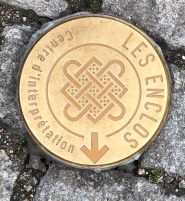
Defined by a grouping of five structures–church, churchyard (once the cemetary), ossaury-chapel (bone depository when the graveyard became too crowded), calvary (not a horseback troop but a cross watching over the dead), and triumphal arch – all enclosed by a wall – Finistère featured over 20 of these Closes.

Thanks to the demand for leather, hemp and linen/canvas Bretons grew wealthy during the 16th, 17th and 18th centuries. And, what better way to spend your money than trying to one-up your neighboring village by building the most impressive religious site? Oh, and to give thanks to your Catholic god for your prosperity.

With limited time we managed to do stop-and-go’s at five of the most famous ones.

And, when I say stop-and-go’s, I truly mean running in/peering around/running out. Our visits of each site must have broken the record for the ‘seen-that-been-there-done-that’ touring. Which is why the only way I can recall which is which comes from checking each photo’s GPS location.

So, a quick litany of our Parish Close Sites follows below, beginning with our first:  Saint-Thégonnec.

The church glittered and preened with the usual gold-toned altars and pulpits boasting over-the-top decor.

Among all the pomp one piece of furniture stood out due to its simplicty:  the Archives Cabinet. To unlock it required the presence of three keys with the priest, the local lord, and the churchwarden each holding one.

Back outside we circled the calvary. As our first exposure to one we were a bit stunned to see the numerous, in some instances cartoonish, figures decorating a multi-sided cross.

However, use of visual storylines made sense considering the lack of literacy during this time. (FYI, with regards to all of the tongues sticking out, I read that it’s a part of the body symbolizing evil in man.)

Guimiliau Parish Close was one of the more beautiful ones, most likely due to its smaller setting and, thus, more intimate feel.

Drawn to its more manageable size we spent the most time here inspecting the elaborate carvings found throughout the interior:

In the churchyard its ornate cavalry beckons you with over 200 statues

and a platform allowing a priest to instruct parishoners on the story of Christ.

Driving into a rougher terrain, we noticed the churches became a bit sterner in appearance. One being the Plounéour-Ménez Close.

Amidst the medieval decor a banner introduced a modern and sobering touch. Later I read the subject was a Polish friar arrested and sent to Auschwitz. After someone escaped from Kolbe’s barracks the Nazis selected ten prisoners to be placed in a chamber and slowly starved to death. Kolbe volunteered to replace one of the chosen men. He ended up being executed after two weeks as one of the four men still alive. He was canonized in 1982 by Pope John Paul II. The man who was replaced survived the war and spent his life touring the world and speaking about Kolbe. He died in 1995.

Commana’s Parish Close appeared to be the ‘roughest’ of the four we’d seen this morning, yet its wooden reredos (ornamental screens placed behind altars) take the prize as Brittany’s most glorious according to a brochure. A placard in the churchyard attributes the ‘technical perfection’ and the ‘exurerance’ of these carvings to the naval sculptors from Brest (when they weren’t building boats).

By now we had visited four of these religious sites in less than three hours, including driving time of an hour. A graduate degree in religious architecture and art would have increased my interest tenfold. Either that or a guide who could explain it all.

Continuing on we began to climb to a bit higher elevation with sweeping views on either side. Atop one hill we noticed a chapel and decided to check it out. Turned out to be perched on one of the four highest peaks in the area:  Mont Saint-Michel de Brasparts (1,253 ft).

At first glance the small chapel appears lonely, but determined to stand its ground. And, when we stepped through the small doorway we saw colorful and disparate offerings giving thanks on a wide range of issues. I love the fact the location served as a site for worshipping the Celtic sun god :)

We stopped at one more Parish Close (couldn’t resist), Plebyn, which was undergoing repairs but allowed us a peek of the unusual three-bell tower

and a much simpler and easier to ‘read’ calvary.

By early afternoon we arrived in Quimper and proceeded to yet another church. Begun in the 12th century the Cathedrale St-Corentin stands in the center of town on a lovely square ringed by cafes and begging for lively fairs.
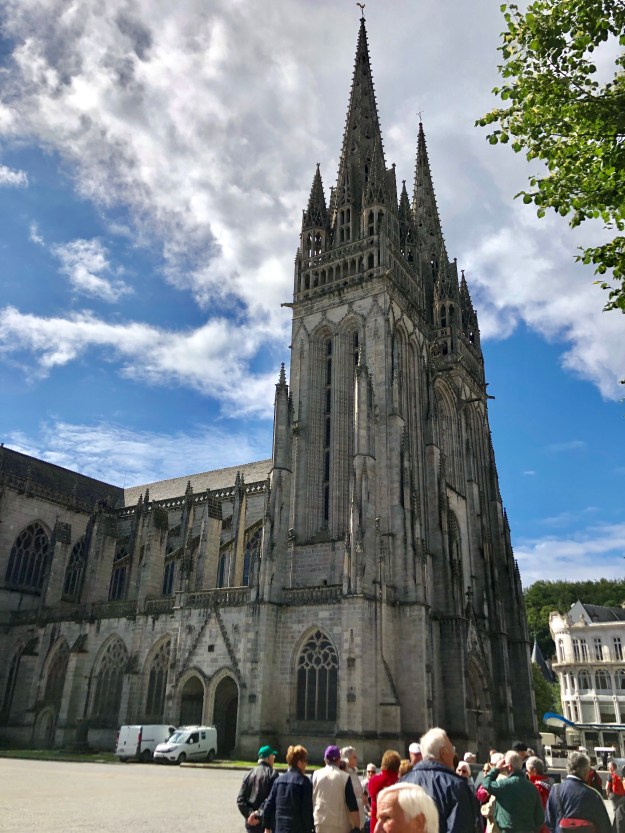
Its dominance, though, diminishes a bit when you enter. Looking straight down the nave to the chancel you notice a slight skewing to the left. This came from a decision in the 19th century to add the twin towers without compromising the 13th-century sanctuary.

They later said it represented the tilt of Jesus’ head on the cross. Nice try.

What this ‘head tilt’ did, though, was bother Max who kept wondering why they screwed up the comforting symmetry of a straight shot to the altar…

Next door we visited the Breton Museum located in the former Bishop’s Palace (built by the Rohans in 1508, the same family whose castle we toured on another road trip). We saw an excellent, temporary exhibit on the Gallo-Roman period following Caesar’s 56 B.C.E. conquering of the Veneti, one of the province’s five Gallic tribes. Armorica became Roman. One of the tribes, the Osismii (meaning ‘the furthest’ in Celtic, probably due to the western-most point of Gaul)  occupied what is now considered Finistère, one of Brittany’s four departments (counties).

The Romanizing of the former Gallic culture was evident in finds such as this Iron Age stele rechiseled to show Roman gods. Although, I doubt this stamped out worshipping of Celtic gods entirely…

These Iron Age steles were particular to western Armorica along with underground galleries close to settlements.

Going back even further to the Bronze Age, the huge supply of tin led to a huge production of goods.

Surprisingly, this mound of pristine axe heads was used for exchange and exporting, not for slicing and dicing.

After perusing early history we climbed stairs to the permanent exhibits, which seemed quite small and brief. On display were statues of several of Breton’s beloved saints:

Sainte-Anne  (Virgin Mary’s mom and Jesus’ grandmother) with two pilgrimages:  Sainte-Anne d’Auray (in Morbihan region) and Sainte-Anne-La-Palud (in Finistère region)

and Saint James (bro of John the Apostle) whose tomb at Saint-Jacques de Compostela in Spain is the second most important pilgrimage after Rome (note the scallop shell on his pouch).

More recent artifacts included: some lovey sculpture by RenéeQuillivic (1879-1969),
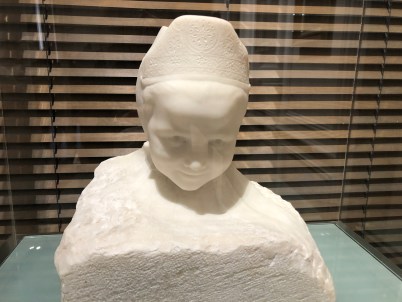
the traditional hats depicting the various regions,

the traditional ceramics started in this area in the 1600s,

and, the Swiss-army knife of beds:  the lit-clos or box-bed where you can sleep, sit on the bench, and stash clothes or other stuff in the chest under the bench.

Interestingly, even in Brittany, a relatively small geographical area, the design of these beds varied:  this one had two sliding doors popular in Cornouaille, whereas in Finistère the lit-clos generally only had one, while in Morbihan the beds were usually curtained off and half-closed with no doors.

We didn’t make it to the Musée des Beaux-Arts located on the square opposite the cathedral but did wander around to soak up the medieval-ness and beauty of this city.

And, to take advantage of you-know-whats ?:)

We left the next day to return to Roscoff back on the north coast. The only site on our to-see list involved a monastary called Landévennec located on the River Aulne. Unbeknowst to us ‘the land of priests’ is one of Brittany’s taglines, or so says one of our books. And, it’s not often we can see a group of live monks.

Set in a lovely wooded area,

we entered a modern church

and enjoyed the 2pm NONE, one of the Horaires des Office. I quietly clicked on recording for a short stint to capture, to me, a special moment. Not because I’m religious (just ask Bobbie, Ellen and Carter about that) but because those sounds create a haunting atmosphere.

We also found ourselves on the continuation of the GR 34, the 133km trail outlining Brittany’s coast.

Ending up on this trail off and on the past three weeks I think it’s a wonderful alternative to getting your scallop shell at Spain’s Santiago de Campostella. Although, in speaking with Cami, a local Breton (who had just finished two months on the Norman Trail) this coastal path may not offer much in the terms of convenient lodging.

On the road again we ended up taking a side tour to Locronan. The Grande Troménie (a 12-km trotting around of religious banners following in the footsteps of the 6th-century founder of the town, Saint Ronan) occurs every six years in early July, 2019 being the sixth year. Although we’d miss it, photos captured previous ones as costumed Bretons exited the church to begin their march.

With a history tied to canvas (supposedly even the Vikings shopped here for their sails) the town grew into a lovely medieval one. And, it’s well worth a stop no matter how brief.
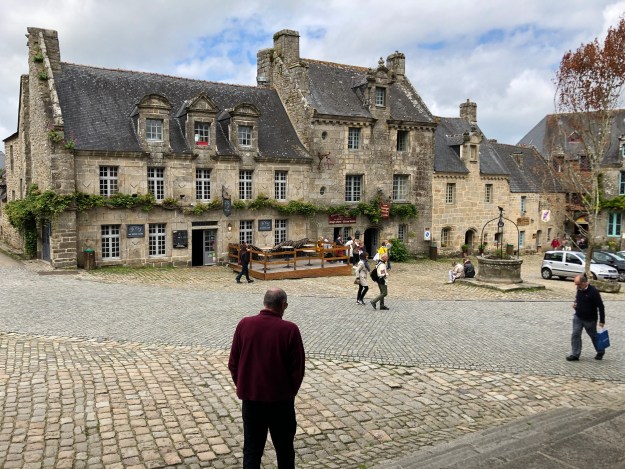
With that, we concluded our road trip in this part of Brittany and traded our wheels for sails.

But, not before one more photo from Roscoff. Now, that’s a head tilt… :)


BRITTANY: Part III

ROSCOFF and ÎLE DE BATZ

Sunday-Tuesday, June 9-18, 2019

After Lézardrieux we continued our trek westward, timing our departure so we would have a favorable current en route, and slack water when arriving at the next anchorage since it was up a  river.  We looked forward to getting to South Brittany which doesn’t have the high tides and strong currents that make sailing North Brittany’s waters so challenging, and limit the options when picking our next harbor and the time windows to get there.

Planning our route resulted in several hops, each one navigating one of the three sites of potentially unpleasant waters. We chose Roscoff, some 50 miles away as our next port of call.

Initially we hadn’t planned on stopping here due to some online reports from other cruisers. One that definitely gave us pause was this report (paraphrased):  We noticed how hard the tide was flooding through the marina. A boat approached and we watched him T-Bone our transom, causing substantial damage. The harbor staff told us, no wonder, we were tied up in the ‘danger zone’ at the extremities of the pontoons. Why didn’t they tell us that when we arrived?”

We also learned the new marina offset the docking difficulty by meeting incoming boats and literally pushing them into the berth (which we later witnessed).

However, we also read that approaching the harbor at slack tide (either at highest or lowest water mark) with little-to-no wind negated the need for the rubber-boat nudging; so, we coordinated our departure to coincide with favorable (low) winds and little-to-no current. And, all went well.

The marina still retains its newness with facilities being excellent (which means including a good laundry area :), friendly staff, and easy access to lovely town and old harbor.

The only oddity was grocery shopping required a bike ride (the marina rented bikes for boaters to reach it). Otherwise, whatever began as frozen or cold food would be quite warm by the time you deposited them on the boat. Yet, if you ended up there to provision, you may want to lug your laundry because we spotted an unusual (to us) service in the parking lot:

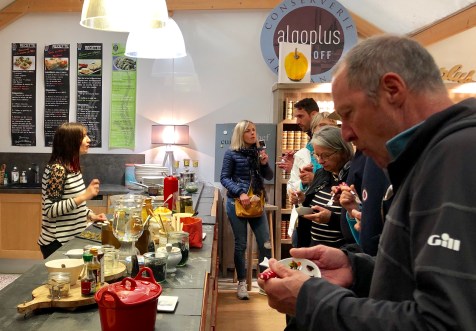
But, if all you desired was a taste of traditional Breton cuisine, shops sold tantalizing options: both savory and sweet items, including some from Algoplus, the local seaweed factory where we took a tour with Max getting a sniff of Nori…

IMG_E4980

all in French but, at least the tasting didn’t require language other than ‘yummy’ or ‘yucky’.

Like most cafes and restaurants over here, menus are conveniently mounted outisde, so you’re able to decide if you’d like to eat there before entering. Although, when checking out one establishment’s menu we noticed a strikingly unusual dish, which I’ll let you discover for yourself…

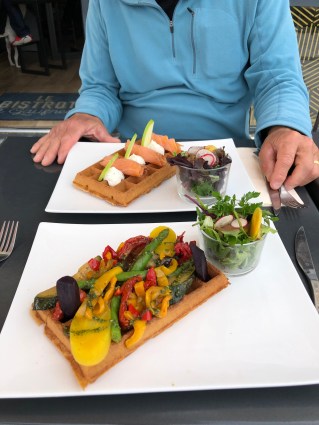
Additionally, walking just 15 mintues into town brought you to an array of local cafés offering crepes, galettes, or gaufres, the latter served at Le Bistrot a Gaufres, and where we ate three times (!) during our stay (we highly recommend the vegetable one :).

Or, you could order bread and pastries the night before at the marina office, retrieving it the next day beginning at 7:00a. We most definitely were in France :)

Unbeknowst to us we arrived as the marina was preparing for an annual event, one of the most prestigious sailing races in France:  La Solitaire; and, this year was the 50th anniversary, which raised the celebratory atmosphere a notch or two.

As the name implies it’s a single-handed race, meaning you’re on your own on the boat. Which may not sound too bad until you add in non-stop sailing for 72 hours or so  (implying 15-20 minute cat-naps for a maximum of two hours sleep every 24 hours) in the often atrocious tides, currents and weather of the English Channel. There are four separate races, each one more than 400 nautical miles. Oh, and no toilet aboard. Considered the world championship of solo around-the-buoys racing, and an unofficial qualifier for garnering sponsorships for the Vendee-Globe (the non-stop, around-the-world single-handed race), La Solitaire earns its reputation as an extremely tough race. It’s not surprising to notice the entrants’ ages appeared on the younger side…

Out of 47 entrants, only 7 are non-French. We were rooting for three of the non-French sailors (a Brit, an Irish and a Kiwi). The 2019 raced featured brand new high-tech Beneteaus equipped with foils (think ailerons projecting out from the side which help lift the boats to of the water to reduce drag). Unfortunately, this challenging race served as a shake-down for these new boats. We heard of several racers being penalized for replacing faulty screws with bolts for a plate covering the foils (which allowed water to leak, sometimes at a rapid rate, into the cabin). To us it seemed unfair to not allow this repair in order to make these boats safer for the racers.

We were in the pefect position to participate in the excitement of seeing these racers arrive after their second stage

with Max helping with lines as needed as boats began arriving en masse.

Wandering the pontoons we also got a glimpse of the preparation required for such a race, such as one sailor’s notes in his cockpit.

By the evening the boats added a festive look to the marina with the various sponsors’ logos in the rigging and on the hulls.

Thanks to hiring a ride on one of the many sight-seeing boats accompanying the fleet out of the harbor,

we watched as the fleet departed, jockeyed for the starting gun, and sailed off on their third leg.

But, the best aspect of the race for us was meeting Maria, Project and Communications Manager of Alan Roberts (www.AlanRobertsRacing.com), one of the few British sailors in the race.

We enjoyed her company immensely. We learned she, too, had raced, which is how she first met Alan. And, it was only asking further what she raced (dinghies) did we eventually get out of her she won the 2018 national championship with her crew Rob Henderson! I later read she also was, and I quote: ” the first female helm to win an adult fleet at a UK RS national championship since the RS classes were first established 25 years ago.”

If anyone needed a project manager who’s extremely capable, intelligent and personable, you’d be fortunate to have her on your team. Again, we only wish we had more time to spend with her.

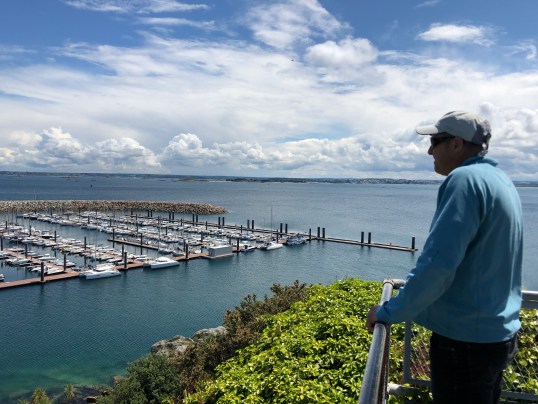
The race was only one of the attractions here. Directly above the marina overlooking the la Baie of Morlaix we noticed a viewing platform. We discovered it belonged to the Jardin Exotique et Botanique de Roscoff, which opened in 1986.

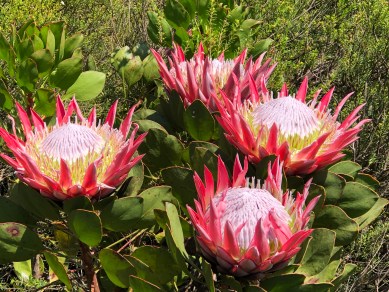
So, off we treked the short walk where we peered at various trees, shrubs, and flowers

Most of the signage had English translations, albeit cumbersome ones, and I especially enjoyed reading about the various professtional and amateur botanists associated with certain flora. Some of these  were placed in a familiar historical context such as Joseph Banks (1743-1820) and Daniel Solander (1733-82) who sailed with James Cook (1728-79) on his first voyage (1768-71).

Two others – Phillbert Commerson (1727-73) and Jeanne Barret (1740-1807) – caught my interest due to the unusual arrangement of their relationship. As the following so oddly explained…

Being the perfect day for outdoor sight-seeing, the view from the top was as promised: a perfect perch from which to gaze across the bay. If you could put the next three photos together, left to right, you’d have a look at the marina (in the middle photo JUANONA is almost at the end of the second pontoon from the left… not that you can see her!)

The village of Roscoff seems quite touristy but definitely provides visitors with examples of typical Breton architecture,

including its church, the Notre-Dame de Croas-Batz. Built over a 200-year period beginning in 1520 its belfry (double gallery with two tiers of bells) served as a prototype for many other churches we saw in Brittany.

One of Roscoff’s claims to fame involved a visit by a royal personage on August 13, 1548:  Mary Stuart, aka Mary Queen of Scots. She stopped here with her entourage from Dumbarton near Glasgow. At only 5-1/2 years of age she was aboard the Royal Galleon of the French king, slated for marriage. Supposedly she prayed at the chapel. Would have been fascinating to hear what she prayed for. I have a feeling it wasn’t for a couple of fresh croissants.

Standing at the quay in the old harbor you can see a lovely island called Île de Batz, one we decided to visit on a sunny day.

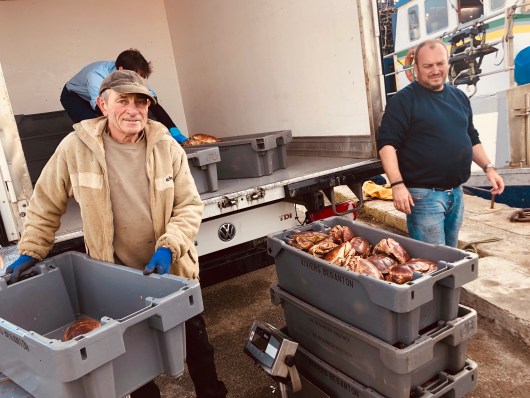
While waiting for the morning ferry we had a chance to see one of the fishing boats

unload its cargo of crabs. Crate after crate (10 days worth) came off the boat and, when weighed, loaded into a truck for their next destination. We wish we could have asked them where they’d been and more about the process but while they were friendly (agreed to a photo) they were busy.

By then the ferry was ready for boarding. After paying and settling into our seats we watched as other passengers (locals, tradesmen, and tourists), multiple sacks of mail, bread from one of Roscoff’s Boulangeries, and construction materials were laded. It reminded us of the daily runs of Casco Bay ferries and how they, too, served as life lines for everyday living on small islands.

Within 15 minutes we found ourselves walking amidst the ruins of a 6th-century monastery, subsequently replaced by later churches.

We continued our counter-clockwise circumnavigation on lanes and trails running parallel and perpindicular to potato fields. Stopping to watch one harvesting operation, the tractor driver waved us into the field where we could see up close how the machine pulled the potatoes from the earth after which two people (most likely his wife and one of their fathers) sorted the small from the large before dropping them into crates.

They agreed to a photo then proceeded with their work, and us with our leisure.

Within a mile we cycled into a broad expanse of green fields and blue sky with a stone house in the distance along with a bypassing helicopter.

Pedaling closer we saw a man working on a window frame.

Unsure if we were riding on a private lane, we tried to mime the question. When it looked as if he was coming down to see us, I thought he may not be happy of our interruption, especially if we missed any sign stipulating the path as ‘privé’.

Fortunately, that couldn’t have been further from his demeanor as he welcomed us and asked if we wanted to see the house (!). In the meantime his wife biked up, introductions were made, and off she went inside leaving us with our friendly host. From her patient manner I got the impression she’s use to his embracing strangers. If anyone remembers Ed Wynn in the first “Mary Poppins” movie, this Breton could be his brother.

In showing us around he told us it was his NYC cousin’s place, one that belonged in the family and used to be the island’s mill. Which made sense of the two towers standing at one end of the house, and the 360º panaramic view. He also mentioned it was available for rent.

If looking for a place to R&R away from it all (and with little distraction), this would be it.

Thanking him and waving goodbye we returned to our bikes and followed the larger trails that allowed bikes on them (although some requiring a bit of bushwhacking)

to scenic coves

and fields never far from the shoreline.

With a quick stop at the local store for some of those potatoes we saw earlier we completed our ride within two hours.

Catching the ferry back we were glad we took the early one over for there was quite a crowd waiting to board in Roscoff.

And, with the tide having gone out, we disembarked on the long ramp built to accommodate the 20 to 30 foot tides.

As an aside, it’s fascinating to see how local boats handle the outgoing tide. On Île de Batz, we scrutinized several small sailboats balanced on their keels and shored up by two poles on either side, ones they carry on deck.

In the old harbor we’d seen boats hanging on their lines as the water goes out. Check out the larger boat against the quay in the photo below,

and the ones pretty much sitting on the bottom of the harbor.

As we mounted our bikes, once again fishermen caught our eye.

Detangling their nets of various hues, they created a scene some of our artist friends would be happy to paint.

Before ever touching foot in this part of France, I associated blue-and-white striped cotton shirts as traditional French nautical apparel, and specifically, worn by those in Brittany.

Several companies made the most of this style as we saw in the ubiquitous, blue-and-white-striped-wearing tourists roaming the sights like we were. They are pretty cool, especially the ones of a heavier cotton weave, which last for a long time (as per my sister who snagged one when in Brittany).

However, I learned that this jersey or marinière became synonymous with not only sailors but also a unique Breton, the ‘Johnny’. This was due to a political cartoon created by a British artist in an illustration. And, I found that out was during our tour of La Maison de Johnnies.

This tiny but informative museum explained how Johnnies (called Petitjeans in Britain) crossed the English Channel in the early 19th century to sell their pink onions.

Henri Ollivier (1808-65) appears as the father of this trade when he sailed to England with his cago of onions. When reading about his successful green thumb* it’s not surprising to learn of his entrepreneurial spirit carrying him to Britain.

*In 1842 this enterprising Frenchman gained national recognition when his cauliflowers and artichokes took ‘1st Honors’ in a contest run by the Royal Society of Horticulture of Paris.

A combination of abundent produce in Brittany, lack of it in Britain, and overpopulation in Roscoff led to the seasonal exporting and selling of these tasty onions. Not only were they delicious but also had a long life once picked.

The museum explained the process of shipping …

stringing, the arduous job of creating the braided ropes (image the paper cuts doing that?!), which reduced the flow of oxygen increasing their preservation …

and selling these aromatic globes by walking or cycling door-to-door, both men

and children.

They concentrated their selling in Wales where shared Celtic roots made it a popular and natural market for the Bretons.

With the exception of a small nostalgic group, the Johnnies and their onion-selling have all but died out due to changing economics post-WWII. However, we did meet a Brit earlier this summer who recalled a visit of a Johnny at his grandmother’s home.

Now that you’re familiar with a Johnny, back to the shirts…

In the August 16th,1944 edition of PUNCH an illustration by Ernest Howard Shepard (1879-1976) appeared featuring “The Breton onion-man”.

Shepard used this figure to represent the human spirit of determination and strength of France’s resistance fighters during WWII. He dressed the man in patched trousers (characteristic of Johnnies since the 1800s) and the striped jersey or marinère, which the landsmen actually didn’t wear.*  But, thanks to Shepard they stayed a symbol of the onion-selling Breton.

And, if Shepard’s style reminds you of another illustration, you’d be correct in thinking of A.A.Milne’s tales about a lad, a teddybear who loved honey, and a whole gang of stuffed pals.

Shepard’s work created the first visuals of this heart-warming group in 1923 when Milne’s verses appeared in PUNCH magazine.  Although his work comprised subjects other than children’s stories, his connection with Pooh continued throughout his life. At the age of 93 he drew his last work when he finished 240 color drawings for the 1973 edition of WINNIE THE POOH.

*This shirt originally began as a naval uniform for seamen from Northern France. Designed in 1858, each stripe represented one of Napoleon Bonaparte’s 21 victories. Since Coco Channel popularized it in her 1917 nautical collection, the distinctive shirt has been worn by an array of personalities, from James Dean in the 1955 movie “Rebel Without a Cause” to Duchess of Cambridge in 2018.

So, when it comes to a momento of Brittany what better one than a marinère jersey? :)

BRITTANY: Part II

Road Tripping continued…

Wednesday-Friday, June 4-7, 2019

DINAN

Instead of a making a day trip we decided to spend the night in a quintessential medieval village: Dinan (formerly called Saint-Sauveru). [In the map below Lézardrieux is in the upper left where you see one of the rivers, and Dinan is far to the right at the end of the river next to St. Malo.]

Within an hour or so driving we reached this medieval jewel.

Founded in the 1st century on the banks of the Rance river, Dinan would grow into a commercial hub. Exporting food crops, and later hemp, cloth merchants became prosperous during the 12th and 14th centuries. A healthy middle class emerged and became more powerful thanks to the support of Jean the 3rd who granted the town special privileges to curry the bourgeoisie’ favor.

The town also attracted the reigning dukes: In the late 1300s Duke John IV built the Château de Dinan (unfortunately closed for renovations); and, in the late 1400s Duke Francoise II approved the building of a town hall and a municipal tower. In 1500 Duchess Anne gave them a bell, converting it to a belfry, one you can climb, which Max did (I went only part way up not wanting to be on the open-air balcony at the tippy top).

Of course, if there’s a decent-size town, there’s a good-size religious building. Dinan’s is a lovely one named St. Saviour’s Church.

A Crusader, the knight Rivallon le Roux, a member of the Lords of Dinan family, made a promise to himself to build a church if he returned from the Crusades. He did return, remembered his pledge, and called the church Saint-Sauveur.

Behind it an English garden flows to the town wall, built in the late 1700s,

where peering from one of the towers

you see the old town spread out below you.

Our first taste of Brittany’s famous crepes occurred here (Max eyeing our targeted lunch spot…)

and we quickly became hooked as we had crepes for both lunch and dinner. I really don’t know how these French folk stay so slim. If they’re not eating crepes or croissants, they’re eating a baguette the size of a bat. And, let’s not forget the cheese AND the wine. It’s tough trying not to follow in their footsteps.

We loved the medieval-ness of the town but a 21st century event really made our stay magical. Our hotel happened to be adjacent to the Jacobin Theater, During a quick scouting of the area Max noticed a dance performance being staged the one night we were in town. Figuring dance would allay any issues of not speaking French, we bought two tickets.

If you EVER get the oppportunity to see “Du Désir D’Horizons” (Desire for Horizons) by Salia Sanou, GO. Being modern dance the first minute or so when a lead performer just pretty much moved one finger or a toe I thought, ‘Oh, boy, this is going to be a long evening…’. Twenty seconds later I sat in awe and for the next 60 minutes watched chaos made beautiful by eight dancers whose limbs darted, crashed, and swayed across the stage. Minamalistic music added to the raw power on stage punctuated every now and then with some speech.  http://www.saliasanou.net/new/du-desir-dhorizons-2

I’ll remember Dinan for its ancientl setting, but more so from the magnificent performace we were fortunate to see.

ST. MALO

The next morning we left for St. Malo on the eastern edge of the Côtes d’Armor. This city is a favorite for sailors, as well as tourists.

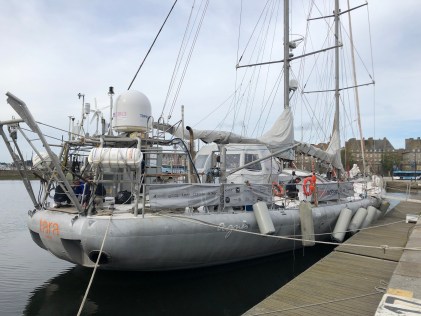
We parked in the underground garage next to the old city and stopped to take note of an interesting sailboat moored along the town quay. Conversing with one of the crew aboard we discovered it was used for research, spending three months to three years at sea depending on the project. They were prepping the boat for their next excursion:  studying microplastics, beginning in the Thames. Another reminder of the harm we’re doing to our world.

With that sobering thought we journeyed back in time to the 12th century when the fortifcation of this Ducal town began with construction of impressive walls.

In the late 14th century a castle, Château de Saint Malo, was added and it’s here we visited the city’s History Museum. Since most of it was in French and the displays seemed a bit dusty, we were in and out within the hour. Yet, we did grasp an understanding of the importance of cod fishing for the area. The ships would leave St. Malo for the Grand Banks of Newfoundland. Each ship carried 20 dories, each manned by a crew of two who would catch the cod and then return to the mothership to offload. Not a job I’d want.

Back outside we explored a bit more, first stopping in for a coffee at a restaurant made famous for its highly unusual decor.

I couldn’t help but laugh when I saw one item hanging in the window:

Ellen, Liza and Tracy, do you remember your Patty Playpal :) ?

Fortified, we joined the busloads of tourists checking out shops and eateries along cobblestone streets. Then we escaped the masses by climbing the steps to the lovely promenade on the impressive town walls wreathing the old city.

During our wandering Max eyes lit upon a fruit we’d been searching for: pomegranites!

Thanks to our friends Sue and Carol W. we’ve been making two delicious quinoa meals, one requiring the bulbous seeds of those lovely pink globes.

Yet, after Max started picking several out of the crate, the proprieter came running towards us stating they weren’t for sale. And, it’s then we looked at the storefront and discovered it’s a cafe selling smoothies (with a sign stating ‘please don’t touch the fruit’). In other words, they, too, were using them as a key ingredient…

This town definitely deserved more than the cursory few hours we allotted, but having seen Dinan and anxious to continue our explorations elsewhere, we returned to our car and headed for less Disneyesque views.

PAIMPOL

Our final stop of the day involved the amazing display of this coast’s tidal waters. Several cruisers have recommended the port of Paimpol as a unique opportunity to experience the complete draining of a harbor. However, we subsequently heard stories that made us rethink heading there with our deep-draft boat. Basically, there is no margin of error if you miss the high water mark to enter the port. To paraphrase British sailor Mike’s experience, whom we met in Guernsey, and who misread the tide tables and had to beat a hasty retreat to deep water:  “when you can see the eyes of the crabs under your keel you realize it’s not a good time to be there.”

Which is why we opted for the safe ‘cruise’ on land where happy boats float on one side of the lock…

while the other side is not so likely to float one’s boat.

And, after witnessing the incoming sailboats endeavoring to dock alongside or in berths, I am so willing to wait for the perfect tide + current combo, or as perfect as we can get them.

It’s no wonder this area breeds excellent sailors. Like we did in the Channel Islands, we have to plan our exits and entrances to coincide with the tide and current.

If we ever think of going against the current at its peak all we have to do is remember watching a sailboat trying to dock recently. First it appeared as if they’d be coming alongside with no problem only to see them moving horizontally as all on aboard quickly assess how to get the boat pointing back towards the dock. Once they manage that, it’s a fight to land without the bow hitting the pontoon first. When they’ve finally reached the dock and someone is able to jump off (or toss their lines to a person on the dock) and wrestle to slowly inch the boat closer to finally allow all to breathe a sigh of relief and the captain cut the engine.

I know it sounds crazy but we’ve both been helped (thankfully) and have helped boats to dock. At times a boat feels like a bucking stallion. And, god help you if you mess up tieing the lines!

PAIMPONT

Thursday was our last day with the car. Heading back towards Lézardrieux we stopped at the enchanting Fôret de Paimpont. The forest is known for its ties to the Legend of King Arthur and Camelot and his sidekick Merlin (and Max).

Supposedly he found Excalibur here. Although, I think it more likely he located some good cider and an abbey.

The Paimpont Abbey sits next to a lovely lake and dominates the small village. Like most of these religious structures it began as a much smaller version in the 7th century when missionaries seemed to flood the area. The Normans knocked it down, resulting in a rebuild during the 9th century. Four hundred years later, the abbey acquired its Gothic style with add-ons and renovations occurring during subsequent centuries.

Similar to other churches we’ve seen in Brittany, the roof resembles an upside-down ship’s hull. And, it’s made of wood versus stone, which is unusual.

While in Paimpont we met a charming Irish cyclist who uses the summers to recoup from a hectic winter of musical work including teaching and touring with musicals. Ger (short for Gerald) had two weeks to explore this area and was making the most of it without brutalizing himself. We wish he had more time or was closer in his circuit to JUANONA for he would have been great to have aboard for a night of conversation.

JOSSELIN

We then  headed almost due west to Jossselin and its Château. In the 11th century a viscount built a fortified town here in the Oust Valley; but, it didn’t last too, too long because the English King Henry II (same guy who built the Dover Castle and took Eleanor de Acquitaine as his 2nd wife) destroyed most of the château in 1168 when the feudal Bretons opposed him.

Two hundred years later the rebirth of what was left of the building began after a swap between the Count of Alençon and the High Constable of France. The latter, Olivier Clisson, proceeded to strengthen the defense by adding three towers along the riverside

and one more as a stand-along (which looks like a perfect Rampuzel residence if you note the little red door).

What amazed me, though, is that the current owners are related to that original Clisson. Can you imagine someone doing their geneology being able to trace it back to this house?!  When Olivier died in 1407 the renovations continued via his grandson, Alain IX de Rohan, and great-grandson, Jean II.

However, once again, revenge caused massive damage to the place in 1629. This time that marvelous spiritual guidance, i.e., religion, was the culprit when Cardinal de Richelieu didn’t take too kindly to rebellious Calvinist Henri de Rohan. Rumor has it the Cardinal snidely quipped to Henri, “Sir, I have just scattered your skittles.” And, he most obviously wasn’t talking about the candy.

Daily tours were available, and we joined the group after the guide provided a quick background. ‘After’ because it was all in French.

With no photography allowed inside we contented ourselves with exterior shots

and referencing an English brochure.

In the write-up we learned…

The ‘Battle of the Thirty’ in 1351 occurred close to Josselin during the ‘Deux Jeannes’ war (Brittany’s Civil War). The fame derives from being seen as the most chivalrous battle in history (Encyclopedia Britannica.com). It began when the governor of Brittany (supporting the French House of Blois) challenged the Captain of Ploëmel (supporting House of Montfort) to a fight composed of 30 soldiers per side. The governor eventually won with both sides suffering heavy casualties while ensuring the prisoners of the losing faction were treated well and released (The House of Montfort eventually won the overall war.)

A more recent tidbit appeared in the form of a contemporary portrait of Duke Alain de Rohan, father of the current owner. I hadn’t heard of him but some of you may have:  his friend, the American artist Trafford Klots (1913-76), painted it in 1966. Just one more reminder of the longevity of Olivier’s DNA…

I convinced Max to purchase the joint ticket so we could visit The Musée de Poupées, a collection of puppets and dolls by Herminie de Rohan during the 19th century with more recent donations reflecting current times.

Having read in THE LONELY PLANET guidebook it was, and I quote:  “more interesting that it sounds!” I thought it could be fascinating.

Hah! Fascinating if you, too, collect dolls. However, it provided some light-hearted (and extremely fast) viewing resulting in naming some of them myself, such as…

The guilty one…

Big-headed Gulliver


Religious salesman

Bad Hair Day Lady

Temper Tantrum Tess

Juvenile on my part, I know. Okay, EXTREMELY childish.

CHÂTEAU DE LA ROCHE-JAGU

Our last stop made us wish it could have been a longer one. On the outskirts of Ploëzal Château de la Roche-Jagu sits above the Trieux River, only a couple miles up from where we’re docked in Lézardrieux. Built as part of a ten-fortress defense in the 15th century, it’s the only one still standing.

And, it’s stunning with its stoic facade juxtaposed against lovely gardens.

Renovated by the Côtes de l’Armor county council, the château and grounds host exhibitions and performances. Our late arrival precluded anything but a brief visit, but we met a teacher who takes his young students here annually. He kindly walked with us to the magnificent viewing platform and explained this location was strategically important for hampering any Viking raids coming up river. Standing where we were it was easy to understand how.

After he left we strolled through some gardens. In one we spotted an Insect Hotel.

A bit bizarre, but, then, we’d seen one earlier in the day just outside of the Château de Josselin.

Hey, if I were a bug I’d be booking in at one of these hotels that sit within buzzing range of a château.

Our time in Lézardrieux was coming to a close with a forecast of a good combo of wind and tide. However, our next port isn’t too far from here. And, we’re looking forward to more adventures in Brittany!

Next, more medieval-ness and an amazing sailing race…


CHANNEL ISLANDS: Part III

GUERNSEY (continued…)

Thursday-Thursday, May 23-30, 2019

We didn’t only do indoor touring as these islands offer a gorgeous backyard in which to play.

We had heard of two beautiful islands close to Guernsey–Herm and Sark. Daily ferries connect to both for day tripping, and based on some friends’ recommendations we decided on Sark.

The island is populated by 600 people, not including the seasonal influx of tourists, animals–both domesticated and wild

IMG_E4141

(saw a rabbit, Deborah, and thought of you :), tractors, horse-drawn carts,

and bikes. What we didn’t see are cars, which are not allowed on the island ensuring lovely cycling roads–when not avoiding the tourists, animals, tractors, horse-drawn carts, and other cyclists.

We saw a few of the formal sights such as the local prison,

and the 17th-century La Seigneurie where two of the three ruling families (seigneurs and dames) lived.

Not quite understanding exactly who these Seigneurs and Dames were, I learned about one of the more recent ones when stopping in at the Tourist Information (TI) Office. There I read about the Nazi Occupation and the formidable and feisty Dame Sibyl Hathaway (1884-1974), the feudal overlord who inherited the position of Dame when her father, the Seigneur, died.

Wanting to learn more about this Dame, I found a wonderfully entertaining article, which is definitely worth reading if you’re interested.

During her lifetime Dame Hathaway fought to maintain Sark’s bucolic way of life, one established way back when. She did so with comments such as, “If it was good enough for William the Conqueror, it should be good enough for us”. After reading the above-mentioned article, this pronouncement gives you a pretty good idea of why she could be labeled ‘feisty and formidable’.

Speaking of good ole William, feudal laws followed under the Normans still existed well into the 1900s, which is how Sibyl inherited her right to govern over the other islanders.  This changed in 2008 with elected officials replacing this hereditary position, but not necessarily voiding all of the Dame’s ‘rules’ as cars are still not allowed on the island…

Similar to other islands of intoxicating landscapes, Sark has attracted its share of artists. Prior to WWII some set up their own colony calling themselves the Sark Group. They built their own two-story studio and gallery, which today serves as the Post Office and store. We saw some of their art work on signage in the small TI office. Every time I read about creative retreats such as this one I think of our artist friends and how they would soak this up.

The painting above captures one of the most spectacular views on the island. It appears when crossing to ‘Little Sark’ via a manmade bridge (repaired in 1945 thanks to Dame Hathaway’s use of German POWs from the occupation).

In spite of quite a drop on either side my fear of heights didn’t keep me from enjoying the 360º vista.

Although, I do admit the handrail came in handy every now and then as we walked our bikes across. Walked because riding wasn’t allowed.

I can’t tell you how much I loved exploring this island. And, I can’t specifically state why except to believe it came from riding down country roads under a sunny, blue-sky day, poking here and there, stopping for refreshments (yes, coffee) while engaging in conversation with other contented souls, and just literally ‘being’. Talk about lucky.

The only dark cloud above Sark, and not one tourists would necessarily know about, comes from the recent domination of two landlords, the billionaire Barclay twins. In 1993 they purchased Brecqhou, a little island NW of Sark and proceeded to build a huge Gothic castle. Subsequently, they bought/built four hotels on Sark and also planted a vineyard (in an area not necessarily noted for its fine wine…).

With all of this wealth they exhibited the typical 1%-ers behavior:  we later heard of the Barclays helicoptering in a head of lettuce from their Ritz Hotel because it was organic. It better make some good salads if that’s how they’re doing their grocery shopping.

Being the wealthiest islanders they aimed to mold Sark into their own private fiefdom. They bullied the islanders into changing an inheritance law, reducing Brecqhuo’s taxes, and challenging the centuries-old rule of the Seigneur (or Dame). The latter the Barclays said wasn’t democratic enough. But, then, after the 2008 voting in of a democratically elected chamber they threw a temper tantrum when their candidates weren’t voted in. For revenge the twins shuttered their businesses  (tossing over 100 locals out of work). They reopened them later only to close them again. Trust me, it gets complicated.

For visitors, though, this friction seems pretty muted.  We learned of only two signs of this divisiveness: (1) when our waitress said they had just opened after four years of closure,and, if the Barclays felt the business did well, they’d remain open;

IMG_4128

(2) the withering grape vines we passed cycling out of town. But, as I said, we didn’t feel any simmering undercurrent during our short stay.

Returning our bikes we walked down the steep hill back to the ferry dock, feeling completely sated with a summertime joy.

You don’t have to go off island to appreciate Guernsey’s outdoor attractions.

The town itself provides interesting walks. A maze of cobblestone streets and stairs wind up and down the hills. It seemed we were always going up or down some incline.

Yet, any climbing resulted in a lovely view over the city.

Even after a week of going places in town I still couldn’t tell you the most direct way to reach anywhere. Other than our coffee place, of course.

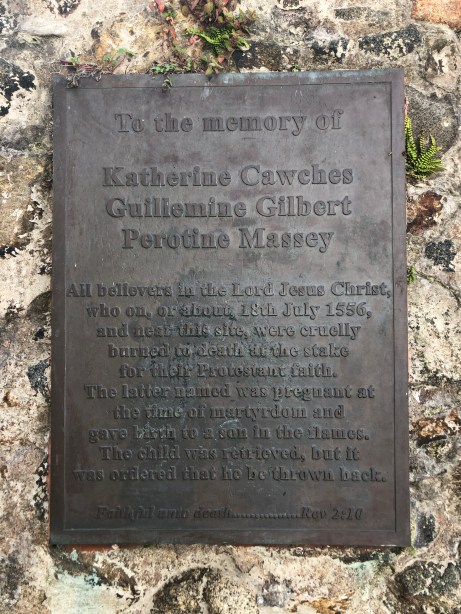
During one of our first self-guided tours around town we passed a plaque on Tower Hill. It was one of the most disturbing ones I’ve seen, for it marked the spot where a mother and her two daughters, one being pregnant, were burned to death for their Protestant belief under Bloody Queen Mary’s rule.

To make it even more horrifying the daughter gave birth during the burning, and the executioners decided to throw the baby back into the fire. Makes me sick just writing this even now.

When discussing this with the minister mentioned in my earlier Guernsey post he said people were horrified to hear this and determined the islanders needed to be educated. So, when reigns changed from Mary to Elizabeth I, the Elizabeth College for Boys was established by the Queen in 1563.

A much pleasanter walk took us to a peaceful oasis in the middle of town where stunning photographs serve as part of the flora.

Candie Garden, perched on a hillside in the north part of town, drew us to another spectacular piece of St. Peter Port. We didn’t visit the Guernsey Museum and Art Gallery there but did see a statue dedicated to its famous exile-er.

I had mentioned in Channel Islands: Part I the best-seller, THE GUERNSEY LITERARY AND POTATO PEEL PIE SOCIETY, as being one of my few sources of information prior to arriving here. Set during the Nazi Occupation 1940-45 the story features landmarks existing today.

I found reminders of this book scattered throughout the town, which isn’t surprising considering the tourism board has embraced this novel whole-heartedly. They’ve even created a ‘passport’ you can get stamped in various locations.

Adding to that, one of the walks promoted in their “Tasty Walks” guide book features a city trail dedicated to locales associated with the book’s characters.

That guide book turned out to be a great resource. We didn’t really do any of the 20 self-guided walks but wish we had, especially after circumnavigating the island on the public buses.

Halfway around we had to switch buses, and while waiting we noticed a wetsuit throng of little ones hoisting surfboards for a lesson. Whenever we come across surfers I always think of my Nags Head family who, for sure, would have been catching waves if they were here. Those wetsuits would come in handy as I believe the water is about the same invigorating temp as Maine’s.

We ended up taking a trail on the south side of the island, and the scenery was stunning.

Being a Bank Holiday Weekend plenty of other visitors were out and about strolling the streets. Especially the one fronting the harbor featuring an annual fair. A mushroom of tents had sprouted up over night and now offered a range of wares from ice cream to pet accessories.

IMG_4112

And, no surprise seeing dog collars and catnip for sale:  tThe Guernsey SPCA sponsored the fair. Which also accounted for the appropriately dressed folk playing ball.

IMG_2720

The day also offered one of our favorite activities:  sticking our heads out of head holes…

Being in a harbor where boats appeared to come and go as often as the tide we met some fabulous folk, both visiting cruisers and locals:  Karen and Jean-Luc; Elie, Jan and Mike; Sadie and Denis; and, the local port captain of the Cruising Association, Richard. And, being sailors, they kindly shared their knowledge of ports and anchorages assisting us in where to head next.

This port didn’t lack for boaters, especially with the number of regattas. We’d go to bed on an almost-empty pontoon only to wake up the next morning surrounded by a boat load of racers, some even rafting to us in the middle of the night. Definitely added a higher level of energy to the harbor.

Experiencing some of the Channel Islands I was amazed we hadn’t really thought of them as a vacation destination. The lovely outdoors combined with a distinct cultural experience felt similar to visiting the Azores, another European archipelago (albeit a bit further away from the mainland).  Although, we had heard more cruise ships were popping into the harbor here, which explained the American accents we heard when walking in town or riding the buses.

In speaking later with a resident, she said tourism had actually decreased since the heyday of the 1950s, 60s and 70s.

During those decades these islands served as an exotic destination for Brits who wanted sun and beaches (and there are some amazing ones here) while also enjoying the ease of an English-speaking country. Furthermore, frequent ferry runs between the mainland and islands ensured convenient transportation.

Yet, as the Brits began to venture further afield to Spain and other countries offering similar amenities, and sometimes for less money, the Channel Islands lost a lot of their visitors. Now an emphasis is on marketing these islands resulting in an increase in tourism, one of Guernsey’s main economic drivers. 

So, if you’re looking for a relaxing spot to stretch your legs and treat your eyes, consider the Channel Islands. And, if you do, please say hello to Mrs. Tiggy-Winkle for me :)


CHANNEL ISLANDS: Part II

GUERNSEY

Thursday-Thursday, May 23-30, 2019

With decent winds we left Alderney for the 24-mile sail to St. Peter Port (aka, Saint-Pierre-Port), the capital of the Bailiwick of Guernsey, which is one of the three Crown Dependencies of Great Britain.

After 5 hours we arrived at the harbor entrance, requested permission to enter and did so after waiting outside while a large ferry docked. Next we waited for one of the marina skiffs to guide us carefully to one of the floating pontoons.

We opted for those docks in lieu of Victoria Marina, an interior harbor protected by a sill from low tides*.

Originally planning on getting a berth in the marina, we decided not to risk crossing the stone barrier:  some cruisers in Alderney mentioned they had heard of a boat with the same draft as ours (2-meter or 6’ 6”) getting stuck on the sill (!). No thanks. Plus, the pontoons were only a three-minute walk from one of the main streets.

I have to say living in Maine one gets use to tides and steep ramps to and from floating pontoons, but in this neck of the woods, they can get a heck of a lot steeper…

which is why many boats are built to sit on the ground when there’s no water under them.

JUANONA, not so much.

*A sill is a barrier that captures a harbor’s/marina’s water at high tide and retains it during low tide. Basically, just think of it as a bathtub for boats.

And, in spite of the rather tired and dingy appearance, the showers provided luxurious hot water with strong pressure (similar to Alderney’s) and appeared surprisingly clean. Actually, even the public restrooms throughout the islands seemed exceptionally clean. No laundry facility at the marina, but we found one in town easily enough. With a supermarket nearby, plenty of buses and ferries within a five-minute walk, and a great Tourist Information (TI) Office just across the street, the location offered everything we needed. Oh, yeah, and a great coffee shop, too :)

Doing some quick research online we discovered a fabulous treasure in St. Peter Port–Hauteville Maison, also known as Victor Hugo’s House.

Having visited his apartment in Paris a few years ago, to tour his home here seemed a no-brainer. Especially since this is where he wrote one of our favorite books and musicals, LES MISERABLES. Just writing that makes me break out in song, lucky for Max it’s not out loud.

Reading that they required reservations and noting none available until the following week, I thought we’d miss seeing it. But, the lady at the TI suggested I try calling, and, voila! a last minute opening for the hour-long tour was available.

The house had actually stayed in the family until 1927 after which Hugo’s granddaughter and the children of his grandson donated it to the City of Paris. When water leakage damaged the interior, the billionaire art collector, François Pinault  (also, a key benefactor of the Notre Dame roof re-build) funded the entire, 3 million-euro renovation in 2018. Fortunately, careful restoration left the house the same as when Victor Hugo lived here.
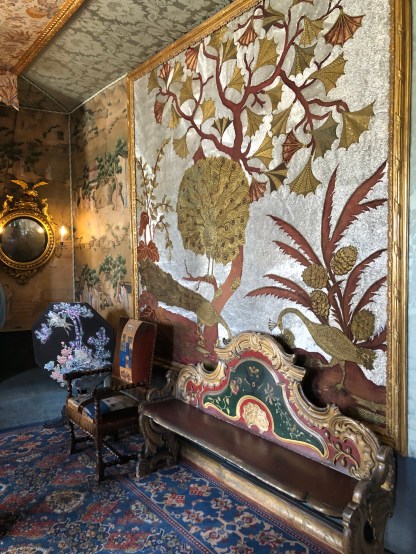
Not being up on the details of this novelist/poet/dramatist/artist, we learned that Victor Hugo’s (1802-85) political beliefs morphed over the decades, from supporting the monarchy to opposing it. The latter occurred when Louis-Napoleon Bonaparte (1808-73) threw a tantrum over the one-term limit of his presidency and staged a coup d’etat. Having a way with words, Hugo coined the derogatory (but, one must admit, clever) phrase, “we have had Napoleon the Great, now we have Napoleon the Small”, a none-too-subtle expression of his feelings towards Louis-now-self-titled-Napoleon III.

He (Hugo, not Emperor 3) avoided arrest by heading to Brussels in December 1851. But his stay was short due to the proximity to France and a formal decree of exile, so he left for Jersey in 1852 where other non-Napoleon III supporters lived.

But, Hugo obviously knew how to p_ _ s off royals. An unflattering article about Queen Victoria’s visit to Paris in 1855 caused his next boot out of a country. Not that he wrote it; but, the article penned in London was re-published in a Jersey paper by some of his fellow exiles. When they were expelled from that Channel Island, Hugo decided to also leave in a show of support.

He moved to the nearby island of Guernsey in 1855 and with the success of THE CONTEMPLATIONS, a poetry book, he purchased the house in 1856. And proceeded to decorate it. And, boy, did he decorate.

Arriving before our scheduled tour, we had access to his backyard,

and, while Max enjoyed the ambiance here,

I went on the hunt for a cup of coffee, which I found just up the street in a hotel with another lovely garden view.

A young guide with a lilting French accent (of course) led our small group of ten through the public rooms where he entertained:

the Billards Room with family portraits and drawings…

the Tapesty Room wallpapered with oriental rugs (a small sun-lit room next door offset this dark one)…

the Dining Room with Dutch Delft tiles, and where he provided meals for the city’s poor children,

along with lessons of life, which were also carved into the decor.

Stairs to the first (what we call second) floor landed us in an elaborate hallway off of which were two richly,(overly so in my opinion) decorated lounges for more entertaining,

with one end of the two rooms suitable for presenting plays.

Then to the second (third) floor where the hallway served as his library, which included one of the first ever editions of an Encyclopedia…

and opened into a large study and bedroom, but one he never slept in.

To the tippy-top third (fourth) floor where he did actually sleep…

and work (this is the room in which he was sitting in the sepia photo above…

and where, finally, I would be able to rest if I lived here) as he looked out to his garden and the sea beyond to France.

Throughout the house the guide pointed out Hugo’s fascination with Chinese culture,   one shared by others during this time.

(Ellen, note the peacock :)

I can’t imagine how wonderful it would be for those who had studied this man’s life and work because for me, not well-versed on Hugo, this tour was fascinating and a definite highlight of our time here.

Unlike some of our other cultural visits we didn’t tour a lot of museums here. Actually, as I write this, I realize Hugo’s house was it as far as museums go. We did, however, do a quick stop at one other building, also overly decorated:  the Little Chapel.

We reached this little (and, it is wee) site after a 30-minute bus ride to the center of the island.

Along with a group of other curious tourists we hopped off to stroll the one-minute walk to a building festooned with broken pottery shards.

Inspired by a similar chapel in Lourdes, this grotto chapel was the third one begun by Brother Déodat. His first one (9’x4.5’) was too small as was his second (9’x6’), and I love this–he decided the second one didn’t fit the bill when the Bishop of Portsmouth couldn’t fit through the door.

The one we toured measures 16’x9’, and, as you can see, we easily stepped through the opening.

Being un-consecrated anyone and everyone can mediate/pray/worship/perform miracles here. And, visit for free with donations accepted.

It is lovely it its kitchyness and fantastical mosaics,

It’s also where Max caught the spiritual glow.

As I said, basically you could walk through the chapel

and out the door

in 20 steps.

We could have dwelled a bit longer but…. And, evidently we weren’t the only ones feeling as such because we joined the same stampede of visitors who caught the bus out with us who were now determined not to miss the next bus heading back. Otherwise, we’d all have to wait another hour and there’s just so much cemented pottery shards I can take at one time no matter how devotedly placed.

Another day, while waiting for our coffee place to open we popped into a larger place of worship, the Town Church.

Spotting a guy who appeared to give impromptu tours we asked him about some mounted plaques. For the next 15 minutes he entertained us by pointing out some of the more interesting of these memorials.

When I asked about a rather prominent one for The Very Reverend Daniel Francis Durand and noted it was pretty cool he was the son of the guy who headed up Canterbury, he laughed and corrected me saying,’no, that was something stated to make him sound important:  he wasn’t literally the son, he simply came from there.

He then walked us over to the memorial of Captain Nicholas Messier, a privateer (aka pirate) who fought the French. Our informal guide appreciated the hypocrisy for he said isn’t it wonderful how someone is lauded by the same people who could just as easily have treated him as a criminal. I think I could use this guide on all our tours…

One of the largest plaques immortalized one of the most famous islanders, James Saumarez, Lord de Saumarez. He fought with Lord Nelson in the Mediterranean, though not at the Battle of Trafalgar. The two officers had a strained relationship, and our guide mentioned it was due to Saumarez not approving of Nelson’s romantic liaison with Lady Hamilton. As our host stated succinctly, ‘Saumarez was a prude.’

Our last critiquing of these plaques concerned one dedicated to Rear Admiral Thomas Saumarez Brock (his father being another famous islander, Isaac Brock, who defeated the Americans when they attacked Canada during the War of 1812) and his wife and her eldest son. Here we learned their daughter used plundered marble from the Roman Temple of Diana in Ephesus, a famous ruin in Turkey… and, bragged about it.

It’s also when I noticed a clerical collar peeking out from our guide’s sweater.

I left that church thinking now, he along with a few others, is a minister whose sermons I wouldn’t mind listening to. Nothing like some irreverent humor to spice up one’s Sunday :)

Next, the great outdoors…

CHANNEL ISLANDS: Part I

Getting there

Monday-Tuesday, May 20-21, 2019

To lessen the miles (and help with any adverse current) we left Lymington and headed to Studland Bay, an easy 17 miles away. As we passed the Isle of Wight the three formations of chalk and flint called the Needles came into view.

Although, to me, ’The Molars’ would be a more appropriate moniker.

Reaching our destination, startling white cliffs greeted us reminding me of how much we enjoyed our first visit here in 2014. One of the reasons being Studland Bay was the only anchorage we had while cruising the south coast of England due to being a coastline relatively devoid of safe places to drop one’s hook.

The anchor dropped quickly and smoothly, always a relief when performing that exercise the first of the season.  Pulling it up made up for the ease of dropping it as the current pushed JUANONA forward while the anchor chain pulled backwards. But, the windlass (anchor motor) won out, and off we sailed to Alderney, the northernmost island of the Channel Islands.

You could count my knowledge of this archipelago in the English Channel on two fingers:

(!) They are not part of the EU, which means non-EU boats can check in here to reset the VAT clock (avoid having to pay VAT tax on the boat) of 18 months. Considering the other possibilities to reset the VAT are Norway and Morocco, this land mass offers a valuable service to yachties. If we didn’t have our import of JUANONA under our Dutch temporary residency, we’d also be very thankful for this (and our visit here will serve as a backup for difficult bureaucrats)

(2) The 2008 book, THE GUERNSEY LITERARY AND POTATO PEEL PIE SOCIETY, that swept the U.S. book club repertoire described a brutal Nazi occupation during WWII.

So, I checked online to find a bit more background on the Channel Islands…

Romans visited the islands followed by Christian missionaries (which may be why the largest cities on the islands all start with “Saint”?) in the 6th century. In the 9th century Norse invaders took over the islands and they became the property of the Duchy of Normandy. By the 10th century the islands came under English rule when William II of Normandy (aka William the Conqueror) became William I of England after the Battle of Hastings in 1066.

A jumbled history of English and French stakes to the islands occurred over the next eight centuries, resulting in a split of the islands into two Crown Dependencies:  the Bailiwick of Jersey (the largest island) and the Bailiwick of Guernsey (the latter covering Guernsey as well as Alderney, Sark and some smaller islands).

Not to go into too much detail (and, frankly, I don’t think I could untangle the snarl of who-ruled-what-when well enough for myself, much less you), the islands are self-governing but are still ‘possessions’ of the United Kingdom. They print their own currency (1:1 to the British pound), and have their own courts and administration. (FYI:  there are three of these Crown Dependencies, the other being the Isle of Man.)

Jersey (population 100,000+) and Guernsey (pop. 63,000+) are the dominant islands with Alderney (pop. 2,000), Sark (pop. 600), Herm (pop.60), Jethou (and, I love this:  pop. 3) and Brecqhou forming the primary grouping, with much smaller iles dotted around.

Fishing, quarrying, mining (silver), and agriculture (cows) formed the economies, with tourism now being one of the largest money-makers.

Obviously, I’m missing a lot of history here but you, at least, know as much as I do (and, probably more if you’ve read about this area).

So, now to our first island…


Alderney

Tuesday-Thursday, May 21-23, 2019

Current and tide rule the boating world around here. No wonder when there are 10+ meter (33 ft+) tides which can create currents of up to 5 knots or more. The high tide range significantly limits anchorage possibilities, which is one reason there are so many shallow-draft boats around here which can ‘take the bottom’ (ie they can dry out and stay upright on ground when the tide goes out).

When we left England we set a heading of 190 degrees, a straight line into the town of St. Anne at Alderney, 56 miles south-south west of us. But, as you can see from the chart plotter, the current pushed us almost 40º to the east giving us a course over ground (COG) of 150º and moving the bearing to Alderney to 205 degrees and eventually even more.

It wasn’t until a few miles from our destination that our COG came close to matching our set heading. As these two photos show, our track simulated a drawn bow.

We picked up one of the many guest moorings and the next morning hailed the water taxi operated by one of the many friendly locals we met during our two-night stay here.

Expecting more deserted harbors the number of other boaters (mainly, a lot of guys enjoying a boys’ cruise it seemed) surprised us. Yet, sailing season starts early over here. Although, we still had plenty of time to peruse this area of the sea before the huge bubble of boaters when schools let out in July and August.

Within 90 minutes, we managed to snap a photo of the interior harbor,

climb the steep hill to town center, eat a lovely breakfast (some of the best coffee ever) at Jack’s Cafe (highly recommended),

rent electric bikes (and, we agree with Colleen:  they provide the perfect spurt of energy when needed :), and clear Customs after lowering our official yellow quarantine flag we had raised prior to entering.

Speaking of Customs, we asked the officials to stamp our passports. Now we felt doubly ‘legal’ for not only did we have our temporary Dutch residency covering us for Schengen and temporary import of JUANONA but also official exit from the Schengen zone.

In addition to the official paperwork we will also retain receipts of our Channel Islands marina andharbor fees to prove our temporary exit from the European Union for any future official questioning. This pertains to diesel fuel as well, for some countries require proof that we didn’t cheat the system by buying fuel while claiming it was for commercial use and therefore exempt from tax.

Official business completed we hopped on our rented bikes for our jaunt around the island under a brilliant blue sky and warm sun.

Although it’s not my area of interest, anyone fascinated by military equipment and defense should visit here. Known as one of the most heavily fortified places in this part of the world, Alderney boasts over 30 forts, batteries, bunkers and armories seemingly on every headland, 18 of which the Victorians constructed between 1850 and 1860.

Within two hours we had easily biked and toured various landmarks around Alderney, espying a rookery of gannets,

spotting an immense fog horn located on top of Mannez Lighthouse, built in 1912…

reading the plaques in English, French, Polish, Hebrew, Russian, and Spanish on the  Hammond War Memorial commemorating the forced laborers who lost their lives here during the occupation…

and recognizing a name used for Rod and Jo’s famous log on Sleeth Island :)

As we continued our cycling the circumference of this island we couldn’t avoid reminders of how heavily fortified this island became. It seemed every few miles we’d come upon some sort of military structure. Many, if not all, of which the Germans repurposed during WWII.

To obtain a more in-depth education about Alderney we visited the local museum;

and, it’s well worth visiting, beginning with the lovely lady greeting us. She was happy to have us since it seemed we represented 50% of the museum’s visitors that afternoon. We were joined by another couple from the states, two friendly gentlemen ending their three-month, eclectic travel of Malawi, the Greek Isles, and now the Channel Islands. The four of us weaved various paths in and around several rooms filled with peacetime artifacts, such as a mangler (in which I once got my arm caught in a motorized  one a long time ago  that was fun,),

juxtaposed with wartime memories.

IMG_3861The book mentioned earlier in this post has generated huge interest during WWII. Unlike Guernsey, the majority of the islanders decided to evacuate. This occurred when they saw the Germans continuing their march west towards the French coast. In 1940 the first to be evacuated were the children, many of whom went to Cheshire, England. The islanders voted at a town meeting to leave their homes and the next day on June 23, 1940 six ships from England left for Weymouth.

Hitler relished the invasion and occupation of these islands, Germany’s one foothold in territory belonging to Great Britain. In particular, he saw Alderney as an important part of his ‘ Atlantic Wall’. It was this island’s proximity to mainland Europe (only 8 miles separating it from mainland Cherbourg, France) that caused Hitler to heavily fortify Alderney.

He also planned to invade England from Braye harbor in which we were currently moored (which, thankfully, never took place).

Initially German soldiers felt it an honor to be posted on the first invaded piece of British soil; however, the lack of fighting and amenities soon changed this attitude to one of boredom and lackluster duty. Although, it didn’t keep the local SS from terrorizing the 5,000 slave laborers imported from mainland Europe to construct fortifications around the island. As one German soldier wrote in his diary, “It certainly was a godforsaken island.”

But, there always seems to be bits of caring humanity regardless of which side one is on, and the museum featured one such German soldier, Conrad Gries.

He was responsible for drawing up plans of the minefields laid on Alderney. Ordered to destroy the plans prior to the liberation of the island May 16, 1945, he hid a copy in the hopes the Allies would find it. Which they did, no doubt saving many lives.

A small room off to the side detailed a curious event right after the war when islanders returned to Alderney (due to lack of resources on the island this occurred in stages using the application below). The first group returned December 15, 1945.

A joint project of the curator, a school group, and residents describes the ‘Battle of the Butes’ (the Butes being a locale). After five years of occupation, many homes were in disrepair and household goods sorely lacking. Added to this was the need to fumigate for vermin, causing further destruction to personal property. To compensate, the Red Cross, British government, and other sources sent, i.e., ‘issued’, supplies, aka ‘Issue Furniture’. Included in this stash were items recovered from the island’s homes.

This didn’t sound so bad but how the appointed judge from the Home Office in England decided to allocate these household goods is bizaare:  they roped off the goods, assembled the returning islanders, then blew a whistle, lower the ropes, and a stampede of frantic men, women and children try to claim as many pieces as possible.

I mentioned to the woman at the front desk how demeaning this free-for-all must have been, especially considering what those people went through during the war. She said it caused a lot of friction between the islanders, and even now, there’s a residual disgruntlement. People would enter a friend’s home only to spot a bureau or vase that use to be theirs (!). Or, they wouldn’t invite someone over in case the friends recognized an item belonging to their family.

Beyond the horror and sadness of WWII, the museum showcased local shipwrecks, all understandable due to the dangers of navigating these waters.

From an Elizabethan wreck dating late 1500s to the  LIVERPOOL, the world’s largest four-masted, full-rigged ship, in 1902

to a small cabin cruiser in 1969 and the SS ARMAS of Cyprus in 1973.

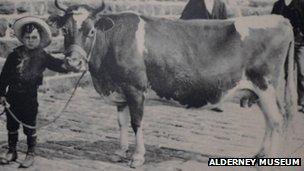
Another interesting bit of information concerned the Alderney Cow, bred form the 1850s to 1920s. Since my knowledge of cows as a farm animal is iimited to the love of cheese, butter, and all things fatty, I’ll quote directly why these animals were prized:  ‘high quality milk-butter yield, easy husbandry, and requiring littler expensive dietary needs’.

Unfortunately, the uniqueness of the Alderney cow was lost when interbreeding with Guernsey cows occurred in 1927. But, at least they live on in literature for those who have read A.A.Milne’s “The King’s Breakfast” and Jane Austen’s EMMA.

Looking for further island exploration Max happened upon, most likely, the most dangerous adventure on Alderney:  The Bat and Hedgehog Tour.

Checking with the Alderney Wildlife Trust, the guide said this week’s tour had been scheduled for Tuesday (the day before) but he’d be happy to accommodate us by doing it tonight. Sounded great to us! So, we made our reservation and then strategized on filling up the four hours prior to meeting him at 9p.

We settled on finding a local hang-out followed by dinner. However, we faced a minor problem: the liveliness of the town bustling with locals and tourists alike that greeted us in the morning had now dwindled to a trickle of activity. All shops and most eateries had shut their doors and would next open Thursday morning.

As we slowly made our way up the main street peering in windows hoping for an ‘OPEN’ sign, a kind woman stopped to ask if she could help us (this was the second time of the day someone had offered us guidance, earning Alderney high marks on friendly natives). She said we may have noticed that businesses close every Wednesday afternoon but what were we looking for? We said eventually a place for dinner. And, with that piece of information she said, ‘Eddie’s is just right up the block, and tell him Norma sent you.’

Her name worked like a charm. Being his Tapas Night, he said he was full but could serve us out in the garden. Which is how we ended up with not only a lovely view but also some exquisite samplings of dishes.

A setting sun brought on a chill so we left for a pub we had checked out earlier. Wanting to be alert for our tour, Max decided to order a tea, and if anyone looked like the sort of person who would ask for tea in a pub, Max would be it:

But, the most entertainment came from the warm and chatty bartender’s response to his request. She was flummoxed and stunned, then exclaimed, ‘TEA? You’re in a pub and you want TEA?!’ I can only imagine how she would have responded if he had added that it was really herbal tea that he wanted…

Forty minutes later (after a beer after all) we found ourselves back in the Alderney Wildlife Trust office where our young guide Roland commenced the tour with so much information my head was spinning. This guy is a walking encyclopedia for bats and hedgehogs.

We discovered bats comprise almost 20% of the earth’s mammals… you identity the different families by  their echolocation range… they actually fly, not glide like ‘flying squirrels’… and, they’re difficult to spot in the dark (that’s my observation after walking around with a loudly clicking echo meter managing to only see one or two madly darting objects).


Hedgehogs, on the other hand, are easier to spot as long as you know where to look and have an informative guide. Alderney has the unique distinction of being one of two habitats (North Ronaldsay, an Orkney Island is the other) where you can find blonde hedgehogs. And, it seems locals take on bragging rights if one lives in
their garden. Otherwise, it’s the more common brown ones.

They don’t burrow but nest. And, naturally, those nests are often under and in hedges.

Roland ensured we knew that they were not albino but blonde due to a recessive gene that just keeps occurring. Having no predators on the island, hedgehogs thrive on Alderney. And, possibly the blonde ones increased in population due to being easier to see at night, so less road kill. Nice to know.

My fondness for these little creatures comes in large part from a childhood addicted to Beatrix Potter’s books.  A favorite was THE TALE OF MRS. TIGGY-WINKLE, the story of a female hedgehog who washes clothes for the animals in the neighborhood.

I even had a little animal hedgehog I could dress up. I know, I know, anthropomorphism and sexism combined but, hey, I was a kid. Who wouldn’t want to know of a hedgehog with whom you could sit and share a cup of tea?

So, when I saw them they immediately brought to mind a little hedgehog running around in a mob cap and apron while my voice became the high-pitch of baby talk.

Roland told us not to worry about harming them because if they truly felt threatened by us they’d curl up in a ball versus just scurry away. Which made both of us relax a bit when he shone his flashlight on one.

Supposedly, it’s rare to see them, but all we saw were little blonde hedgehogs out for the night.  Hmmm…. perhaps the blonde ones have more fun? :)

Our dangerous tour ended with our happily exclaiming our luck in seeing those cuties as we made our way back to JUANONA.

With sun shining and decent winds we left the next morning for our next Channel Island, alas, one without Mrs. Tiggy-winkles…


Really?

We’re in France, and to get further southwest, we’re going north? 

Yup, we’re going north…

ENGLAND

Thursday-Monday, May 16-20

New Haven

Our original plan for reaching the Channel Islands was to follow the French coast from Boulogne sur Mer to other French ports until we reached Cherbourg. Then cross to Alderney, the northernmost of the Channel Islands.

But, after speaking with other cruisers and considering the tides, we changed countries (and courtesy flags) and headed straight across to New Haven, England.

With decent winds and a favorable current, 10 hours later we pulled into a small marina in New Haven for the night. At a local pub we recovered from our docking (strong currents and wind on the stern created a ‘fun’ time) and made plans for an early leave-taking the following morning.

Lymington

We hoped to stay in Cowes on the Isle of Wight. You may know of this as being the location of Queen Victoria and Prince Albert’s summer home, Osborne House. Maybe more noteworthy for sailors:  it’s the site of the original race leading to the America’s Cup. However, we discovered two regattas had fully booked the marina. Quickly perusing the chart we noticed a port opposite the island and found an open berth there.

Again, currents and tides dictated our ETA as this area, known as the Solent. The currents flow at significant strength and require diligence and careful timing.

Another full day’s sail and we landed in one of the poshest marinas we have ever been in, the Lymington Yacht Haven (the marina in the bottom, right-hand corner below).

When checking in the friendly, young staff member handed us a welcome bag (four-color, marina brochure, floating keychain, and two bottles of water) stating, ‘…and, the showers are luxurious.’  That intriguing endorsement ensured I’d be holding them up to a high standard only to discover that, indeed, the shower facilities were jaw-dropping to die for. First, you walked into a bathroom you would be happy to find at a pampering spa…

only to enter your personal shower stall featuring

not one, but TWO shower heads…

a teak changing bench and sink complete with sweet-smelling soap and lotion…

and, drum roll here:  a towel-warming rack (!).

I later discovered Max wasn’t as careful and almost singed a body part….

When delicious hot water gushed from the heads my joy increased:  I felt my hair leap with happiness as I purged it of the shampoo build-up from five weeks of tepid, spitting showers. Plus, a convenient hair dryer and curling iron, if needed, resided in the shared sink area.

Adding to my high rating of the facilities was the laundry room with two washers and two dryers (and an ironing board with iron available at the front office).

The only downside came from trying to hook up to the free WIFI, but in all other areas–easy stroll to town, access to chandleries and groceries, bucolic scenery, and helpful staff–this marina earned its hefty nightly fee.

Taking the weekend to enjoy our surroundings we walked into town, a leisurely ten-minute stroll. With its cobble-stone roads fronted by small cottagey-stores,

we felt as if we stepped back in time to August 2014 when we first landed on England’s SW coast after our nine-day passage from the Azores. Then, Max, our crew member Steve, and I soaked up the yachting heritage associated with Falmouth.

And, similar to Falmouth, you’re never far away from someone plying the waters.

One boat’s captain exited a wheelchair to take a disabled passenger for a ride on the water. From the passenger’s huge grin we knew he was anticipating a lovely morning on the river.

Walking back from town we noticed a large pool stocked with floating apparatus. This was the Open Air Baths filled with sea water and waiting for customers to enjoy a chilly (refreshing?) swim.

It seems any town on this side of the English Channel reflects centuries of livelihoods earned from the sea. Lymington’s economy depended on four industries:  shipbuilding; smuggling; salt; and, sailing.

From the medieval times shipbuilding played an important role in this town. During the reign of Edward I (1272-1307) nine ships built here contributed to the defense of the country. Just up the river from our marina, the Berthon Boat Company founded in 1877, continues that trade.

Like many of the towns situated on England’s southern coast, smugglers found plenty of ways to ‘import’ wine, bandy, silks, coffee, tea and other goods into the country. Support from the local community here ensured a steady flow of goods (and revenue), especially at the end of 17th century.

Salt created Lymington’s wealth in the 1700s with this town and surrounding area being the largest sea salt industry in England. This dominance eroded when Cheshire mined it for less causing Lymington to close it’s saltern in 1865.

Finally, sailing and yachties provide a good source of income for the locals; and, based on the fee for our two nights, it’s a very rewarding business.

The marsh served as the backdrop for the marina, and on Sunday we joined other walkers and stretched our legs along one of the many paths. It was here Max found some jetsam that he quickly rescued.

He managed to return it to spiffiness with a wash; and, after scraping off the algae grime he proudly added it to our flotilla of fenders. I have to say it’s a handy souvenir of Lymington :)

Next, crossing the Channel (again)…

Hi Ho, Hi Ho, it’s down the coast we go…

HOPPING ALONG

Monday-Friday. May 13-17, 2019

Favorable winds from the north encouraged us to leave our adopted Dutch country and head down the southern part of the North Sea. As opposed to doing one long overnight passage we decided to do daily hops of 40 to 60 miles, landing us in a new port each night.

Covering miles only during daylight made it a heck of lot easier for coastal sailing. If sailing at night, I’d rather be out in the middle of the ocean:  when you see a light, there’s no question it’s attached to a ship, oil platform, or UFO. When you’re near the coast it could be an onshore beacon, street light, reef, or even a low-flying airplane (which occurred in 2004 sailing by Boston’s Logan Airport…).

As our AIS shows, we were amidst a lot of ships,

some requiring a close watch, the ship named CAUSEWAY being one of them. According to the CPA (‘Closest Point of Approach’) of 0.0 miles, if neither of our courses changed in the next 3.7 miles, we’d see a bold ‘Collision warning!’ flashing on the screen.

By the second day we’d established a routine of rising, checking the wind forecast, reviewing the currents and tides as well as shipping lanes* then heading out of the harbor to follow the coastline south and west.

* To facilitate  commercial traffic while lessening the chances of collision with pleasure boats the authorities have established shipping channels, typically a lane in each direction with a TSS (Traffic Separation Scheme) in between. To accomplish the fastest crossing of these lanes, we need to do so at a ninety-degree angle. And, trust me, when crossing the lanes extending out of Rotterdam, the busiest port in Europe, we wanted to be on the other side of them as quickly as possible. You can see the solid line of ships heading south in one of the AIS photos above.

With only a few, all-weather ports (many man-made) along this stretch of the coast we based our selection of marinas on their ability to accommodate our 2-meter (6’ 6″) draft and the ease of entering and exiting the harbor (strong currents can play havoc when docking and undocking). For three mornings we exchanged one port for another:  Scheveningen (Netherlands) for Zeebrugge (Belgium) – the teal blue dot is where we docked;

Zeebrugge for Dunkirk (France)–the green is where JUANONA was,

and Dunkirk for Boulogne Sur Mer (France), not to be confused with Bologna, Italy…

It got to the point where I’d wake up and try to remember the previous port’s layout by visualizing the dock, and the toilet-shower facilities.

A ritual we carry out at sea is exchanging one country’s courtesy flag (flown on one of our spreaders) for another’s. In this case it was our Dutch flag

for France’s.

Having covered a fair bit of miles in three days and seeing the favorable forecast of northerly winds continuing for a few more days we decided to stop for 36 hours in Boulonge, a port other cruisers had recommended.

Being one of the few American boats around we managed to attract the attention of the French law enforcement. Four officials boarded the boat upon our arrival in Boulogne, and for an hour they perused our paperwork trying to decide if we needed to pay V.A.T. on JUANONA.*

* Just to give you a quick synopsis of issues facing foreign boaters in European waters, we would have to pay a 20% Value Added Tax (basically a sales tax) on Juanona if she had been in the European Union for more than 18 months. The only way to avoid this tax is by taking her to a non-EU port (which is why we always touched the coast of Norway prior to returning to an EU country).
On top of this is a restriction on foreigners themselves in Schengen countries (currently, all EU and Scandinavian countries except for the UK). If you’re not a Schengen resident, then you’re only allowed three months within those countries; and, once you’re reached that limit, you have to leave and not return for three months.
These regulations mean your boat is allowed for 18 months and yourself, three. You can see how tricky of a dance this is if you plan to cruise these European waters.
By obtaining temporary Dutch residency in the Netherlands, Max and I are considered Schengen residents. And, thanks to the advice of fellow cruisers, Gus and Helen Wilson, we were able to temporarily import JUANONA into the EU. Due to those two actions we’ve protected ourselves and JUANONA from the EU and Schengen restrictions.
However, the French customs officers weren’t familiar with the Dutch paperwork stating we had temporarily imported JUANONA into the EU, thus the hour sitting in our cockpit trying to decipher another country’s government form.

It all ended well with their providing us a French document approving our temporary import. Since 2014 we’ve been boarded five times by custom officials:  twice by the Brits, once by Germans, once by the Dutch, and now by the French. And, we were hailed over VHF by the Norwegians.

As the French Customs officials were leaving I realized I had actually seen them as we made our way south. Fortunately they didn’t board us then as it would not have been fun maneuvering, especially for an hour…

Like most European cities and towns we visit, Boulogne’s history includes centuries of different occupants who desired this strategic port. Situated at the mouth of the Liane River, the Romans called it Gesoiacum. Later it became known as Bonoia and switched hands often:  Normans destroyed it in 882; it was rebuilt in 912 and became a desirable harbor for the Burgundian Dukes, then French kings beginnng with Louis XI in 1477; England got hold of it in 1544 after a two-month siege and ruled for a short while before it reverted back to France in 1550 via the Treaty of Boulogne. Napoleon used this as his headquarters when planning to invade England (but didn’t); and, the British used it in WWI; the Germans overtook this port in the 1940 Battle of Boulogne just a few weeks before Operation Dynamo (evacuation of Dunkirk); finally, the city was liberated in 1944.

We explored the upper city or ‘old city’, which features preserved buildings from earlier times including the fortified gate.

Max, in search of an MDT (Max Disaster Tour), read two reviews saying there’s ‘a must-see’ crypt under the Basilica of Notre Dame de Boulogne.

I joined him for the above ground walk-around but, having read in a guidebook that the crypt was ‘imminently skippable’, I opted out of paying the 5 euro fee to visit below ground.

Considering Max found me down the street within 15 minutes of his MDT, I think the LONELY PLANET guide book provided a more accurate description of that site…

But, the real highlight of Boulogne was a modern building perched above the beach:  a fabulous aquarium.

With a 2018 expansion the Nausicaá became the largest aquarium in Europe. Its mission not only focuses on raising awareness of the marine environment but also encourages action to improve global management of this vital resource. This French National Sea Centre is now a UNESCO site due to its promoting of healthy oceans and seas.

The design of the new Nausicaá replicates a manta ray, although my photo of it as we’re leaving the harbor doesn’t provide the aerial view to show it as such…

The admittance fee of 25 euros each gave us pause, but a second look at recent reviews convinced us to take the plunge. And, we are very glad we did.

We weren’t the only ones anticipating a fun day of exploring the mysteries our oceans.

In spite of kid mobs, who always seem to carry their own peculiar smells and exuberant noise levels,


the displays handled crowds well with easy-to-follow signage creating a smooth flow of people throughout the exhibits.

Imagine oceanography, marine biology, and environmental studies combined into one semester of school. That’s what it felt like when peering in the tanks and reading the signage.

The mission of Nausicaá focuses primarily on the relationship between mankind and the sea; and, in each area the aquarium presented the effects of climate change and its disastrous consequences,

while acknowledging those without a political voice or monetary resources are the ones paying the price caused by those with that power.

Yet, as opposed to being totally depressed by the way we’re destroying our world, Nausicaá offers hope in the forms of activism, both on the parts of individuals as well as organizations. For example, a partnership between The Environmental Advisory Company and the Four Seasons Hotels has funded the Reefscapes Programme (at the end of 2011 160,000 cuttings were transplanted onto 200 coral structures).

To encourage visitors’ participation in these efforts, the aquarium provided websites as well as coin drops so visitors could donate to various causes, which we did for one (Andrea, this was for you :).


It was difficult to avoid being caught in a hypnoptic trance gazing at tanks populated by ballooning jellyfish…


and swirling highways of fish,


with the pièce de résistance being the soaring ray.


All with New Age music (which you can’t hear in my clips) enhancing the otherworldliness in front of us.

We had seen a similar exhibit but on a much smaller scale at the Ozeaneum in Straslund, Germany  last year. There, the focus was on a specific body of water, the Baltic Sea, versus Nausicaá’s global coverage. Both are stellar examples of using entertaining displays to teach those of all ages about our watery world.

From simple explanations of tides…

and displays on oil rigs…

to communing with marine life,

we found ourselves stopping at almost every display, only skipping those geared towards young children, with one exception as seen in the top photo of this post…

The exhibits did include flora and fauna associated with the water but not necessarily in it. One being the stick insect hiding in this photo.

This aquarium would be worth seeing just to surround yourself with fantastical marine life. In one of the largest tanks in Europe we became encased in blue,

with smaller tanks showcasing otherworldly critters, both bizarre

and lovely.

After three house of meandering through exhiibits of above and below the oceans, we reluctantly left.

I find it easy to be overwhelmed by the richness of information available in sites such as these. If we were going to be here for any length of time, I would get a season pass and peruse one small section at a time. Or, simply sit and watch a world swim by.

When leaving the next day it seemed so appropriate that Nausicaá was one of the last landmarks we saw exiting the harbor. A reminder of the precious resource on which we sail as we continue cruising…


Launched (for real)!

MONNICKENDAM to AMSTERDAM…

Friday-Monday, April 26-29, 2019

After sprucing up JUANONA with new bottom paint

and John’s repairing of the keel,

Jim carefully launched her

after Max taking a ride to the top of the mast for affixing the repaired wind instrument.

A successful launch and some good-byes

And, we’re off! Although, only for a short distance(16 miles) to Amsterdam Marina located a free ferry ride

across the harbor to the city center.

This marina offers great amenities, including, Anne, a bathtub (!), private showers, AND my fav:  washing machines!

We took the opportunity to revisit some sites and explore new ones, such as Micropia, a museum focused on microbes.

And, where’s there an opportunity to use my most agreeable model…

IMG_2486

A bit bizarre and one I’d recommend as a second (third?) tier museum; but, it provided some interesting tidbits such as the fact that all species on earth “share a single ancestor:  an ancient bacterium… the same hereditary material within their cells:  DNA.”

The museum featured a microbe body scan where Max discovered he carried 168 trillion microbes.

By selecting a specific body part details we found that the small intestine trains our immune system to recognize the good and the bad bacteria. And, that Brevibacterium linens, which digest dead skin cells such as between the toes resulting in stinky feet, also produce some of the strong-smelling cheese some of us enjoy. That can give one a bit of a pause…

Being a holiday weekend (April 27 is King’s Day, celebrating his birthday) we found some lines intensely long (such as the Rijks Museum) and the city crowded (typical, though, especially in tulip season). Remembering a great Asian restaurant we decided to get take-out for dinner

where we peered through the window into a tiny kitchen where three to four people managed to choreograph delicious dishes. And, incredibly (too) filling.


Continuing onto HAARLEM…

Monday-Monday, April 29-May 6, 2019

Knowing we could easily access Amsterdam and its sites from one of our favorite Dutch cities, we decided to head off to Haarlem, just a few bridges and one lock a further 12 miles down the canals.

Three years ago  this city seduced us in the loveliness of the Netherlands, from the abundance of flowers to its famous Golden-Age Dutch master Frans Hals to its 16th-century charm, prompting us to apply for temporary residency and making Holland our winter home from 2016-19. It felt appropriate to return, making our stay here a full-circle.

We tied to the town wall on the other side of the windmill where we were on our first visit. And, the perfect introduction to Holland for our young friend, Sarah Arndt.

One of John and Leslie Arndt’s daughters, Sarah had worked as one of the program leaders shepherding 20 college students through a semester of accessing Ecuador’s, Malawi’s, and Italy’s food policies. With time between the end of her job and meeting her sister Hannah, she joined us adding a zest to JUANONA’s crew.

And, it was wonderful.

Seeing familiar haunts through the eyes of a newcomer inspires renewed appreciation for all we’ve experienced, and Sarah’s interest in different cultures gave us that gift. During her stay we toured Haarlem,

enjoyed local beers,

and requested poses, which she kindly agreed to do.

With a shared interest in Dutch history and art, we visited some of Haarlem’s museums–Frans Hals, Teylors, Corrie Ten Boom’s House–while taking in the city’s ambiance of what some call the small Amsterdam.

Our daily excurions would often begin as a trio, then duo, ending as singles when specific areas would draw us into solo journeys.

One example of our divergent courses began when we couldn’t get into the new David Hockney exhibit at the Van Gogh Museum. This led us to the Rijks Museum’s Gallery of Honor featuring stellar work by the Dutch Masters of the country’s Golden Age (17th century), with Rembrandt’s ‘The Night Watch’ covering the entire back wall.

Exiting we heard music drawing us to a group of street musicians. Having mentioned to Sarah we usually hear some beautiful classical tunes, I couldn’t identify these notes (not unusual for me). I decided to record it in order to ask some knowledgeable, musical friends, Melanie and Anthony. Then I heard a familiar tune and laughed…

yep, the score from ‘Game of Thrones’! Soon followed by the theme from ‘Mission Impossible’.

But, back to the Van Gogh Museum, one Sarah really wanted to see. So, while Sarah decided to take her chances of garnering a ticket from any possible no-shows, Max and I headed to the Neue Kerk (New Church) to see the World Press 2019 photographs. Finding that closed, we turned to the Palace just to the left of the church.

Never having been tempted to tour this site, the short entry line enticed us in, and we’re glad we did. The palace is a stunning example of the imperial style created during Louis Bonaparte’s brief reign as King of Holland (1806-10) during his brother Napoleon’s occupation of the area (1806-13) .

Initially constructed in 1648-55, this building served as the Amsterdam’s Town Hall and came to represent Holland’s independence from Spain and the end of the Eighty Years’ War (1568-1648).

Designed by architect Jacob van Campen and featuring over 100 sculptures by Antwerp sculptor Artus Quellinus, considered in the same league as Italy’s Bernini, the building was pronounced the eighth wonder of the world by the residents of Amsterdam.

Beginning with the impressive Citizen’s Hall,

we wandered through 21 rooms–many containing the original furniture from Louis’ time.

Now, it’s a tourist attraction as well as the official reception Palace of the Royal House of the Netherlands (one of government’s three palaces). It also is where foreign dignities may stay during their welcome here.

With the Tribunal room located on the ground floor we discovered an MDT (Max Disaster Tour) site. In this surprisingly small but elaborately sculpted room judges reviewed and announced death sentences four times a year. Here the accused would be tried, sentenced, and the type of execution chosen – hanging, strangulation, beheading, or drawn (big ugh).

This led upstairs to the Justice Chamber where all knelt in prayer upon which the accused stepped through the window to the balcony (installed during Louis’ times) where he/she was executed.

Max and I also saw the special exhibit at the Hermitage, a small sister museum to the one in St. Petersburg. Catherine the Great (1729-96) began collecting art and in 1764 displayed it in the ‘Small Hermitage’. Her grandson Tsar Nicholas I expanded it by building a larger museum 88 years later. This was renamed the State Hermitage Museum after the 1918 Russian Revolution. In 2009 Amsterdam opened its Hermitage, a sister museum we’ve frequented often when in Amsterdam.

Unfortunately we had only an hour before closing but the art was tremendous, and some was intriguingly juxtaposed with two similar items yet from two distinctly different time periods. One example being the statue of Egypt’s King Amenemhat III with the affable bust of Catherine the Great; both were created during their lifetime and both reflected the monarch’s desires to be approachable. Catherine’s even smiling!

The exhibit included a wide range of items, from a rather disturbing portrait, ‘Donna Nuda’, by Leonardo da VInci…

to a wasp-waisted dress worn by Tsar Nicolas II’s mother, Empress Maria Fyodorovna (1847-1928)…

to a musical desk created for Catherine the Great.

With a video demonstrating this lyrical desk’s sliding doors and hidden drawers we ended our too-brief tour and began our trek back to JUANONA.

Memorial & Liberation Days (Saturday & Sunday, May 4 & 5, 2019)

On the weekend we observed the two-minute silence at 8pm. Initiated at the end of WWII this joint event has grown into recognizing the sacrifices of all who have died to protect the freedom of others.

We thought this time would be extremely powerful if surrounded by a stilled, hustle-and-bustle crowd; but, unable to locate one we wandered into St. Bavo, Haarlem’s imposing church anchoring its main square. There we stood with a small group as they tolled a bell up to the time,

then listened to the quiet sound of thankfulness to be where we were because of the sacrifices by others.

The next day the mood flipped 180º from the somberness of memories to a fiesta associated with Liberation Day. Since 2016 this time has been a keynote in our Dutch experience and truly the one that cinched our decision to use this delightful country as a home base. Yet, unlike in Amsterdam’s Dam Square 2016, this time the celebrations mainly offered loud music, food and drink carts, and a horde.

As you can see from an overflowing receptacle,

the public urinals came in handy with Max demonstrating his single-hander.

And, a mixed signal with a young entrepreneur dressed as a hot dog selling hamburgers…

Sarah, too, found it underwhelming in culture and overwhelming in crowds as she tried it out after a day in Amsterdam.

Back aboard we enjoyed another evening of shared meals, some augmented with treats from Sarah, and conversation

then retreated into our private thoughts and projects as the late evening sun turned to night.

With a decent weather forecast we decided to give Sarah a taste of canal cruising then sailing in the open sea. Tomorrow:  On the move again with favorable winds, and even better, more friends to see!


The Venice of the North

BRUGES in French, BRUGGE in Flemish

Sunday-Monday, April 14-15, 2019

To make the most of our out-of-town boat errands we sandwiched between the tasks two Belgium cities we wanted to explore:  Bruges and Antwerp. We had visited the former when visiting with our Belgium family (Ta, Koen, Seppe, Frieke, & Wannes and pup Cuba) in 2002. But, Max didn’t feel well, it was cold, and early Christmas shoppers packed the streets. And, we had missed Antwerp in our previous travels, making it now a prime destination before starting summer cruising.

So, off we drove early Sunday morning, first dropping off Scandinavian cruising guides to some friends in Blankenberge, Belgium then to Bruges.

This once-fortified city was one of the richest in Europe during the Middle Ages thanks to the trade of cloth. And, the city wears this mantle of medieval entitlement well, starting with its stately buildings

and scenic canals, which give Bruges its well-earned descriptor Venice of the North*.

*Another nickname this city earned is Brugse Zotten (The Bruges’ Crazies) from the time of Holy Roman Emperor Maximilian I (1459-1519). Due to his having been held captive here for four months, he denied Bruges the right to hold fairs. The residents tried to appease him with a huge party in his honor. In addition to being allowed to have fairs again as well as levy taxes, the townsmen requested the right to build a madhouse. Reportedly he replied, “Close all the city gates and it is a madhouse”. By the way, the local beer is called Brugse Zot and, since the early 2000s, is sent by pipe out of the city to be bottled, as we saw in the Brewery’s floor.

For an excellent background of Bruges during its medieval period read Dorothy Dunnett’s eight-book series THE HOUSE OF NICCOLIÒ. I hated reaching the last page of the final book. Frankly, I think it would rival “The Game of Thrones” if someone managed to translate her story into a TV show.

But, you can see Bruges on the screen in the film noir “In Bruges” with Colin Farrell. Definitely another worthwhile view of this town, although we later met two travelers who hated it, so consider my recommendations as very subjective.

The history of Bruges and the province of Flanders becomes clear as mud when you start reading about the power struggles between various rulers and wanna-be-rulers over control of this European territory. So, below are excerpts providing a glimpse of this city’s past:

  • The site began as a landing on the Zwijn estuary of the Reie River (Bruges’ name is derived from a Roman bridge over the river). Later flooding of the area created channels as well as a link to the North Sea and an opportunity to increase trade.
  • The town later served as the fortification of Baldwin the Iron Arm (love these names), the count of Flanders, against Vikings/Norman invaders in the 9th century.
  • The House of Burgundy entered into the picture when Count Louis II of Flanders’s heiress Margaret III (1350-1405), the last Countess of Flanders, married Philip the Bold (1342-1404), the youngest son of French King John II and Duke of Burgundy.
  • Due to its monopoly on English wool (considered the finest grade) used in the weaving of Flemish cloth, Bruges became one of the richest European cities during the 13th- and 14th-centuries, along with nearby Ghent and Ypres.  With such a reputation, it’s not surprising to hear of the royals purchasing Flemish tapestries to warm their damp and chilly castles. Some of the most famous and stunning ones- black & white as well as full color -are the Jagiellonian tapestries ordered by Polish Kings Sigismund I & II in the mid-1500s for their Krakow royal residence, the Wawel Castle. Out of the approximately 170 made, miraculously over 100 still remain.
  • The city’s wealth led to internal struggles including one between the guilds and the governing power, resulting in the Brugse Metten (Bruges Matins) May 18, 1302:  guildsmen murdered anyone who couldn’t pronounce the Flemish phrase ’schild en friend’ (shield and friend). A statue in the main square memorializes the two leaders of this revolt, Pieter de Doninck (head of the Weavers Guild) and Jan Breeder (head of the Butchers Guild).

  • Bruges, whose status in the cloth trade attracted the attention of the economic powerhouse, the german Hanseatic League, joined this commercial organization in the 14th century.
  • In the 15th century the Dukes of Burgundy helped foster Bruges’ trade dominance. Not only aristocrats and merchants prospered but also artists, such as  Jan van Eyck (1370-1441) who became the court painter to Philip the Good, Duke of Burgundy (1396-1467) (not sure why he acquired the nickname ‘the good’ but I did read he had at least 18 illegitimate kids so he was obviously good at something besides begetting riches).
  • But, just as water positioned Bruges as a vital trading port on the North Sea, it also took this gift away when the Zwijn waterway began silting up. The Hanseatic League moved to Antwerp with merchants soon following, and by the end of the 15th century Bruges slipped into dormancy.
  • The Eighty Years War (1566-1646) between the Spanish rulers and the Dutch created a split between a Protestant secular governance in the Netherlands and a Catholic royal rule in the Spanish Netherlands (basically, present-day Belgium, Luxembourg, and a part of northern France).
  • Bruges began its revitalization in the 1800s when wealthy tourists discovered this idyllic city wreathed by canals.

  • Spared during German occupations in WWI and II Bruges became a UNESCO site in 2000 and was designated the European City of Culture in 2002.
  • In 2015 the city hosted 7.8 million tourists. A bit overwhelming considering only 20,000 of the just under 120,000 residents inhabit the city center.

Okay, I’m finished with the history lesson, now off to explore.

With less than 24 hours to see the sights we booked a room within easy walking distances of the sites, which isn’t difficult since one can cover the whole area within two hours of walking. We quickly stashed our luggage and exited into medieval times.

Believe it or not, we didn’t tour many museums because we wanted to simply soak up the ambiance during our short stay here. Which meant we strolled the streets in spring sun beginning in the Markt, (the main square) where the Halle with its famous, 83-meter (272 feet) belfry stands.

The belfry was added in 1282 with the octagonal upper section completed 200 years later.

With 366 steps to climb we opted out of that exertion but did peek into the courtyard

and snapped a photo of a photo showing the view if we had climbed all those steps.

Similar to other cities we’ve toured a small carnival plopped itself on the main square flashing colorful lights advertising kiddie rides and games.

All a bit surreal against a backdrop of imposing buildings; yet the modern fair added a light-hearted touch to the surroundings dominated not only by the 13th-century Belfry but also the late 19th-century, Neo-Gothic Provinciall Hof (seat of the provincial government).

Spotting a city tour bus

we hopped on for 50 minutes of a bored driver who would pull up to a site, point his arm and let the multi-lingual headphones provide their limited commentary. The only time he smiled occurred as we were exiting next to the tip jar.

Just to give you an idea of the throngs milling about this spring day (foretelling the mob scenes to come as spring turns into summer), I took a photo out of the window:

Not too informative of a ride but it did provide an opportunity for our picking out where we’d want to go next.

And, two sites we selected centered on the importance of religion (not unusual since churches seem to sprout like mushrooms in these medieval towns), the first being Onze Lieve Vrouwekerk (aka O.L.V.-Kerk, aka The Church of Our Lady)

Built on a plot inhabited by previous churches (first from the 9th-century, followed by a Romanesque one in the 12th-century) the current structure began 1210 in the Gothic style and continued birthing additional parts (steeple tower, chapels, etc.) into the 16th and 17th centuries. Bizarrely (to me) in the 18th century, after the French Revolution, the church was for sale resulting in the parishioners buying it back.

During the centuries saintly relics, those pilgrim magnets, i.e., money-makers, pumped up attendance and the church’s coffers insuring O.L.V.’s religious importance. But, entering structures of this magnitude with their soaring ceilings and impressive decor, such as the 12 apostles lining the main aisle of the nave, one doesn’t need dead people’s organs to feel spirituality hovering in the air.

Today the church serves as a museum with one of its most notable pieces being the statue ‘Madonna and Child’ by Michelangelo Buonarotti (1475-1564). Commissioned by a Cardinal who later became Pope Pius III for the main alter of Siena, Italy’s cathedral, it ended up as a gift by Bruges merchant Jan Mouscron to O.L.V.

Because you can’t get within less than 20 feet of this guarded piece of art (I zoomed in to capture the image above), there’s an unimpressive duplicate, although, that, too, is encased in a glass box. When I noticed Max peering at it, I pointed to the real one. He was happy to hear it wasn’t the original as he didn’t think the copy looked too great. (Nor did this statue replace Michelangelo’s Pieta as his all-time favorite.)

The need for security is understandable considering the statue was stolen in 1794 during the French Occupation, returned in 1816 following the Peace of Vienna, only to be seized by the Nazis in 1945, then found along other priceless pieces of art in an Austrian salt mine. And, it was placed back in its original site for paying visitors to now see.

Other notable work catching my eye included:

two elaborate oaken confessionals carved over two years in High Baroque style (1697-98)…

two ceremonial tombs of Mary of Burgundy (1457-1482) who died falling off her horse and whose husband, Holy Roman Emperor Maximilian of Austria (1459-1519), commissioned this tomb in 1502 with her son, Philip the Fair (1478-1506), adding the gilt-work,

all on top of her bricked-in remains (empty burial tomb seen below through glass floor)

and lying nearby is Charles the Bold (1433-1477), Duke of Burgundy who died at the Battle of Nancy, in the other glittery tomb after Charles V brought his remains to Bruges in 1558 and his son,  Philip II (who fought William I of the Netherlands for control of the Low Countries during the 80-year war) commissioned this one in 1562.

Unlike Michelangelo’s statue these monuments were safely squirreled away during the French Revolution only to be returned in 1806, and you could get with ten feet of them…

The pulpit created in the mid-1700s features a woman (‘Faith’) sitting on a globe who’s proclaiming the ‘Good News’ while holding the proverb “Understand what is wise, O ye of little wisdom; listen, and I will tell you many great things; for what passes my lips is righteous and true”, obviously what’s true has something to do with Jesus or God and not advertising Burger King’s Impossible Whopper…

finally, lots of paintings hung on the walls with one, to me, of the most striking being ‘The Crucifixion’ attributed to Antoon van Djick (1599-1641).


Of course, we can not not tour something with even a whisper of an MDT (Max Disaster Tour ), and we found one of those in The Basilica of the Precious Blood (a 19th-century photo of this building appears earlier in this post)

The Chapel sits on the 9th-century fortification occupied by the first count of Flanders, Baldwin Iron Arm.

Crusading Count Thierry of Alsace (1099-1168) built a Romanesque, two-story chapel. Dedicated to St. Basil, the lower chapel creates a sombre and muted atmosphere with its unadorned stone walls and dim lighting,

while the upper story, added in 1530’s, matches the exterior with regards to ornate architectual elements. With no flash allowed some of my photos, as you’ll see, are unfortunately blurry but will give you a hint of the richness within these walls.

And, it’s in the Upper Chapel where one can witness and partake of the bizarre, daily ritual of parading past a cylindrical vial holding some of Jesus’ blood; and, those who know me can probably imagine my eye roll at that bit of ‘truth’. But, hearing this event would occur in 15 minutes we decided to take one of the seats in a small area (seen below) off to the right of the main altar (seen above) to get our dose of sacredness.

Supposedly the Patriarch of Jerusalem bestowed this valuable bit of Jesus to Count Thierry, a fanatical crusader, to thank him for his bravery during the Second Crusade (1147-49).

However, later research indicates the relic most likely came to Bruges from Constantinople in the early 13th century. Oh well, at least the Jesus’ blood part is true…

By the time the relic made its appearance on the altar, a guard motioned people, by now standing as well as sitting in front of the altar, to begin lining up one by one. When my turn came I climbed the eight steps or so, approached the relic, smiled at the woman overseeing it, then dropped my eyes to see a stained bit of cloth.

A bit anti-climatic for me but I can only imagine how powerful this must be for those who believe in it.

However, for me, all I can imagine is the power of the all-mighty coin; yet, to be fair, surprisingly we were not charged extra to see the relic.

When not being brought out for 30 minutes of homage by tourists such as ourselves, the encapsulated blood resides in a gold and silver, gem-encrusted reliquary.

The highlight of this worship occurs every Ascension Day (when Christ finally goes to Heaven 40 days after his resurrection).

After our holy episode, it was time to leave Bruge, but not without gazing once more at this sumptuous jewel of a Medieval city and saying to one another, we’d love to come back. Only this time I can skip the blood.

And, that ends our 24-hour stroll through this medieval treasure.

Next, Antwerp!