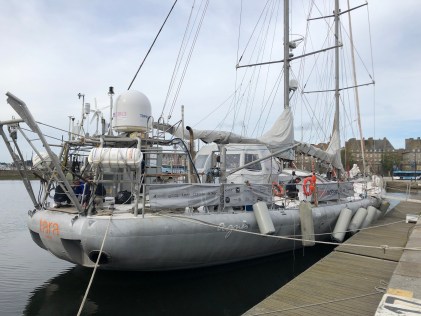
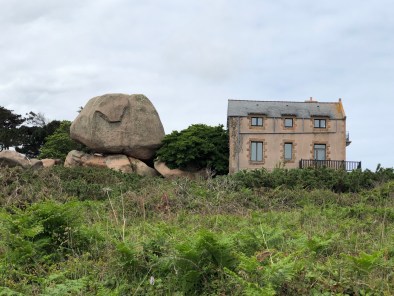
Starting to cruise Galicia…

Tuesday-Thursday, July 16-25, 2019

Remember when I said we basically glided for two days and nights down the Bay of Biscay to Gijón? None of the traditional rock ‘n rolling due to the ocean rollers that can ‘knock your head right off your shoulders’ (from a Schooner Fare song). Well, our east to west sails along the north coast of Spain made up for our smooth north to south passage.

For 60 miles we slipped and sloshed our way through water throwing a liquid temper tantrum.

Occasional dolphins created a welcome reprieve during our roller-coaster motor-sailing.

With relief we turned into Ria de Ribadeo for the night.

Not so fast. Not only did a weedy bottom in places force us to re-anchor, but we continued to roll up, down, and around on swells. After a sleepless eight hours we upped anchor as soon as it got light and headed for the Ria de Viveiro.

But after reading that this anchorage can be rolly, we said let’s keep on going, which is how we ended up anchored in a lovely bay off of Cedeira late in the afternoon.

So began our cruising the Galician coast of Spain.

CEDEIRA

July 17-19

We explored the town, enjoying lunch in a little square where the town had smartly planned an activity playground for kids while adults sat at tthe outdoor cafes enjoying local fare.

A path along the river took us behind the town where we passed senior citizens out for their morning stroll and, when returning to town, spotted a father and son walking the exposed river bed at low tide.

Besides a blissfully calm surface in which to sleep this town gave us the gift of meeting Pam and Mark, two Brits heading in the same direction. When dinghy-ing back to JUANONA from town, we headed near their boat but with enough space to turn off in case they didn’t wave back (our litmus test for how receptive others are to two cruisers disrupting their peaceful solitude). Fortunately they were as glad to meet other English speaking cruisers as we. They invited us aboard and conversation flowed :)

ARES

July 19-22

After our stay in Cedeira, we headed to the Ares, the next Ria south of us with Pam and March appearing later in the day.

Over the next three days we relaxed off this small beach resort,

where we joined other locals and visitors in slowly walking the boardwalk

and, of course, sampling local seafood :)

Tucked amidst some trees at the far end of the beach we found a cafe with some decent WiFi and across the street a few blocks away a fantastic laundramat. Unfortunately the WiFi only really worked that one day at the cafe but clean bedding and clothes offset that inconvenience.

With Caribbean-color water tempting us, we dinghied to one of the beaches for an evening swim.

Our ‘swim’ ended up as a quick dip instead for the water temperature resembled Maine’s more than any tropical warmth.

With the start of summer holidays beginning in full force we’d been a bit concerned about crowded harbors and anchorages. But our fears were unfounded. We discovered plenty of space along this coastal region, an assurance other sailors had mentioned.

And, it appeared some cruising boats never left as witnessed by the tatters of a country flag…

A CORUÑA

July 22-25

Our next rendezvous put us in A Coruña, a port whose history included…

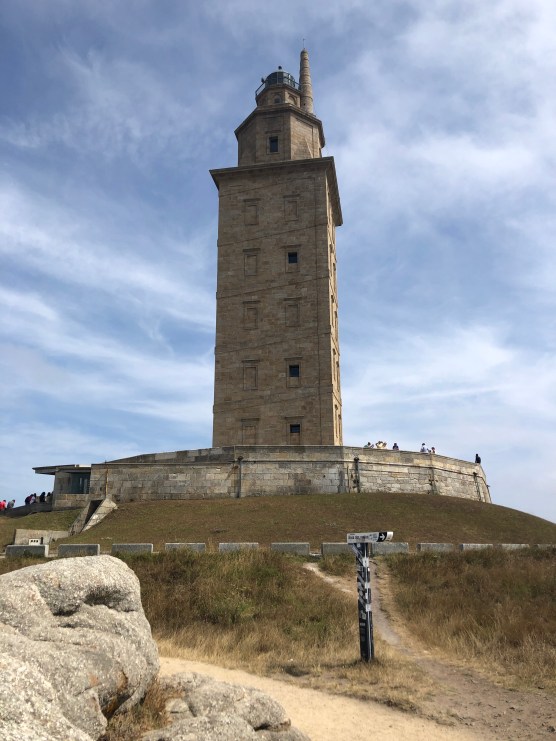
the world’s oldest working lighthouse (more on that latter)…

…and a landing for those arriving from sea to continue their pilgrimage to Santiago de Compostela.

A misunderstanding put us In two different marinas. Pam and Mark moored at the Darsena located in the town center while we turned into the first marina when entering the harbor. Although even on the outer part of the city it was an easy, five-minute walk into the old town.

Generally it takes us a bit to become accustomed to the quicker tempo of a metropolis after the peace of a quiet village.  But, with an afternoon of walking through the old town we settled into the city’s pace. Which picked up, as did we, when learning we had arrived just as one of the largest parties was beginning: the Medieval Festival :)

Beginning Tuesday night and continuing through Sunday, locals outfitted in medieval dress manned booths selling wares of non-edibles (headscarves to amulets)

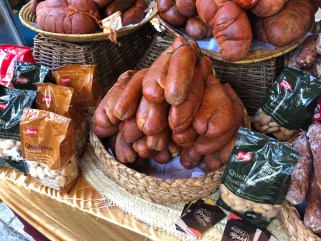
and edibles (Iberica jamon to honey), some appearing mighty odd.

But, the best offerings of the festival appeared in the form of acrobats,

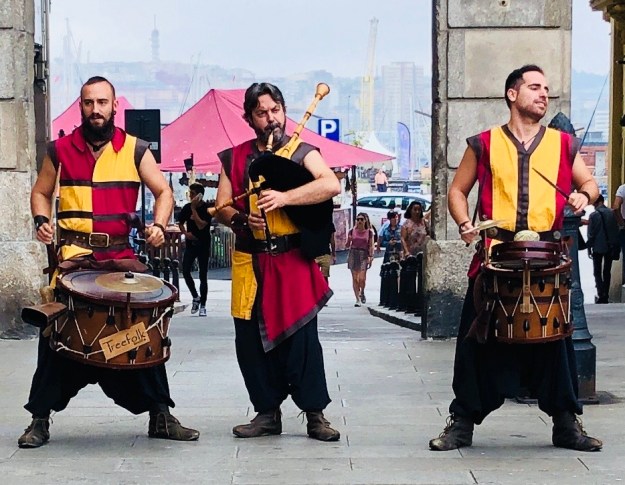
Strolling troubadours,

Ogres,

who didn’t seem to faze some kids despite in-your face ‘greetings’,

walking vegetation,

and, a fire-breathing dragon, which did cause at least one child to scream in holy terror (check out the video, pretty horrifying for a kid).

I fell under the spell of this festival with its blending of GAME OF THRONES + LORD OF THE RINGS + WIZARD OF OZ. Not what I was expecting in a region known for its Catholicism.

Delicious street food served as our lunch and dinner fare for most of our days there where we partook of kabobs, actually MANY kabobs. It’s also where we learned the importance of vigilance against theives.

As Max stood in front of a booth deciding what food to order three women, grandmotherly in appearance, crowded around him. He felt pressure where he kept his wallet inside a Velcro-closed pocket, and when he realized it was gone quickly grabbed the woman’s arm. Suddenly a young man standing nearby pointed and yelled ‘the thief went that way!’

Well,s he hadn’t gone that way. In the confusion all the thieves got away. Within 15 minutes the police ‘discovered’ and returned the wallet, minus cash but with credit cards intact. How they knew where to find the wallet so quickly made the entire episode seem a bit suspicious, but Max was relieved to only have lost some cash. He now pins that pocket closed with a safety pin.

A Coruña also where we found a perfect retreat from the street melange:  a cafe with great WiFi, peace for writing all accompanied by good java.

I discovered even more relaxing hours during two glorious massages by Rita at the Oriental spa located right on the main plaza. Now that’s a true luxury.

We met up with Pam and Mark

for some amazing mojitos (while learning of some special rum)

then joined the stream of happy revelers navigating the narrow lanes with Mark encouraging Max to demo a head scratcher.

The days were hot under the sun but really pleasant in the shade. By afternoon an onshore sea breeze kicked in, providing free A/C to all. In the late evening the air cooled off a bit more, warranting a blanket for sleeping. With most of Europe experiencing acute heat waves, this part of Spain was bathed in cooler temps. Talk about luck.

We explored beyond the old town gaining an appreciation for this Spanish city.  Just walking out of the main plaza placed us amid modern life, including seeing a peaceful protest against the local telecommunications company.

Walking further on we saw an evocative photography display, ‘Castaway Women’. With over 10 portraits, the photographs captured the terror, exhaustion, and relief experienced by these migrants. In the image below Olmo Calvo caught a group of immigrants found in a rubber dinghy next to the Libyan coast. The Spanish NGO, Proactiva Open Arms, supplied the life vests and later rescued 60 people also attempting to cross to Italy. 

The expression ‘there but for the grace of god go I’ seems appropriate.

Crossing to the other side of the peninsula we prominaded along a boardwalk rimming a pristine beach, a feature of many of these coastal cities and towns.

And, where one beach goer would possibly rue her time in the sun.

A cool sculpture at the end of the beach reminded us of the popularity of surfing

and always of my brother and nephews’ love of the sport. So, I just had to pose (as seen in cover photo :)

The Spaniards definitely appreciate their ocean access. In all of our stops along this coast kayakers, paddle boarders, divers, jet skiers, and swimmers joined sailors and power boaters on and in the water. But, nothing beats the pure joy of seeing kids leaping off land and splashing down in the ocean, which occurred frequently along the city’s harbor.

By Thursday A Coruña had become a familiar face. Having adjusted to city living we settled into an easy routine of visiting favorite haunts (roaming the old town, running miscellaneous errands, and provisioning as needed).

Additionally, Thursday, July 25th is one of the most popular holidays of the year:  the Feast of St. James, the patron saint of Galicia and of Spain.

He’s the reason (well, at least way back when) why all those pilgrims make their way to Santiago (‘Saint James’ in the galician dialect) de Compostello where he’s (supposedly) interned. And, why the Festival’s spirit reached an even higher pitch. Which is truly interesting considering how joyfully pagan we felt.

Yet, aboard JUANONA we had highlighted this day for another reason. With that, I’ll close with something I never got tired of during our time in A Coruña:

¡España!

GIJÓN Y ENVIRONS

Tuesday-Wednesday, July 9-16, 2019

Gijón

Marina Yates welcomed us onto the north coast of Spain Tuesday morning with Jésus, the marina manager, and his friend catching our lines. We had heard of the warm hospitality visiting yachts received in Spain, and Jésus and his staff proved it.

He later came aboard to help us plan our exploration of Gijón and the surrounding area. His enthusiasm for this region of Spain was infectious, and we carefully noted routes and sites to see.

But, we also had another treasure trove of information for this area, which we frequently consulted during our stay. Our friends Linda and Joel had traveled here resulting in several detailed emails providing excellent suggestions for a road trip.

Another source came from my brother and sister-in-law who had just recently returned from a two-week road trip, which included both inland and coastal sight-seeing. Coastal because my brother managed to bring his wetsuit and surf several times :)
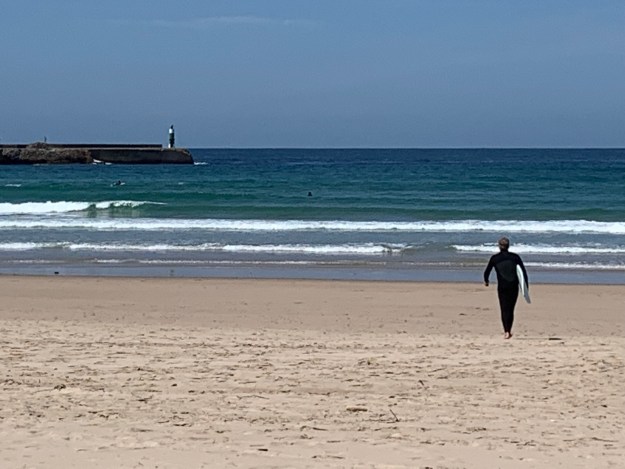
Not only did Jésus assist in mapping out our itinerary but also served as transport to the local medical clinic. Furthermore, when we didn’t return until much later in the afternoon, we discovered he drove to the hospital (!) to see if we had been sent there. But, it was nothing that drastic. The clinic gave us an appointment and within two hours we had paid the 51 euro bill and obtained a prescription at a local pharmacy for 5 euros. The efficiency and low-cost stunned us (other times we’ve had to pay much, much more to access a country’s medical services), as did the concern and care from Jésus.

Our marina sat on the outskirts of the city resulting in a 20-30 minute walk to reach the old town. Along the way we noticed some ugly graffiti mirroring what’s going on back home. Another reminder of how nationalism brings out the worst in people.

But, that was one of the few signs we saw, hoping there weren’t more.

When exploring Gijón we walked by a statue of a king named Pelayo holding aloft a cross.

In reading later about this guy we discovered Asturias, a principality facing the Cantabrian Sea (Spanish name for Bay of Biscay) to the north, Cantabria to the east, Castile-León to the south, and Galicia to the west, served as the first area of this peninsula to reconquer lands from the Moors.

Pelayo (d.737), whom they think may have been a page or a bodyguard in the royal court of Visigothic King Roderick (who died fighting the Muslims), led the revolt in the early 700s, becoming king in 717 after pushing the Muslims out of his country and reinstating the Catholic faith and Spanish independence, at least in this bit of Spain.

Subsequently, Pelayo became a legend and is hailed as the savior of Christianity. One site describes his victory over the Moors as such: “Vastly outnumbered but armed with invincible faith, Don Pelayo’s heroic spirit attracted God’s blessing and changed the course of Spanish history” (www.tfpstudentaction.org). Yikes. Thus begins another religious righteousness that, to me, has poisoned the world.

But, back to Asturias where prior to Pelayo evidence has been found of human habitation 100,000 years ago. Later, during the Iron Age, Celtic tribes arrived and settled in this area. By the 5th century B.C.E. the Castreña culture populated the area, living in fortified settlements called castros located on hilltops surrounded by a circular ditch.

Next, the Romans arrived in the Iberian peninsula 219/8 B.C.E. They overcame their main rivals, the Carthaginians, in 205 B.C.E. and proceeded to push north and west, conquering tribes along the way – one being the Lusitanians.

The Lusitanians lost to the invaders in 133 B.C.E. but only after putting up fierce resistance. Interestingly, some historians accredit the Lusitanians under their leader Viriatus (d.138 B.C.E.) as employing the first Spanish guerrilla tactics.

The Romans continued their push into Iberia, now focusing on the Celtic tribes occuping northwest Spain, primarily in Asturias and its eastern neighbor, Cantabri. Only after ten years of fighting (29-19 B.C.E.) did Rome finally win the war.

Then, 700 years later the Moors arrived, which brings us back to Don Pelayo (FYImost of the rest of Spain remained under the Moors until King Ferdinand V and Queen Isabella I captured Granada in 1492).

Okay, back to Pelayo (labeled ‘the wild ass’ in an Islamic chronicle). Since his reconquering of Asturia from the Moors soon after their initial invasion, this part of the Iberian peninsula remained independent with the title “prince of Asturias” being used by the Spanish monarchy to this day. And, in spite of the Roman and Moorish invasions, the native traditions still exist as we saw during several festivals.

With time to explore the region we rented a car and headed south towards the beautiful Picos de Europa. For three days we oohed and awed over the glorious scenery laid out in front of us.

Covandonga

Within several hours we found ourselves in one of the Asturians’ most venerated sites:  Covandonga. Here Pelayo began his reconquest of Asturias. Supposedly, the breath of the Virgin inspired Pelayo to win the Battle of Covadonga thus placing this spot on the history map. The cave, Cova Dominica, in which Pelayo and his soldiers sheltered became a holy site with the third king of Asturias, Alphonse I (693-757) building a chapel there. A masonry one was built on the spot in 1940.
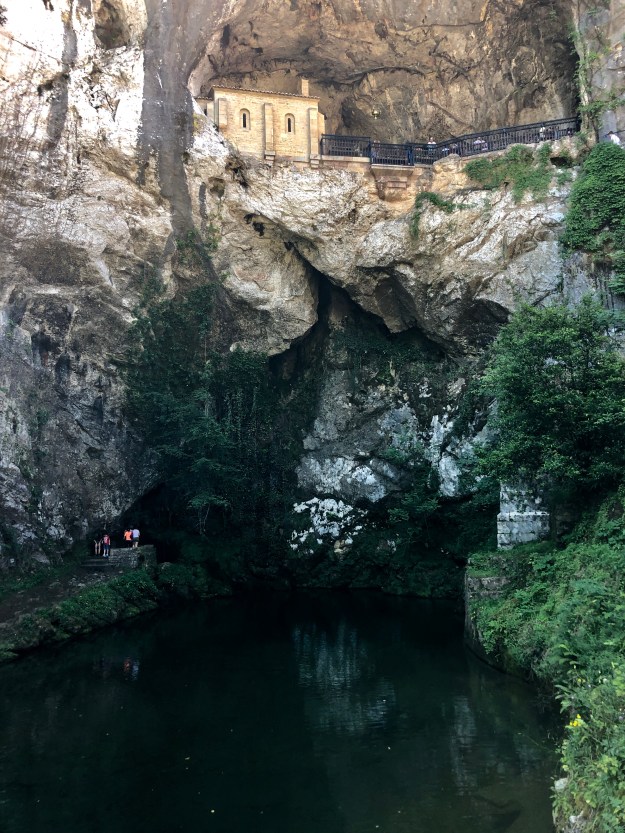
Not only does the Holy Cave enshrine the Ausurians’ patron saint, la Santina (the Virgin de Covandonga) seen below in a 1918 procession to the Holy Cave…


but also Pelayo, his wife Gaudosia,

and Alphonse I who are entombed here.

Originally, pilgrims crawled on their knees up the 100 stone steps (Staircase of Promises) to reach the site, but now a tunnel connects it to the esplanade of the Basilica. And, overseeing the entire plaza is the iconic statue of Don Pelayo with his infamous Christian cross, la Cruz de la Victoria.

The Basilica dramatically rises as you begin your approach to the plaza,

passing the Collegiate Church of San Fernando.

Commissioned by King Alphonse XII (1886-1941), the Basillica was completed in 1901.

Walking back to our car we contemplated joining a long line waiting for the bus to see two magnificent lakes, Enol and La Ercina. It was tempting, as was taking the Fuente Dé cable car to the top of Picos Massif as my brother and his wife recently did; however, the heat won out with our choosing, instead, to avoid the crowds. We opted for an icy pop then slurped our way back down the hill to our car.

We continued winding our way further south through mountainous countryside with a few stops at roadside adventure camps

and miradors along the way.

Cangas de Onis

Our next destination was Cangas de Onis, capital of Asturias until 774 with its former Roman bridge reconstructed during the Middle Ages.

We also took advantage of some other works of ‘art’.

Posada de Valdeón

Late afternoon we began our search for a place to stay, and we found the perfect spot in Posada de Valdeón:  Hotel Rural Picos de Europa. We knew we were lucky because not a lot of accommodations populate these small towns, but our hosts said the high season had only just begun since earlier rainy weather delayed the typical onslaught of visitors.

And, our room tucked up into the top floor made for a perfect ‘Heidi in the mountains’ feel.

This tiny village offered several lodges, a few restaurants (one being so good we returned for our second feast the next night), and an outdoor adventure shop. That’s it, along with the incredible vistas.

It’s also where we met and shared some wonderful conversations with two avid New Hampshire hikers who kindly suggested an easy stroll for us, starting in Cain, another small village further north.

We drove a half hour or so to Cain for a morning trek alongside the Cares River, a riverbed chiseled out of huge limestone blocks.

It also serves as a feed for hydropower, which is probably why such a well-established trail is carved out of the limestone, beginning with some short tunnels.

We went to the mid-point, then turned to retrace our steps. But, not before we experienced a religious moment… Thanks to our friend Ellen, we started seeing Flat Jesus in odd spots, including on a trail sign,

and in my back pocket.

We felt a bit abashed when others noticed our Flat Jesus, but we hopefully allayed any disrespect by saying it was ‘for our church’.

On our way back to our inn we stopped at yet another viewpoint (honestly, you can not not take photos of all this splendor)

only to find when we got back in the car that we could only go in reverse (!) while in first gear. Not a good thing when on narrow, steep, winding roads. In other words, backing up all the way back was definitely not an option.

After a few moments of wide-eyed concern of ‘how the hell do we get out of this predicament?!’, Max discovered he just had to really, REALLY gun it when starting on an incline. Problem solved but not without some rapid heart beating.

The next morning we packed our bags and headed off for more exploring as we made our way back to the coast, heading north and east.

The roads appeared well kept 

although still a bit unerving with steep drop-offs and potential fog banks ahead.
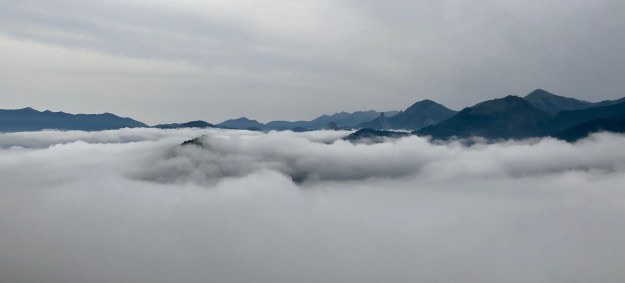
Potes

With a full day ahead we decided to check out another popular pilgrimage site.

Just outside the city of Potes in the Cantabria province east of Asturias, Turibius of Liébana and some Benedictine monks settled in the foothills of Picos de Europa in the 6th century.

Several centuries later Don Pelayo’s successful campaign against the Moors resulted in a Catholic stronghold. Later, emigrating Christians from the north created a strategic buffer in the Valley of Liébana along the River Duer.  Which is how the monastery Santo Toribio de Liébana came to be.

It gets a bit confusing as this Turibius of the 6th century (who would become a Saint) gets mixed up with another Turibius of Astorga of the 4th century (also granted Sainthood). I believe it’s the latter whose bones found their way to this monastery.

To me, what’s interesting is both championed Rome’s Catholicism versus Priscillianism, a form of Christianity developed here in the 4th century by, whom else, Priscillian (340-385).*  And, one I had never ever heard about, which isn’t surprising considering my tiny knowledge of religions.

*This doctrine is a mix of Gnosticism (the Christians’ God didn’t directly create the earth, an imperfect spirit did…) and Manichaeism (the good power of God opposed the evil power of the devil) with the underlying dualistic premise:  material was evil and the spirit good, which, leads to the logical (?) belief that this denied Christ’s humanity.

Priscillian didn’t sound like a fun guy as he has been described as a rigorous ascetic forbidding all sensual pleasures, marriage, meat and wine. He also has the distinction of being the first ascetic executed (he literally lost his head) for heresy by the Church.

And, this is one of the rabbit holes I follow when something unusual catches my interest and, which I’m certain doesn’t capture yours! So, onwards to what we actually saw…

We passed groups of orange t-shirted youth making their way up the long hill.

I later spoke with several of them who explained they comprised a group of around 100 kids from all over Spain. Their week-long pilgrimage ended here, for which they appeared extremely thankful.

We followed them into the church, built in 1256. The simplicity of the decor was refreshing after the lavishness of other churches and cathedrals we’d visited.

Here we witnessed a short sermon (which we didn’t understand) and a song (which didn’t matter that we didn’t understand as it was lovely).

Off to the left of the Apse an iron grill secured the Chapel of the Lignum Crucis. Eye roll not withstanding, peering through the bars we saw a glass encased, gold encrusted sacred relic.

This was the Lignum Crucis or in lay terms, the largest known piece of the True Cross… left branch, mind you, of the cross Jesus died on. And, if you could look at it without the gold casing (created in the 18th century) you could see the nail hole for one of his hands, I mean, the sacred nail hole.

And, how did this priceless piece of wood come to be here you ask? Well, Emperor Constantine’s mom, Helen (Saint Elena now) (246/248-330 C.E.) discovered it along with the crucifixion nails, the holy tunic, and the crown of thorns belonging to Jesus. Historians can’t quite pinpoint how Camaleño managed to get their hands on this artifact; but it most likey arrived in the 8th century along with the remains of Santo Toribio de Astorga. Which is why this ancient monastery is known as “The Sanctuary of the Lignum Crucis”.

I didn’t see it but the monastery’s cloister has replicas of the “Commentary on the Book of the Apocalypse” by Beatus of Liébana (730-800). Drafted in 776 then revised twice over the next ten years, his work served as a rallying cry for his countrymen against the Moorish rule. Thus, it became a best seller, causing others to create over 34 versions (called “beatus”) from the 10th to the 16th centuries.

In a small gift shop you could obtain a bunch of Christian items, including several versions of a baby Jesus,

with price tags that probably pay for some good communion vino.

As tempting as it was, we decided to not bring one aboard to keep our pagan doll company.

Rgardless of who did what when, this stone grouping of quiet buildings nestled amongst the forested hill exudes peace. One we enjoyed in spite of our heatheness.

Back down the hill we drove into another popular destination, Potes. We eventually found a parking spot and joined other tourists out and about enjoying a warm summery day.

A tower offered some great views

and a quick history of the region beginning with the Roman conquest of NW Spain and continuning through the rise of the Inquisition.

And, remember the Beatus mentioned earlier? An exhibit featured replicas of these manuscripts, noting that a variety of institutions (Paris National Library, Madrid’s Royal Academy of History Library, New York City’s Morgan Library, etc.) hold the originals.

Since the majority of text appeared in Spanish we deciphered what we could- not quite understanding the Beatus’ significance, but appreciating the illustrations,

including some rather cartoonish expressions of Adam and Eve…

While I perused the Beatus Max joyfully occupied himself scouting out various placements for Flat Jesus, the most notable relating to the Inquisition.

An outdoor lunch (numerous sidewalk cafes mean very few choose to eat indoors) and people-watching ended our tour of Potes.

We continued on our journey while every now and then gazing heavenwarads to thank the road gods for the nets above us.

We stopped in at the 10th century church of Santa Maria de Liébana. Unfortunately, we had missed the confusing signage citing opening hours but did appreciate the setting, situated below a rock climbing school.

Santillana del Mar

Our last destination before Santander landed us in one of the quaintest medieval villages we’d seen in Spain:  Santillana del Mar. Thankfully, Linda mentioned this otherwise we might have missed it, which would have been a real mistake.

We paid a small entrance fee to access one of this village’s main sites:  Santa Juliana Collegiate Church.

Another fascinating religious structure educated us on the connection of the French King Luis IX (1214-70) to this region of Spain via his father’s (Luis VIII’s) marriage to Blanca de Castilla (1188-1252).

A display describes this king as one of the most prestigious figures of the Middle Ages. No doubt this reverance came from Louis’ devotion to the Christian faith (he’s the only French king named as a Saint). He wanted to trade his crown for a monk’s robe but knew his duty was to lead his people, which he did in the 7th and 8th crusades while spending boat loads of public funds on Christian relics (he built Sainte-Chapelle to hold these special items). Considering he zealously suppported the Inquisition, his reforming of the French legal system and the presumption of innocence seems a bit hypocritical. Eventually Luis got his halo and became Saint Luis in 1297.

For all his monkhood he certainly enjoyed the conjugal bed, for his wife Margaret of Provence (1221-95) popped out 11 kids.

We wandered along the cloister noting elaborate columns decorated with religious scenes

and an elaborate storyboard depicting the life of Christ,

which jolted us when it suddenly sparked into animation.

On our way to this site Max noticed a potential MDT (Max Disaster Tour), the Torture and Inquisition Museum. Oh boy.

However, when we met at the cafe (I decided to sit this one out) he said the displays present these despicable practices in historical context, and notes which ones continue to the present day in particular countries.

Another very historical site we unfortunately missed:  the Cave of Altimira with its 14,000 year-old paintings. But, hey, yet another reason to return to this magical region of Spain.

By 10pm we found ourselves standing in Santander’s small airport waiting for a special visitor to arrive. Soon we spotted my beautiful god daughter Maggie :)  She had made the trek from Lyons where her French studies had just ended and was joining us for a too-brief visit.

Oviedo

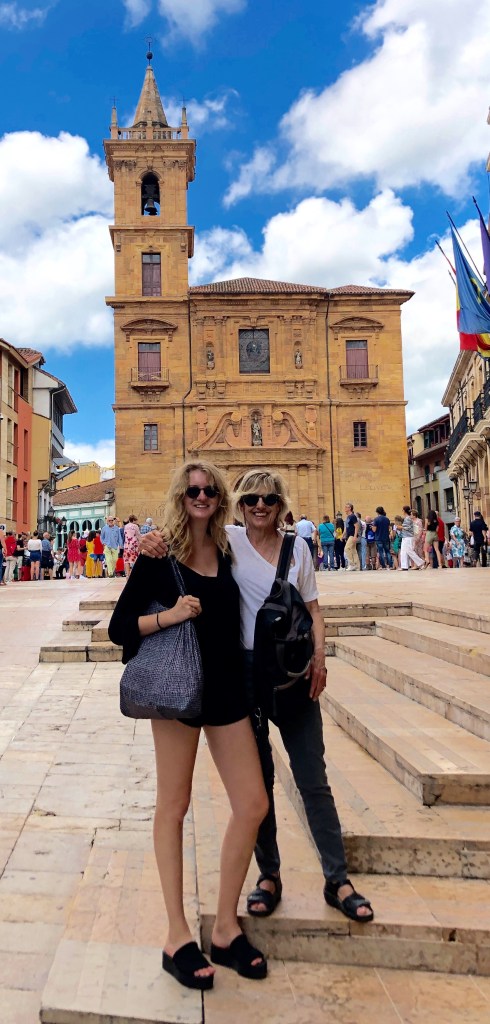
Back on JUANONA we fell into berths and woke Sunday morning for another day of sight-seeing. We made the short drive to the capital of Asturias, Oviedo, where we posed for photos in front of its famous cathedral in the Plaza Alphonse II El Casto,

listened to traditional music while watching costumed locals dance,

enjoyed some tapas and some of tapas including shaved slices of jamón,

and appreciated one of the stunning sculptures scattered throughout out this city.

A circular route back to Gijón included some back roads to another small church, again whose viewing hours we missed; but, we did see one of this area’s traditional hórreos or granaries.

Raised onto mushroom topped stones,

this design supposedly kept rodents out of the stored grain; however, I’d like to see a test run of this for all of us thought rats could scale those pillars pretty quickly if they’re anything like the squirrels at our feeders.

Cudillero

A quick drive down to the small harbor of Cudillero found us amidst a flood of locals and tourists. Against a steep backdrop of homes, cafes, and shops locals and tourists alike basked in the hot sun

with some getting a respite from the water.

After a whirlwind of a visit Maggie boarded a bus to Bilboa to meet her friends as well as reacquaint herself with her luggage that hadn’t arrived on her flight to us.

A quick provisioning at a huge supermercado and a wash down of JUANONA’s deck to remove coal dust from the loading port next door prepped us for our next adventure:  Galicia, which, to say it properly, start lisping!

I can’t leave this post without noting a favorite musician of mine who passed away July 16. Johnny Clegg, born 1953, was someone I discovered in the 1980s and followed ever since. Thanks to him, I have a wonderful memory of dancing my butt off with my cousin Cathy and friend Colleen in the early 1990s at a concert in Burlington, Vermont.

So, here’s to Johnny Clegg and the beauty of his music.

https://www.okayafrica.com/listen-to-ten-great-johnny-clegg-songs/


Passage

BAY OF BISCAY

Sunday-Tuesday, July 7-9, 2019

This was the day to face the infamous Bay of Biscay, a body of water that I’d only heard not great things about. Max would every now and then hum a Schooner Fare song and when feeling particularly jolly, sing out “and the Bay of Biscay rollers will knock your head right off your shoulders!” Lovely.

Yet, we knew of several cruising teams who had perfectly fine crossings, one even in January (!) and another who zoomed down from the North with a wonderful wind. So, we knew if we picked our weather, which we usually can due to the luxury of no real time constraints, our crossing would, if not mimic those, at least be relatively peaceful.

That weather window opened up Sunday after a week’s long stay in Quiberon, our last port of call in Brittany. Since landing May 30 in Lezardrieu this part of France had served as an intriguing and captivating place to explore. Despite sometimes challenging decisions concerning extreme tides and powerful currents our time here gave us a completely different feel of France. Not surprising considering the strong connections to the Celts’ immigration pre-900 C.E.

Under a forecast of not too much wind and low wave, i.e., roller, height distrubing our 260-mile journey we left casting a last glance backwards.

Within two hours we were hoisting our asymetrical (cruising) spinnaker, first time of the summer.

For the next several hours we enjoyed a relaxing and even keeled ride.

Ahhh, only us, the wind and the seas, which felt blessedly gentle.

The first day our wind kept up, more so than had been predicted. No matter. Suited us just fine. And, how can anything be wrong with this picture… great legs AND harness attached (Max was fiddling with the SSB Radio antenna).

On our two-person passages our time tables for being on watch flex:  during the day, we’ll trade off cat-napping as needed; at night we generally do three hours on/three hours off. Or, if required, we’re both up to deal with a lot of shipping traffic, sail changes, or major weather disturbances.

But, nothing like that faced us, so the captain got a restful sleep while offering the perfect opportunity for a quick shot :)

The night passed smoothly and another day of sailing coupled with motoring to ensure we maintained 4 knots minimum. We always want to keep ourselves covering miles at a decent pace. It lowers our exposure to changes in the weather as the forecast under which we leave a port is only good for a limited amount of time; so, the quicker we cross, the less likely to be caught out.

Surprisingly, very little traffic appeared during this passage. The one exception were the fleets of fishing boats, which we had heard about. Sure enough, the predicted flock appeared and we easily avoided any issues because they were clumped together.

After that, we rarely spotted another boat either on AIS (automatic identification system) or looking at the horizon. A few times a white sail would appear heading towards us or coming our way; but, other than those infrequent sightings the coast was clear as they say (sorry, I can’t seem to get away from spouting these trite expressions!).

On Monday the wind had dropped as forecasted, so on came the motor. By mid-day we crossed from France into Spain.

Max performed the ceremony of switching our courtesy flags (a nautical requirement to indicate a boat’s foreign status in another country’s waters).

Once or twice before we’ve come to realize after the fact out courtesy flag wasn’t the correct one. In Spain we later discovered flags without the crown on them. When we asked our Spanish marina host, he said, ‘no, you’d want the crown for it shows you support the king.’ Which began our understanding about this northern coast’s heritage: it was the first region of Spain where they reconquered their country from the Moors in the mid-700s. Don’t worry-that’s all the history. For now, at least :)

Monday flowed into the second and final night of our passage. We had hoped to be crossing under a full moon but the timing didn’t work out, so our nights were shrouded in darkness.

I’d check the sails with a strong flashlight but it can feel a bit eerie floating out there with only you, the sea, and a visibility the circumference of the boat.

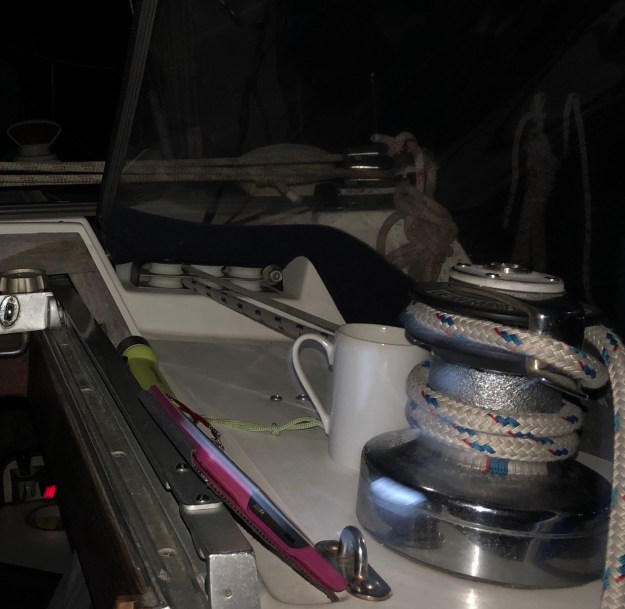
When it’s quiet with no ships around and no unpredictable boat movements due to rough or no-wind weather, you become wrapped in a comfortable blanket of soft darkness. I’d like to play music but don’t since earphones would block out any unusual sounds coming out of the night. So, it’s my cup of tea, book, meandering thoughts, and dropping below to check AIS.

Then dawn breaks, the remoteness fades, and renewed energy infuses JUANONA.  And, this morning involved prepping for our arrival in Gíjon, Spain.

With Marina Yates on the outskirts of the city promising no-stress docking we contacted the marina over VHF (if that fails, we resort to using our limited cell for a phone call).

The staff directed us to our berth, catching our lines and welcoming us to Spain. Within thirty minutes Customs was aboard, and after an easy exchange of legal papers (boat registration, our passports, and other necessary documents), we had officially been accepted into this country.

We had last sailed here in 2003, only it was in southern Spain when we had over-wintered while staging to enter and later leave the Mediterranean. This had a completely different feel, one we were looking forward to exploring.

And, one of the best parts of being here? Our crossing was the easiest one I’ve ever been on. So, the Bay of Biscay for us did not knock our heads off our shoulders, and for that I’m truly thankful.


BRITTANY: Part VI

ÎLE DE GROIX

Thursday-Sunday, June 27-30, 2019

One night was all we required to get a feel for Concarneau, so the next day we hoisted our anchor and headed out to sea. But not too far for our destination only 25 miles away. Soon we landed on one of Britany’s gems:  Île de Groix.

The island has a small marina and some mooring buoys where you tie both your bow and stern. People told us it can get pretty crowded, especially on the weekend, which hastened our decision to get there Thursday. And, we were glad we did for by the weekend every boat was rafting to another one creating a web of lines.

But, we were lucky because we met Camille, Pierre, and Thomas who had sailed here from L’Orient. The boat belonged to Cami and Pierre who lived aboard while their friend Thomas was taking a break from his cycling vacation (he’d been up in Scotland) to join them for the weekend.

We wish we had had more time to spend with them but at least we shared a table watching the quarterfinals of the Women’s World Cup game and saw them briefly during our forays around the island.

And, they generously gave us a traditional cake from Brittany, which we devoured… :)

We rented bikes (we’re becoming hooked on electric bikes…), which gave us the opportunity to toodle around the entire island. And, where we engaged in a staring contest with the horse seen at the beginning this post. We also took our first dips of the season

on one of the pristine beaches dotting the shoreline.

This island served as the second time we came into contact with the Douanes (French Customs). Luckily it’s only because they were on a boat rafted to us. I engaged one of the officers quickly, letting him know we were ‘legal’ with our temporary residency in the Netherlands. He was fine; however, a sterner looking fellow asked him a question which included ‘Ou?’, which I knew as ‘where?’.

The nicer officer with whom I was conversing said, ‘It’s not you, it’s the boat. He wants to know where you sailed from.’ I told him we had stopped in the Channel Islands, technically not in the EU part of the VAT agreement (which has since come into question), and we had temporarity imported JUANONA into the Netherlands. He smiled and said, you’re fine as we have you in the system from when you were boarded earlier this summer.’

In spite of our legal status both with regards to Schengen and the EU VAT, I never quite feel at ease in the company of customs. More often than not one’s compliance appears to depend on how the Custom Officers interprets their understanding of the rules and regulations. And, in the fine print of the EU one, each country can decide whether and how much VAT can/will be charged on the boat.

It was nice speaking with the first guy, but also nice to wave good-bye…


ÎLE d-HOUAT

Sunday-Monday, June 30-July 1, 2019

When Sunday came we provisioned at the grocery store, then quickly decided to leave when several of the rafted boats departed and we spotted an opening to make an easy exit from the harbor.

We rendez-vous’d with another American boat whom we had met via an email introduction via some other cruising friends.  They had  suggested meeting in a large bay off this island.

Jayne, another cruising friend, mentioned they had stopped here several years ago and saw an amazing display of the phosphorescence, a feature this small island is known for. Unfortunately, we didn’t see it but did enjoy a lovely walk the next day

after a fun dinner followed by a sleep amidst swells rocking JUANONA.

We only had a short time to share as we were heading in opposite directions and needed to take adavantage of the winds. That’s the problem with cruising:  you’re always saying good-bye.


COASTAL BRITTANY

Monday-Sunday, July 1-7, 2019

QUIBERON

We only had another short sail to reach our next port, this time a marina (Port Haliguen) outside the town of Quiberon.

We’ve been extremely fortunate being able to live ‘on the water’ because meteorologists had forecast a heat wave blanketing Europe. Being on the coast certainly helped mediate the temperatures; and, even though we couldn’t swing with the wind since we were in a berth, the lower temps of the water kept our hull (and us) relatively cool.

PONT-AVEN

Here we took advantage of our proximity to several sites by planning several day trips with a rental car. A must-see for me was Pont-Aven, a lovely town, one both Max and I just relaxed into (once we fereted out a parking space amidst all the other tourists’ vehicles).

While walking along the riverside we noted how nonchalant some of these boats sat at low tide,

including one whose prop appeared immersed in the muddy bottom goo, which perplexed the captain mightily.

124567F4-446C-443F-A516-AF49FA4DF2D8

This town is where Paul Gauguin started an informal art colony in 1886 by encouraging fellow French painters to come here. However, it had gained popularity 30 years earlier first with American artists, followed by British, Scandinavians, Dutch and Irish.

For those who aren’t interested in history, please skip. For those who are, I’m just doing a brief stroll through the painters’ time in this village, which could charm the most cynical of tourists.

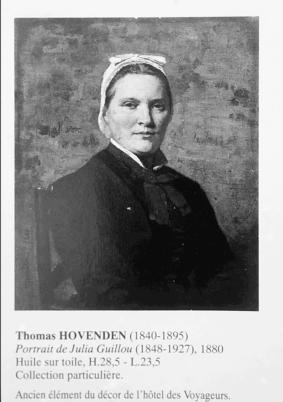
A museum on the main square introduced us to one of the key reasons why artists favored this town: Julia Guillou (1848-1927).She managed to buy the hotel (Hôtel des Voyageurs) where she had worked, soon earning the reputation as the ‘bonne hôstesse’. The museum occupies the annexe she later added to her hotel.

Over the years as owner of this hotel she offered rooms to painters, primarily academic ones, while ensuring a healthy income came from developing her hospitality business. Doesn’t she sound like someone you’d love to meet? She does to me. And, frankly, I have a friend who immediately comes to mind when thinking of Julia. Only she’d be right in there with the artists!

Painters gathered here drawn by Gauguin, including CamillePissaro (1830-1903), Claude Monet (1840-1926) and Emile Bernard (1868-1941) and many I didn’t know:  Armand Séguin; Émile Schuffenecker, Paul Sérusier, Charles Laval, Louis Anquetin,Maxime Maufra, Henry Moret, Ferdinand Loyen du Puigaudeau to name a few. Being senior to the majority of the other French painters, Gauguin became the de facto leader.

During this time several different painting styles arose, and I’ll use Wikipedia.org’s definitiions versus trying to explain them myself:  synthetism (‘emphasized two-dimentional flat patterns’); and, cloisonnism (‘bold and flat forms separated by dark contours’).

With lighter easels and paints available in tubes, artists found it easier to paint on site; and, Brittany with its dramatic coastline and variable maritime light served as the perfect ‘model’ for painters eager to explore new techniques.

The exhibit and excellent audio tour filled us full of the various storylines of the artists and their time spent here. So much so, I stopped trying to make sense of who did what when and simply just enjoyed their work. Well, a lot of it.

The Pont-Aven Group continued to inspire artists beyond Gaugin’s time, and several painters’ later work–

Moret’s (156-1913) ‘Goulphar, Belle-Île’ 1895

Maufra’s (1861-1918) ‘Rochers au soleil couchant; L’Anse du port Lonnec’ 1899

and, Puigaudeau’s (1865-1930) ‘Batz-sur-mer au clair de lune’

–drew my eyes. As did, Moret’s ‘Ramasseuses de goémon’ pastel.

What I loved were the odd non-art details that cropped up every now and then. For example, in 1894 Gauguin ended up with a broken ankle thanks to a fight with some fishermen in Concarneau (the beach resort town off of which we had anchored a week earlier).

Looking at this photo from 1886 in Pont-Aven you can imagine the bohemian spirit zinging around those streets.

Gauguin sits in the middle holding a dog while Puigaudeau stands third from the right wearing, appropriately, a Breton shirt :)

Gauguin seemed a restless soul, coming and going to and from Pont-Aven four times over eight years, with 1894 being his last. That year he returned in April with his young mistress Annah, a Javanese woman he’d met in Tahiti, but he didn’t stay long. He left Pont-Aven eventually landing in Marseilles and leaving again for Tahiti in 1895. He died eight years later in the Marquesas.

Many of these artists owed their growing fame to the art dealer Paul Durand-Ruel (1831-1922).

He first began in 1870-71 with paintings by Monet and then Pissarro and featured the Impressionists’ second showing in his Paris gallery in 1876. Eleven years later he opened up a gallery in New York City, and in 1905 exhibited their work in London.

My goddaugther Maggie reminded me of an excellent book on some of these artists:  THE PRIVATE LIVES OF THE IMPRESSIONISTS by Sue Roe. I had started it on Kindle awhile ago but decided on a paper copy for easier Index referencing. Anyone interested in a behind-the-scenes view of this group would enjoy it.

Although many are devotees of Gauguin, including Pierre Girded (1875-1948)I who painted his idol in a composition mimicking the Last Supper…

… I’m not a fan of Gauguin’s work. However I do appreciate his influence on others. After the fact, the artists who painted here became known as the Pont-Aven School. However, as the museum clearly states: the group of artists is ‘not one of a master surrounded by his students, but instead a sharing of personal and innovative ideas and aesthetics, at the margins of official instruction… According to Gauguin, the painter thus acquired “the right to dare all”. And, ‘dare all’ they did.

A perfect summation of our touring of this picturesque town. With one last look at the high tide having freed the earlier-mentioned sailboat’s propeller and keel, we drove back towards the sea and JUANONA.

CARNAC

The next day our land excursion found us retracing part of our route back to Carnac. We had driven by here on our return from Pont-Aven, and it was then that both of us exclaimed ‘holy cow!’ as we came to the top of a rise.

The reason for our shared shout came from seeing a huge field of megaliths, prehistoric standing stones, quietly laid out in front of us.

We had heard how this area of Brittany featured many prehistoric sites, and we had seen some on our bike ride around Camaret-sur-mer further north. But, these 5,000-6,000 year-old stones appearing in row after row in undulating fields for almost four miles is awesome. This is the only place where so many of these stones appear in one location.

Called the Carnac Alightments, a Neolithic site located just outside La Trinité-sur-la-mer, they stand as sentries; yet, no one knows why, only that they obviously took a lot of work to place them. Not a job I’d enjoy.

The Megaliths Visitor Center provided a good explanation of the site’s main champion, Zacharie Le Rouzic (1864-1939),

as well as other prehistoric areas located in Armorica, this region of Brittany. His mentor was the scottish archaelogist James Miln, but Le Rouzic became enamored with this site in the 1880s when the Carnac Museum opened. He began taking photographs, selling them in the museum. Eventually this led to a dual passion of photography and archaeolgy.

A short video explained the ‘how’ of installing such stones

and signage gave us the background on Le Rouzic. And, one of the staff told us we could simply take a picture of the large map on display

and view the stones on our own without taking a guided tour. (The tour allows you to walk amidst the stones; and, in case anyone can come between the months of October and March, you’d be able to walk along the rows without a guide.)

So, that’s what we did, stopping at all the designated viewpoints to gaze at these solemn rocks…

and stooping to enter one of the dolmens…

where I snapped a shot of Max, one that I would NEVER let him post of me in the same position.

But, it bugs the hell out of me that we don’t know the purpose. This is another reason why time travel would be a fantastic way to experience history. Maybe in the future.

L’ORIENT

Our final day of road travel we focused on two things:  seeing France’s homage to a stellar sailor, Éric Tabarly; and, trying to find a larger battery for our electric outboard.

We accomplished both :)

Tabarly (1931-98) became an avid sailor starting with sailing as a baby aboard his father’s boat, PEN DUICK, and later joining the French Navy. He designed PEN DUICK II, his second racing boat, and began building a winning resumé by placing first in the 1964 single-handed, transatlantic race from Plymouth, England to Newport, Rhode Island.

His racing boats, all named PEN DUICK, evolved over the years adding to his victories and growing reputation both in France and around the world (his countrymen and women thought so highly of him that shipyard workers in 1968 stopped striking so they could complete number IV in time for a race). Max actually recognized one of these iterations, PEN DUICK III, docked at the same Guernsey marina as us back in May.

A relatively small display covered his life, including listing his racing achievements from 1964 to winning the notorious, annual Fastnet Race in 1997.  But, it was only in reading later online that I learned he tragically drowned in the Irish Sea while sailing to Scotland June 1998. He was sailing on the original PEN DUICK, the one on which he learned to sail as a boy.

Racing these boats is pretty dangerous as this video captures a scene of a guy just missing being left behind in the sea…

and of another French solo sailor crashing.

When inside this museum it became clear the emphasis was on exposing visitors to the physics, mechanics and joys of sailing. Videos explained the principles of using the wind to move a boat through water. Another area includes many demos–including an indoor pool equipped with toyboats–

tested one’s marine skills.

In addition to entertaining you, it also showed that what may look simple, isn’t necessarily so. Both Max and I said what a perfect place to bring anyone interested in sailing, especially those attending a sailing school.

After an hour of perusing the exhibits and trying out our own maritime agility, we exited to look at the real thing floating in the marina. As it happened, these docks served as a base for some of the racing boats and teams we saw during the Urgo Le Figaro in Roscoff.

And, the electric outboard battery? After searching several chandleries, one said they didn’t have one and contacted the distributor who couldn’t ship one to us in time. Then he called another store and arranged for us to pick up the battery that had been used as a display (!). This type of help typifies the people we’ve experienced during our time in Brittany.

La Trinité-sur-mer

We visited one more town just up the river from our marina in Quiberon. La Trinité-sur-mer had been an option for a marina stay as we had heard it had a lovely old town and nice waterfront filled with cafes; but, it also had tidal concerns and tight berths. (Although, it would have been pretty cool to be in  Éric Tabarly’s homeport.)

It also was the home of several of the huge catamarans. We spotted one when we were sailing from Île de Groix to Quiberon.

After a brief walk-around we both agreed where we landed (Port Haliguen) served our purpose fine.

Yet, this town did offer a celebration that night so we opted to return. We walked along one of the cobblestone streets

9883E2FF-68BF-4E08-8F4E-4E9CC344933A

as some traditional Breton music drew us towards the town square.

F1325DE5-AF6F-43AB-80DD-E75EFDE30721

There a group of locals were demonstrating some of the centuries-old dances composed of one large group versus individual partners.

An older couple beckoned us in, so we entered the ring and began our clumsy attempts at replicating their paces. Being only a few of the foreigners exerting rhythm often misplaced, we, no doubt, drew quite a few stares. Yet, our beckoners gamely tried to instruct us in the correct maneuvers as we moved with the clockwise circling.

After quite a few mis-steps with the man on my right continuing to shout ‘left’ whenever Max stomped right, we thanked our gracious partners who looked a bit relieved we were leaving. Actually they appeared extremely relieved.

Before I close this long-winded post, I just want to share with you some of our companions during our last sails in Brittany. Truly one of the joys of being on the water…

[NOTE:  we RARELY venture out of the cockpit in the open sea without our harnesses, but we did this time based on the calm seas, water temperature and being extremely vigilant in crawling up to the bow.]

And, that’s the end of our stay in Brittany, a land full of treasures, ones we hope to revisit.

NEXT: crossing the Big Bad Bay of Biscay…


BRITTANY: Part V

After Roscoff we faced only two more stretches requiring careful timing of tides and currents to ensure a smooth passage through potentially dangerous choke points.

We waited for the right tide (not too extreme, so closer to Neaps than Springs) and current (not too strong so a low coefficient*).

* A tidal coefficient states the difference in height between consecutive high tides and low tides. The highest coefficient is 120, but we aimed for 70 and lower. In other words, we avoided extreme high and low tides.

We made our way first to L’Aber Wrac’h where we picked up a buoy for a quick overnight, and where a friendly group of seaweed gatherers welcomed us with a warm shout of ‘United States!’

C2CBAE89-7516-4F81-AA84-95214C2DA37E

The next day we rounded the Northwest corner of France to Camaret-sur-mer, leaving the waters of the English Channel and entering the Atlantic Ocean coast of Brittany.

FBC7A554-ECF7-4BEE-A177-DE2769CD9239

Again, we picked up a buoy. We could have tried to squeeze onto a pontoon but people tend to raft there. It’s not that we mind rafting but, if you want to leave and your boat is on the inside, you have to wait for the other people to return to move theirs. There’s a trade-off because your shore access depends on a dinghy ride to/from; yet, the luxury of being able to swing with the breeze and the privacy factor offset that for us. And, not having to maneuver to dock is always a relief …

The harbor features two historic buildings which we walked around when going to/from our dinghy.

Chapelle Notre Dame de Rocamadour dedicated to the local sailors

and, Vauban Tower built in late 1600s and refortified during the French Revolution in the late 1700s.

Oddly one of the draws of this town is a row of derelict fishing boats from Caramet’s fishing heyday. These rusting relics pose for many visitors’ lens, which to me is: “why?” But, when in Rome, do as the Romans do…

What really attracted our attention is the peninsula, Point de Pen-Hir, which we saw entering the bay into Camaret

57928119-F4E5-426A-94A8-38E341378887

on our way to the harbor.

E91FB4CB-C6F6-4FCB-B005-4110421F169A

This headland offers spectacular ocean views, which we took advantage of using electric bikes (but I try not to use the boost often knowing leg exercise is exactly what I need living aboard…).

Interestingly, when I asked one of the managers if we should wear the yellow vests accompanying the bikes, he laughed and said you probably shouldn’t. Knowing many folk tend to use these when working on roads (they also come with your rental car in case you break down and end up on the side of the road), I wondered why we shouldn’t. Then, I remebered the Yellow Vest protests in France. Okay, I got it. We sure didn’t want to inflame any passionate anti-yellow vester.

Here, as in the Netherlands, drivers are extremely respectful of cyclists, which makes for more relaxed bike touring. Just wish this was the case at home.

We mounted our bikes and cycled out to the point where the Monument to the Bretons of Free France beckons. This war memorial was constructed 1949-51 and later dedicated by General Charles de Gaulle 1960. The solitary statue stands magnificently at the end of a wide path.

4CD81B87-8F31-4BAE-B579-4C65FBC5C262

In spite of the busloads of tourists (we’ve noticed that holidays are slowly starting here) we had time to ourselves here.

And, after being in Brittany since May 30, I noticed a familiar shirt:

We stopped at another WWII site where Germans built a bunker on the ruins of another 17th century Vauban fortress. A row of anchors honoring the 45,000 sailors on merchant naval ships lines the path to the Museum of the Battle of the Atlantic (1939-45).

It wasn’t open but we were able to explore the ruins, part of Germany’s Atlantic Wall defense.

Since the majority of the Free French Naval forces came from Brittany (they were the first to join the French resistance), these two memorials are a fitting tribute to them, as well as to all the sailors who lost their lives during the war.

We had read about some menhirs (Breton’s prehistoric standing stones), which we found appearing in a rather unkempt field next to a school. A description of the stones states that a local historian believed the alignment of these menhirs was connected to the Pleiades constellation. Since the sign was in French that was our best guess of a translation.

I never expected such gorgeous sandy beaches, but it seems you cannot not spot one in Brittany,

making perfect picnic spots.

During our ride, we came upon an informative sign indicating an ochre cliff. The cliff shows the strata of cold and temperate climates during the Quaternary period, while the beach has the distinction of being home to the first inhabitants of the Crozon peninsula.

After a lovely day of cycling we dinghied back to JUANONA. Similar to the other ports we’ve visited, we noticed a sailing school for youngsters.

With so many opportunites to learn how to sail, it’s no wonder the French become such champion sailors. One particular Frenchman contributed to the country’s passion for this watersport, which I’ll note later in another post.

We left early the next morning for a favorable tide & current passage through our last major ‘concern’:  Pointe du Raz. Thankfully, with calm seas and light wind it became a non-event and we whizzed through with 3 or 4 knots of favorable current.

B28048A0-9601-47AA-9B56-17687EA629CA

We picked up a mooring in the town of Bénodet located at the mouth of L’Odet River. Of all the harbors we had visited, this town felt like a beach resort, probably due to the lack of middle age buildings as well as seeing paddle boaders, wind surfers, and sun-tanners flocking to the town’s beach (of which I neglected to snap a shot). And, of course, a slew of sailboats. Yet, just across the river stood the picturesque Sainte-Marine easily accessed by a peasant walk from our marina across a large bridge.

237C4748-7352-4174-94CD-F3698534A558

We strolled through the town,

1BC7C4F1-CA1D-4C9B-AC9D-FC87E59F7C6D

picnicked on some rocks,

2EBCAB52-AA25-4FA4-93B3-E4494285E1E4

and posed in a lobster’s rusty claws.

5966841C-2264-47D6-9545-003D16CE99FF

We spent four nights on our mooring and used one of our days to revisit  Quimper to see the Musée de Beaux-Arts. We had missed this on our earlier tour of the city and now wanted to see its specail exhibit “The last of the Impressionists – the Intimists”.  While waiting at the bus stop we had the good fortune to meet another hr cruiser, Lesley (and later her husband Andy). We shared the same destination, which gave us an opportunity to hear their cruising plans.

Both are avid climbers living in the center of Glasgow. And, to hear their description of their fellow inhabitants in the condo building had me laughing and thinking what a marvelous BBC series this would make. Unfortunately, we didn’t have more time to overlap while sailing, but it would have been lovely to do so.

But, back to the museum (which some will want to skip to the next non-cultural event :)…  I found the exhibit a bit confusing but still enjoyed the ambiance of an art museum.

The exhibit featured work by some artists I knew and many I didn’t, with the majority being French. Their art grew out of the earlier Impressionists (a label derived from Claude Monet’s 1872 “Impression: Sunrise”) who painted based on their own emotional perception of the subject matter vs. pursuing a realistic depiction.

The art we saw reflected this later group, The New Society. Below is just a handful of their work. I can’t explain why these particular pieces captured my attention more than others, but they did. Whatever the reason, I found myself mesmerized by the artist’s work.

Perhaps the vast horizon drew me…

9FEDC817-F55A-4AA2-9E5F-8B7F5FD569A8

Henri Martin (1860-1943) ‘Labastide-du-Vert, le matin’

the perceived movement of a graceful arm…

6FB6D0DF-2BEE-43C9-9C7E-E52579830EC5

Henry Caro-Delvaille (1876-1928) ‘Femme se coiffant’

a reflection of a familial moment in time…

86962865-DCB4-4F11-BCA4-A4727EFCE316

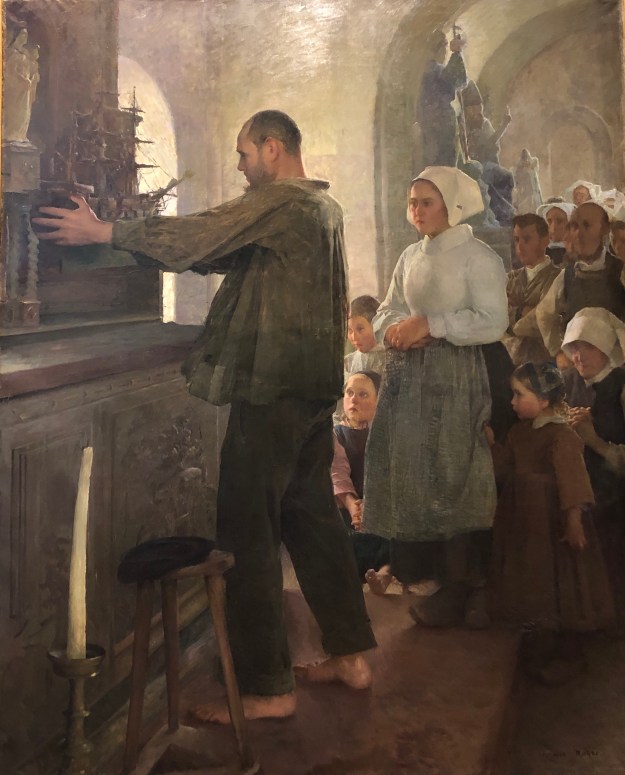
Henri-Paul Royer (1869-1938) ‘L’Ex-voto’

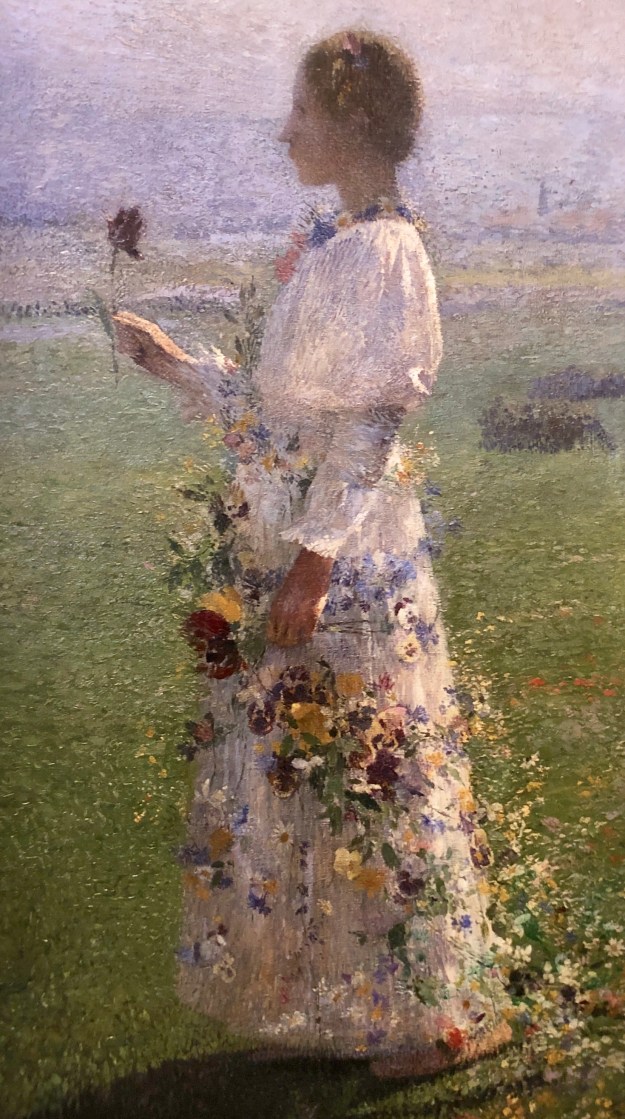
the enchantment of a flower sash…

49CAF33D-B05E-455E-86D0-A568C605B597

Henri Martin (1860-1943) ‘Belle Jeune Fille Marchant à Travers Les Champs’

or the intimate peek of an artist’s wife

A970F944-5D21-4CA4-977A-248DB38ECA21

Antonio de La Gandara (1863-1917) ‘Madame de La Gandara en profil droit’

i could go on, but I won’t :)

They had split the temporary exhibit between two museums, this one and the Musée Breton (which we had toured on a previous trip here). The latter was closed so we only saw half. We would have liked to have seen the full exhibit, but the Musée of Beaux Artes offered a vareity of works as part of their permanent collection so it’s not as if we weren’t overloaded with just trolling the halls here.

Back in Bénodet we decided to motor up river a bit for a night or two on anchor.

5E749780-AA24-44EC-A7ED-9435FB114143

Crossing under the bridge we had walked over when visiting Saint Marine,

AB39FE81-3373-4D4E-B445-4B70BE9E185F

we went a short distance, dropped the hook, and spent the next day lazily motir-drifting with the current up towards Quimper, then following it back down to JUANONA when the tide turned.

We decided to check out a little town located on the eastern shore about 3km inland. Not seeing an easy place to land we noticed a guy unloading his dinghy on what looked like a public ramp. And that’s how we met a delightful fellow named Jean. We ended up stopping at his boat on the way to JUANONA asking if he’d like to join us for a libation. He said he would have loved to but had a lot of work to do prepping his boat for a cruise in a few days.

He retired a few years ago and he and his wife spend three months in a camper van during the winter, and three months on the boat in the summer. They had just returned from their camping trip, having driven to the Black Sea and back (we noted that Albania was one of their favorite stops due to the lovely people). The traveling obviously agreed with him for he was quite a jolly guy!

96843390-1A30-479B-819A-56349C0822C0

After two quiet nights at anchor we left for Concarneau a few miles miles further east. We anchored in the Baie de la Forêt and dinghied into another lovely beach and another summery resort town.

92BA3178-0022-419B-B637-E44998F709CE

Here you truly felt summer had arrived, because it was hot. We weren’t alone as this was during the first of most likely multiple stretches of extreme heat throughout Europe, the type of heat when you hungrily seek the shaded side of a street or step into air-conditioned stores for a respite. This weather makes us appreciate our life on water vs land.

We walked to the old town ringed by a 14th-century fortress and later renovated by Vauban, who appears to have had his fingers in most of France’s defense construction. If you see a star-shaped pile of rocks, you’re probably looking at one of his masterpieces.

2ABA3A32-DBFF-4F57-93E6-B7B2DC13B645

Nowadays the old town serves as a tourist haven filled with souvenir shops, cafes and a Musée de la Pêche covering the city’s history in sardine fishing. We did visit the museum only to find it dusty, dated, and French-only signage (although we did have an abbreviated hand-out in English). But, what really made the visit unappealing was the dead air, i.e., no fans and certainly no A/C. By the time I had wandered through one of the rooms, the hand-out became a limp fan  attached to my frantically waving appendage in the hopes of staving off the trickling feeling of sweat running down my back.

Yet, we managed to make the most of it…

FF3320F4-C182-4992-9174-DE774958DE90

672EE206-81C8-4B1C-B265-204495B12889

What I found more interesting was reading in our LONELY PLANET guide book that this city serves as a landing spot for almost 200,000 tons of tuna caught in the Indian Ocean off the African coast. Now that’s a lot of Charlie the Tuna.

One night was all we required to get a feel for Concarneau, so the next day we hoisted our anchor and headed out to sea. But not too far…

Next:  A fantastic weekend on another Brittany gem….


BRITTANY: Part IV

With Wifi pretty iffy and cell difficult to use at times, I’ll try to keep up with posting but may often be a wee bit behind… this one being a perfect example of such!

ROAD TRIPPING FROM ROSCOFF…

Sunday-Tuesday, June 9-18, 2019

Reading and hearing about Quimper, Finistère’s capital, we knew it was another not-to-be-missed, charming Breton town. And, knowing we couldn’t reach it easily by sailing up the L’Odet River (a future stop further south), we took a bus to Morlaix and rented a car for our journey south.

Yet, before we left we performed our now in-grained exercise of inquiring of the nearest Tourist Office, “What do you think we should see?”

Lo and behold we discovered a flock of religious sites famous in this area:  Les Enclos Paroissiaux (Parish Closes).

Defined by a grouping of five structures–church, churchyard (once the cemetary), ossaury-chapel (bone depository when the graveyard became too crowded), calvary (not a horseback troop but a cross watching over the dead), and triumphal arch – all enclosed by a wall – Finistère featured over 20 of these Closes.

Thanks to the demand for leather, hemp and linen/canvas Bretons grew wealthy during the 16th, 17th and 18th centuries. And, what better way to spend your money than trying to one-up your neighboring village by building the most impressive religious site? Oh, and to give thanks to your Catholic god for your prosperity.

With limited time we managed to do stop-and-go’s at five of the most famous ones.

And, when I say stop-and-go’s, I truly mean running in/peering around/running out. Our visits of each site must have broken the record for the ‘seen-that-been-there-done-that’ touring. Which is why the only way I can recall which is which comes from checking each photo’s GPS location.

So, a quick litany of our Parish Close Sites follows below, beginning with our first:  Saint-Thégonnec.

The church glittered and preened with the usual gold-toned altars and pulpits boasting over-the-top decor.

Among all the pomp one piece of furniture stood out due to its simplicty:  the Archives Cabinet. To unlock it required the presence of three keys with the priest, the local lord, and the churchwarden each holding one.

Back outside we circled the calvary. As our first exposure to one we were a bit stunned to see the numerous, in some instances cartoonish, figures decorating a multi-sided cross.

However, use of visual storylines made sense considering the lack of literacy during this time. (FYI, with regards to all of the tongues sticking out, I read that it’s a part of the body symbolizing evil in man.)

Guimiliau Parish Close was one of the more beautiful ones, most likely due to its smaller setting and, thus, more intimate feel.

Drawn to its more manageable size we spent the most time here inspecting the elaborate carvings found throughout the interior:

In the churchyard its ornate cavalry beckons you with over 200 statues

and a platform allowing a priest to instruct parishoners on the story of Christ.

Driving into a rougher terrain, we noticed the churches became a bit sterner in appearance. One being the Plounéour-Ménez Close.

Amidst the medieval decor a banner introduced a modern and sobering touch. Later I read the subject was a Polish friar arrested and sent to Auschwitz. After someone escaped from Kolbe’s barracks the Nazis selected ten prisoners to be placed in a chamber and slowly starved to death. Kolbe volunteered to replace one of the chosen men. He ended up being executed after two weeks as one of the four men still alive. He was canonized in 1982 by Pope John Paul II. The man who was replaced survived the war and spent his life touring the world and speaking about Kolbe. He died in 1995.

Commana’s Parish Close appeared to be the ‘roughest’ of the four we’d seen this morning, yet its wooden reredos (ornamental screens placed behind altars) take the prize as Brittany’s most glorious according to a brochure. A placard in the churchyard attributes the ‘technical perfection’ and the ‘exurerance’ of these carvings to the naval sculptors from Brest (when they weren’t building boats).

By now we had visited four of these religious sites in less than three hours, including driving time of an hour. A graduate degree in religious architecture and art would have increased my interest tenfold. Either that or a guide who could explain it all.

Continuing on we began to climb to a bit higher elevation with sweeping views on either side. Atop one hill we noticed a chapel and decided to check it out. Turned out to be perched on one of the four highest peaks in the area:  Mont Saint-Michel de Brasparts (1,253 ft).

At first glance the small chapel appears lonely, but determined to stand its ground. And, when we stepped through the small doorway we saw colorful and disparate offerings giving thanks on a wide range of issues. I love the fact the location served as a site for worshipping the Celtic sun god :)

We stopped at one more Parish Close (couldn’t resist), Plebyn, which was undergoing repairs but allowed us a peek of the unusual three-bell tower

and a much simpler and easier to ‘read’ calvary.

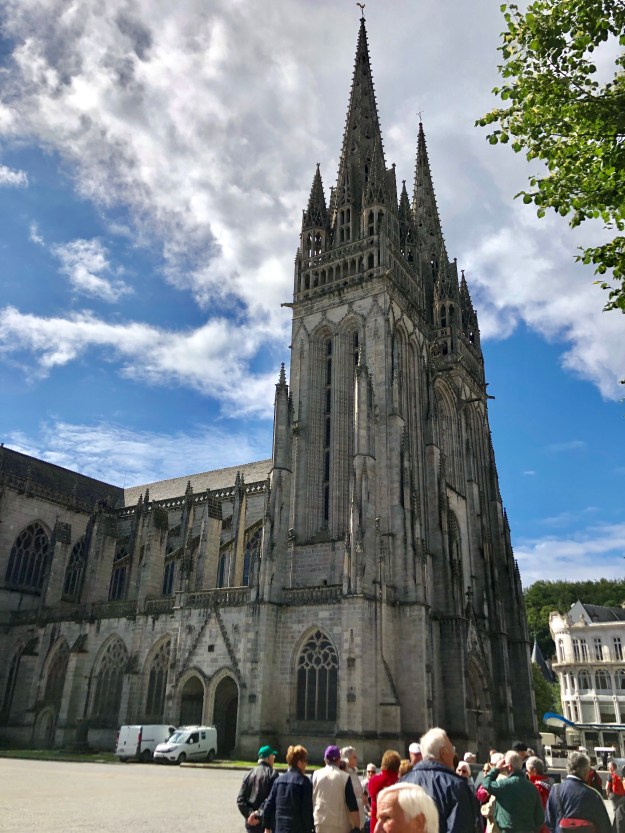
By early afternoon we arrived in Quimper and proceeded to yet another church. Begun in the 12th century the Cathedrale St-Corentin stands in the center of town on a lovely square ringed by cafes and begging for lively fairs.

Its dominance, though, diminishes a bit when you enter. Looking straight down the nave to the chancel you notice a slight skewing to the left. This came from a decision in the 19th century to add the twin towers without compromising the 13th-century sanctuary.

They later said it represented the tilt of Jesus’ head on the cross. Nice try.

What this ‘head tilt’ did, though, was bother Max who kept wondering why they screwed up the comforting symmetry of a straight shot to the altar…

Next door we visited the Breton Museum located in the former Bishop’s Palace (built by the Rohans in 1508, the same family whose castle we toured on another road trip). We saw an excellent, temporary exhibit on the Gallo-Roman period following Caesar’s 56 B.C.E. conquering of the Veneti, one of the province’s five Gallic tribes. Armorica became Roman. One of the tribes, the Osismii (meaning ‘the furthest’ in Celtic, probably due to the western-most point of Gaul)  occupied what is now considered Finistère, one of Brittany’s four departments (counties).

The Romanizing of the former Gallic culture was evident in finds such as this Iron Age stele rechiseled to show Roman gods. Although, I doubt this stamped out worshipping of Celtic gods entirely…

These Iron Age steles were particular to western Armorica along with underground galleries close to settlements.

Going back even further to the Bronze Age, the huge supply of tin led to a huge production of goods.

Surprisingly, this mound of pristine axe heads was used for exchange and exporting, not for slicing and dicing.

After perusing early history we climbed stairs to the permanent exhibits, which seemed quite small and brief. On display were statues of several of Breton’s beloved saints:

Sainte-Anne  (Virgin Mary’s mom and Jesus’ grandmother) with two pilgrimages:  Sainte-Anne d’Auray (in Morbihan region) and Sainte-Anne-La-Palud (in Finistère region)

and Saint James (bro of John the Apostle) whose tomb at Saint-Jacques de Compostela in Spain is the second most important pilgrimage after Rome (note the scallop shell on his pouch).

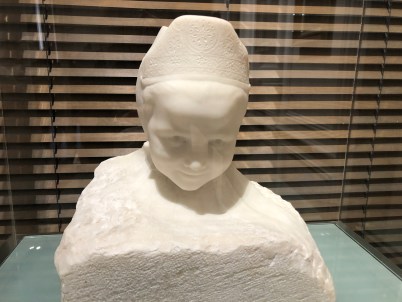
More recent artifacts included: some lovey sculpture by RenéeQuillivic (1879-1969),

the traditional hats depicting the various regions,

the traditional ceramics started in this area in the 1600s,

and, the Swiss-army knife of beds:  the lit-clos or box-bed where you can sleep, sit on the bench, and stash clothes or other stuff in the chest under the bench.

Interestingly, even in Brittany, a relatively small geographical area, the design of these beds varied:  this one had two sliding doors popular in Cornouaille, whereas in Finistère the lit-clos generally only had one, while in Morbihan the beds were usually curtained off and half-closed with no doors.

We didn’t make it to the Musée des Beaux-Arts located on the square opposite the cathedral but did wander around to soak up the medieval-ness and beauty of this city.

And, to take advantage of you-know-whats ?:)

We left the next day to return to Roscoff back on the north coast. The only site on our to-see list involved a monastary called Landévennec located on the River Aulne. Unbeknowst to us ‘the land of priests’ is one of Brittany’s taglines, or so says one of our books. And, it’s not often we can see a group of live monks.

Set in a lovely wooded area,

we entered a modern church

and enjoyed the 2pm NONE, one of the Horaires des Office. I quietly clicked on recording for a short stint to capture, to me, a special moment. Not because I’m religious (just ask Bobbie, Ellen and Carter about that) but because those sounds create a haunting atmosphere.

We also found ourselves on the continuation of the GR 34, the 133km trail outlining Brittany’s coast.

Ending up on this trail off and on the past three weeks I think it’s a wonderful alternative to getting your scallop shell at Spain’s Santiago de Campostella. Although, in speaking with Cami, a local Breton (who had just finished two months on the Norman Trail) this coastal path may not offer much in the terms of convenient lodging.

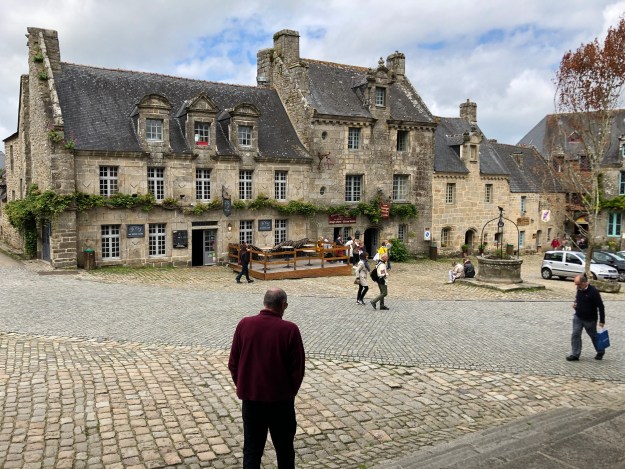
On the road again we ended up taking a side tour to Locronan. The Grande Troménie (a 12-km trotting around of religious banners following in the footsteps of the 6th-century founder of the town, Saint Ronan) occurs every six years in early July, 2019 being the sixth year. Although we’d miss it, photos captured previous ones as costumed Bretons exited the church to begin their march.

With a history tied to canvas (supposedly even the Vikings shopped here for their sails) the town grew into a lovely medieval one. And, it’s well worth a stop no matter how brief.

With that, we concluded our road trip in this part of Brittany and traded our wheels for sails.

But, not before one more photo from Roscoff. Now, that’s a head tilt… :)


BRITTANY: Part III

ROSCOFF and ÎLE DE BATZ

Sunday-Tuesday, June 9-18, 2019

After Lézardrieux we continued our trek westward, timing our departure so we would have a favorable current en route, and slack water when arriving at the next anchorage since it was up a  river.  We looked forward to getting to South Brittany which doesn’t have the high tides and strong currents that make sailing North Brittany’s waters so challenging, and limit the options when picking our next harbor and the time windows to get there.

Planning our route resulted in several hops, each one navigating one of the three sites of potentially unpleasant waters. We chose Roscoff, some 50 miles away as our next port of call.

Initially we hadn’t planned on stopping here due to some online reports from other cruisers. One that definitely gave us pause was this report (paraphrased):  We noticed how hard the tide was flooding through the marina. A boat approached and we watched him T-Bone our transom, causing substantial damage. The harbor staff told us, no wonder, we were tied up in the ‘danger zone’ at the extremities of the pontoons. Why didn’t they tell us that when we arrived?”

We also learned the new marina offset the docking difficulty by meeting incoming boats and literally pushing them into the berth (which we later witnessed).

However, we also read that approaching the harbor at slack tide (either at highest or lowest water mark) with little-to-no wind negated the need for the rubber-boat nudging; so, we coordinated our departure to coincide with favorable (low) winds and little-to-no current. And, all went well.

The marina still retains its newness with facilities being excellent (which means including a good laundry area :), friendly staff, and easy access to lovely town and old harbor.

The only oddity was grocery shopping required a bike ride (the marina rented bikes for boaters to reach it). Otherwise, whatever began as frozen or cold food would be quite warm by the time you deposited them on the boat. Yet, if you ended up there to provision, you may want to lug your laundry because we spotted an unusual (to us) service in the parking lot:

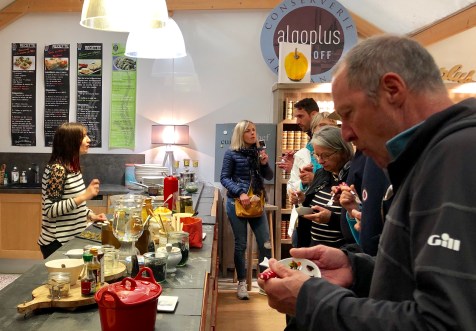
But, if all you desired was a taste of traditional Breton cuisine, shops sold tantalizing options: both savory and sweet items, including some from Algoplus, the local seaweed factory where we took a tour with Max getting a sniff of Nori…

IMG_E4980

all in French but, at least the tasting didn’t require language other than ‘yummy’ or ‘yucky’.

Like most cafes and restaurants over here, menus are conveniently mounted outisde, so you’re able to decide if you’d like to eat there before entering. Although, when checking out one establishment’s menu we noticed a strikingly unusual dish, which I’ll let you discover for yourself…

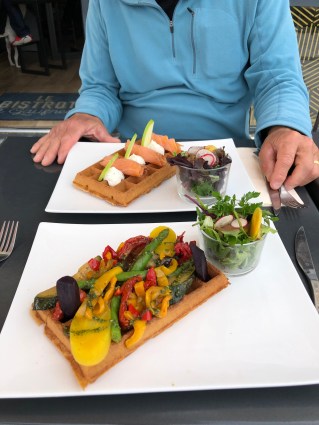
Additionally, walking just 15 mintues into town brought you to an array of local cafés offering crepes, galettes, or gaufres, the latter served at Le Bistrot a Gaufres, and where we ate three times (!) during our stay (we highly recommend the vegetable one :).

Or, you could order bread and pastries the night before at the marina office, retrieving it the next day beginning at 7:00a. We most definitely were in France :)

Unbeknowst to us we arrived as the marina was preparing for an annual event, one of the most prestigious sailing races in France:  La Solitaire; and, this year was the 50th anniversary, which raised the celebratory atmosphere a notch or two.

As the name implies it’s a single-handed race, meaning you’re on your own on the boat. Which may not sound too bad until you add in non-stop sailing for 72 hours or so  (implying 15-20 minute cat-naps for a maximum of two hours sleep every 24 hours) in the often atrocious tides, currents and weather of the English Channel. There are four separate races, each one more than 400 nautical miles. Oh, and no toilet aboard. Considered the world championship of solo around-the-buoys racing, and an unofficial qualifier for garnering sponsorships for the Vendee-Globe (the non-stop, around-the-world single-handed race), La Solitaire earns its reputation as an extremely tough race. It’s not surprising to notice the entrants’ ages appeared on the younger side…

Out of 47 entrants, only 7 are non-French. We were rooting for three of the non-French sailors (a Brit, an Irish and a Kiwi). The 2019 raced featured brand new high-tech Beneteaus equipped with foils (think ailerons projecting out from the side which help lift the boats to of the water to reduce drag). Unfortunately, this challenging race served as a shake-down for these new boats. We heard of several racers being penalized for replacing faulty screws with bolts for a plate covering the foils (which allowed water to leak, sometimes at a rapid rate, into the cabin). To us it seemed unfair to not allow this repair in order to make these boats safer for the racers.

We were in the pefect position to participate in the excitement of seeing these racers arrive after their second stage

with Max helping with lines as needed as boats began arriving en masse.

Wandering the pontoons we also got a glimpse of the preparation required for such a race, such as one sailor’s notes in his cockpit.

By the evening the boats added a festive look to the marina with the various sponsors’ logos in the rigging and on the hulls.

Thanks to hiring a ride on one of the many sight-seeing boats accompanying the fleet out of the harbor,

we watched as the fleet departed, jockeyed for the starting gun, and sailed off on their third leg.

But, the best aspect of the race for us was meeting Maria, Project and Communications Manager of Alan Roberts (www.AlanRobertsRacing.com), one of the few British sailors in the race.

We enjoyed her company immensely. We learned she, too, had raced, which is how she first met Alan. And, it was only asking further what she raced (dinghies) did we eventually get out of her she won the 2018 national championship with her crew Rob Henderson! I later read she also was, and I quote: ” the first female helm to win an adult fleet at a UK RS national championship since the RS classes were first established 25 years ago.”

If anyone needed a project manager who’s extremely capable, intelligent and personable, you’d be fortunate to have her on your team. Again, we only wish we had more time to spend with her.

The race was only one of the attractions here. Directly above the marina overlooking the la Baie of Morlaix we noticed a viewing platform. We discovered it belonged to the Jardin Exotique et Botanique de Roscoff, which opened in 1986.

So, off we treked the short walk where we peered at various trees, shrubs, and flowers

Most of the signage had English translations, albeit cumbersome ones, and I especially enjoyed reading about the various professtional and amateur botanists associated with certain flora. Some of these  were placed in a familiar historical context such as Joseph Banks (1743-1820) and Daniel Solander (1733-82) who sailed with James Cook (1728-79) on his first voyage (1768-71).

Two others – Phillbert Commerson (1727-73) and Jeanne Barret (1740-1807) – caught my interest due to the unusual arrangement of their relationship. As the following so oddly explained…

Being the perfect day for outdoor sight-seeing, the view from the top was as promised: a perfect perch from which to gaze across the bay. If you could put the next three photos together, left to right, you’d have a look at the marina (in the middle photo JUANONA is almost at the end of the second pontoon from the left… not that you can see her!)

The village of Roscoff seems quite touristy but definitely provides visitors with examples of typical Breton architecture,

including its church, the Notre-Dame de Croas-Batz. Built over a 200-year period beginning in 1520 its belfry (double gallery with two tiers of bells) served as a prototype for many other churches we saw in Brittany.

One of Roscoff’s claims to fame involved a visit by a royal personage on August 13, 1548:  Mary Stuart, aka Mary Queen of Scots. She stopped here with her entourage from Dumbarton near Glasgow. At only 5-1/2 years of age she was aboard the Royal Galleon of the French king, slated for marriage. Supposedly she prayed at the chapel. Would have been fascinating to hear what she prayed for. I have a feeling it wasn’t for a couple of fresh croissants.

Standing at the quay in the old harbor you can see a lovely island called Île de Batz, one we decided to visit on a sunny day.

While waiting for the morning ferry we had a chance to see one of the fishing boats

unload its cargo of crabs. Crate after crate (10 days worth) came off the boat and, when weighed, loaded into a truck for their next destination. We wish we could have asked them where they’d been and more about the process but while they were friendly (agreed to a photo) they were busy.

By then the ferry was ready for boarding. After paying and settling into our seats we watched as other passengers (locals, tradesmen, and tourists), multiple sacks of mail, bread from one of Roscoff’s Boulangeries, and construction materials were laded. It reminded us of the daily runs of Casco Bay ferries and how they, too, served as life lines for everyday living on small islands.

Within 15 minutes we found ourselves walking amidst the ruins of a 6th-century monastery, subsequently replaced by later churches.

We continued our counter-clockwise circumnavigation on lanes and trails running parallel and perpindicular to potato fields. Stopping to watch one harvesting operation, the tractor driver waved us into the field where we could see up close how the machine pulled the potatoes from the earth after which two people (most likely his wife and one of their fathers) sorted the small from the large before dropping them into crates.

They agreed to a photo then proceeded with their work, and us with our leisure.

Within a mile we cycled into a broad expanse of green fields and blue sky with a stone house in the distance along with a bypassing helicopter.

Pedaling closer we saw a man working on a window frame.

Unsure if we were riding on a private lane, we tried to mime the question. When it looked as if he was coming down to see us, I thought he may not be happy of our interruption, especially if we missed any sign stipulating the path as ‘privé’.

Fortunately, that couldn’t have been further from his demeanor as he welcomed us and asked if we wanted to see the house (!). In the meantime his wife biked up, introductions were made, and off she went inside leaving us with our friendly host. From her patient manner I got the impression she’s use to his embracing strangers. If anyone remembers Ed Wynn in the first “Mary Poppins” movie, this Breton could be his brother.

In showing us around he told us it was his NYC cousin’s place, one that belonged in the family and used to be the island’s mill. Which made sense of the two towers standing at one end of the house, and the 360º panaramic view. He also mentioned it was available for rent.

If looking for a place to R&R away from it all (and with little distraction), this would be it.

Thanking him and waving goodbye we returned to our bikes and followed the larger trails that allowed bikes on them (although some requiring a bit of bushwhacking)

to scenic coves

and fields never far from the shoreline.

With a quick stop at the local store for some of those potatoes we saw earlier we completed our ride within two hours.

Catching the ferry back we were glad we took the early one over for there was quite a crowd waiting to board in Roscoff.

And, with the tide having gone out, we disembarked on the long ramp built to accommodate the 20 to 30 foot tides.

As an aside, it’s fascinating to see how local boats handle the outgoing tide. On Île de Batz, we scrutinized several small sailboats balanced on their keels and shored up by two poles on either side, ones they carry on deck.

In the old harbor we’d seen boats hanging on their lines as the water goes out. Check out the larger boat against the quay in the photo below,

and the ones pretty much sitting on the bottom of the harbor.

As we mounted our bikes, once again fishermen caught our eye.

Detangling their nets of various hues, they created a scene some of our artist friends would be happy to paint.

Before ever touching foot in this part of France, I associated blue-and-white striped cotton shirts as traditional French nautical apparel, and specifically, worn by those in Brittany.

Several companies made the most of this style as we saw in the ubiquitous, blue-and-white-striped-wearing tourists roaming the sights like we were. They are pretty cool, especially the ones of a heavier cotton weave, which last for a long time (as per my sister who snagged one when in Brittany).

However, I learned that this jersey or marinière became synonymous with not only sailors but also a unique Breton, the ‘Johnny’. This was due to a political cartoon created by a British artist in an illustration. And, I found that out was during our tour of La Maison de Johnnies.

This tiny but informative museum explained how Johnnies (called Petitjeans in Britain) crossed the English Channel in the early 19th century to sell their pink onions.

Henri Ollivier (1808-65) appears as the father of this trade when he sailed to England with his cago of onions. When reading about his successful green thumb* it’s not surprising to learn of his entrepreneurial spirit carrying him to Britain.

*In 1842 this enterprising Frenchman gained national recognition when his cauliflowers and artichokes took ‘1st Honors’ in a contest run by the Royal Society of Horticulture of Paris.

A combination of abundent produce in Brittany, lack of it in Britain, and overpopulation in Roscoff led to the seasonal exporting and selling of these tasty onions. Not only were they delicious but also had a long life once picked.

The museum explained the process of shipping …

stringing, the arduous job of creating the braided ropes (image the paper cuts doing that?!), which reduced the flow of oxygen increasing their preservation …

and selling these aromatic globes by walking or cycling door-to-door, both men

and children.

They concentrated their selling in Wales where shared Celtic roots made it a popular and natural market for the Bretons.

With the exception of a small nostalgic group, the Johnnies and their onion-selling have all but died out due to changing economics post-WWII. However, we did meet a Brit earlier this summer who recalled a visit of a Johnny at his grandmother’s home.

Now that you’re familiar with a Johnny, back to the shirts…

In the August 16th,1944 edition of PUNCH an illustration by Ernest Howard Shepard (1879-1976) appeared featuring “The Breton onion-man”.

Shepard used this figure to represent the human spirit of determination and strength of France’s resistance fighters during WWII. He dressed the man in patched trousers (characteristic of Johnnies since the 1800s) and the striped jersey or marinère, which the landsmen actually didn’t wear.*  But, thanks to Shepard they stayed a symbol of the onion-selling Breton.

And, if Shepard’s style reminds you of another illustration, you’d be correct in thinking of A.A.Milne’s tales about a lad, a teddybear who loved honey, and a whole gang of stuffed pals.

Shepard’s work created the first visuals of this heart-warming group in 1923 when Milne’s verses appeared in PUNCH magazine.  Although his work comprised subjects other than children’s stories, his connection with Pooh continued throughout his life. At the age of 93 he drew his last work when he finished 240 color drawings for the 1973 edition of WINNIE THE POOH.

*This shirt originally began as a naval uniform for seamen from Northern France. Designed in 1858, each stripe represented one of Napoleon Bonaparte’s 21 victories. Since Coco Channel popularized it in her 1917 nautical collection, the distinctive shirt has been worn by an array of personalities, from James Dean in the 1955 movie “Rebel Without a Cause” to Duchess of Cambridge in 2018.

So, when it comes to a momento of Brittany what better one than a marinère jersey? :)

BRITTANY: Part II

Road Tripping continued…

Wednesday-Friday, June 4-7, 2019

DINAN

Instead of a making a day trip we decided to spend the night in a quintessential medieval village: Dinan (formerly called Saint-Sauveru). [In the map below Lézardrieux is in the upper left where you see one of the rivers, and Dinan is far to the right at the end of the river next to St. Malo.]

Within an hour or so driving we reached this medieval jewel.

Founded in the 1st century on the banks of the Rance river, Dinan would grow into a commercial hub. Exporting food crops, and later hemp, cloth merchants became prosperous during the 12th and 14th centuries. A healthy middle class emerged and became more powerful thanks to the support of Jean the 3rd who granted the town special privileges to curry the bourgeoisie’ favor.

The town also attracted the reigning dukes: In the late 1300s Duke John IV built the Château de Dinan (unfortunately closed for renovations); and, in the late 1400s Duke Francoise II approved the building of a town hall and a municipal tower. In 1500 Duchess Anne gave them a bell, converting it to a belfry, one you can climb, which Max did (I went only part way up not wanting to be on the open-air balcony at the tippy top).

Of course, if there’s a decent-size town, there’s a good-size religious building. Dinan’s is a lovely one named St. Saviour’s Church.

A Crusader, the knight Rivallon le Roux, a member of the Lords of Dinan family, made a promise to himself to build a church if he returned from the Crusades. He did return, remembered his pledge, and called the church Saint-Sauveur.

Behind it an English garden flows to the town wall, built in the late 1700s,

where peering from one of the towers

you see the old town spread out below you.

Our first taste of Brittany’s famous crepes occurred here (Max eyeing our targeted lunch spot…)

and we quickly became hooked as we had crepes for both lunch and dinner. I really don’t know how these French folk stay so slim. If they’re not eating crepes or croissants, they’re eating a baguette the size of a bat. And, let’s not forget the cheese AND the wine. It’s tough trying not to follow in their footsteps.

We loved the medieval-ness of the town but a 21st century event really made our stay magical. Our hotel happened to be adjacent to the Jacobin Theater, During a quick scouting of the area Max noticed a dance performance being staged the one night we were in town. Figuring dance would allay any issues of not speaking French, we bought two tickets.

If you EVER get the oppportunity to see “Du Désir D’Horizons” (Desire for Horizons) by Salia Sanou, GO. Being modern dance the first minute or so when a lead performer just pretty much moved one finger or a toe I thought, ‘Oh, boy, this is going to be a long evening…’. Twenty seconds later I sat in awe and for the next 60 minutes watched chaos made beautiful by eight dancers whose limbs darted, crashed, and swayed across the stage. Minamalistic music added to the raw power on stage punctuated every now and then with some speech.  http://www.saliasanou.net/new/du-desir-dhorizons-2

I’ll remember Dinan for its ancientl setting, but more so from the magnificent performace we were fortunate to see.

ST. MALO

The next morning we left for St. Malo on the eastern edge of the Côtes d’Armor. This city is a favorite for sailors, as well as tourists.

We parked in the underground garage next to the old city and stopped to take note of an interesting sailboat moored along the town quay. Conversing with one of the crew aboard we discovered it was used for research, spending three months to three years at sea depending on the project. They were prepping the boat for their next excursion:  studying microplastics, beginning in the Thames. Another reminder of the harm we’re doing to our world.

With that sobering thought we journeyed back in time to the 12th century when the fortifcation of this Ducal town began with construction of impressive walls.

In the late 14th century a castle, Château de Saint Malo, was added and it’s here we visited the city’s History Museum. Since most of it was in French and the displays seemed a bit dusty, we were in and out within the hour. Yet, we did grasp an understanding of the importance of cod fishing for the area. The ships would leave St. Malo for the Grand Banks of Newfoundland. Each ship carried 20 dories, each manned by a crew of two who would catch the cod and then return to the mothership to offload. Not a job I’d want.

Back outside we explored a bit more, first stopping in for a coffee at a restaurant made famous for its highly unusual decor.

I couldn’t help but laugh when I saw one item hanging in the window:

Ellen, Liza and Tracy, do you remember your Patty Playpal :) ?

Fortified, we joined the busloads of tourists checking out shops and eateries along cobblestone streets. Then we escaped the masses by climbing the steps to the lovely promenade on the impressive town walls wreathing the old city.

During our wandering Max eyes lit upon a fruit we’d been searching for: pomegranites!

Thanks to our friends Sue and Carol W. we’ve been making two delicious quinoa meals, one requiring the bulbous seeds of those lovely pink globes.

Yet, after Max started picking several out of the crate, the proprieter came running towards us stating they weren’t for sale. And, it’s then we looked at the storefront and discovered it’s a cafe selling smoothies (with a sign stating ‘please don’t touch the fruit’). In other words, they, too, were using them as a key ingredient…

This town definitely deserved more than the cursory few hours we allotted, but having seen Dinan and anxious to continue our explorations elsewhere, we returned to our car and headed for less Disneyesque views.

PAIMPOL

Our final stop of the day involved the amazing display of this coast’s tidal waters. Several cruisers have recommended the port of Paimpol as a unique opportunity to experience the complete draining of a harbor. However, we subsequently heard stories that made us rethink heading there with our deep-draft boat. Basically, there is no margin of error if you miss the high water mark to enter the port. To paraphrase British sailor Mike’s experience, whom we met in Guernsey, and who misread the tide tables and had to beat a hasty retreat to deep water:  “when you can see the eyes of the crabs under your keel you realize it’s not a good time to be there.”

Which is why we opted for the safe ‘cruise’ on land where happy boats float on one side of the lock…

while the other side is not so likely to float one’s boat.

And, after witnessing the incoming sailboats endeavoring to dock alongside or in berths, I am so willing to wait for the perfect tide + current combo, or as perfect as we can get them.

It’s no wonder this area breeds excellent sailors. Like we did in the Channel Islands, we have to plan our exits and entrances to coincide with the tide and current.

If we ever think of going against the current at its peak all we have to do is remember watching a sailboat trying to dock recently. First it appeared as if they’d be coming alongside with no problem only to see them moving horizontally as all on aboard quickly assess how to get the boat pointing back towards the dock. Once they manage that, it’s a fight to land without the bow hitting the pontoon first. When they’ve finally reached the dock and someone is able to jump off (or toss their lines to a person on the dock) and wrestle to slowly inch the boat closer to finally allow all to breathe a sigh of relief and the captain cut the engine.

I know it sounds crazy but we’ve both been helped (thankfully) and have helped boats to dock. At times a boat feels like a bucking stallion. And, god help you if you mess up tieing the lines!

PAIMPONT

Thursday was our last day with the car. Heading back towards Lézardrieux we stopped at the enchanting Fôret de Paimpont. The forest is known for its ties to the Legend of King Arthur and Camelot and his sidekick Merlin (and Max).

Supposedly he found Excalibur here. Although, I think it more likely he located some good cider and an abbey.

The Paimpont Abbey sits next to a lovely lake and dominates the small village. Like most of these religious structures it began as a much smaller version in the 7th century when missionaries seemed to flood the area. The Normans knocked it down, resulting in a rebuild during the 9th century. Four hundred years later, the abbey acquired its Gothic style with add-ons and renovations occurring during subsequent centuries.

Similar to other churches we’ve seen in Brittany, the roof resembles an upside-down ship’s hull. And, it’s made of wood versus stone, which is unusual.

While in Paimpont we met a charming Irish cyclist who uses the summers to recoup from a hectic winter of musical work including teaching and touring with musicals. Ger (short for Gerald) had two weeks to explore this area and was making the most of it without brutalizing himself. We wish he had more time or was closer in his circuit to JUANONA for he would have been great to have aboard for a night of conversation.

JOSSELIN

We then  headed almost due west to Jossselin and its Château. In the 11th century a viscount built a fortified town here in the Oust Valley; but, it didn’t last too, too long because the English King Henry II (same guy who built the Dover Castle and took Eleanor de Acquitaine as his 2nd wife) destroyed most of the château in 1168 when the feudal Bretons opposed him.

Two hundred years later the rebirth of what was left of the building began after a swap between the Count of Alençon and the High Constable of France. The latter, Olivier Clisson, proceeded to strengthen the defense by adding three towers along the riverside

and one more as a stand-along (which looks like a perfect Rampuzel residence if you note the little red door).

What amazed me, though, is that the current owners are related to that original Clisson. Can you imagine someone doing their geneology being able to trace it back to this house?!  When Olivier died in 1407 the renovations continued via his grandson, Alain IX de Rohan, and great-grandson, Jean II.

However, once again, revenge caused massive damage to the place in 1629. This time that marvelous spiritual guidance, i.e., religion, was the culprit when Cardinal de Richelieu didn’t take too kindly to rebellious Calvinist Henri de Rohan. Rumor has it the Cardinal snidely quipped to Henri, “Sir, I have just scattered your skittles.” And, he most obviously wasn’t talking about the candy.

Daily tours were available, and we joined the group after the guide provided a quick background. ‘After’ because it was all in French.

With no photography allowed inside we contented ourselves with exterior shots

and referencing an English brochure.

In the write-up we learned…

The ‘Battle of the Thirty’ in 1351 occurred close to Josselin during the ‘Deux Jeannes’ war (Brittany’s Civil War). The fame derives from being seen as the most chivalrous battle in history (Encyclopedia Britannica.com). It began when the governor of Brittany (supporting the French House of Blois) challenged the Captain of Ploëmel (supporting House of Montfort) to a fight composed of 30 soldiers per side. The governor eventually won with both sides suffering heavy casualties while ensuring the prisoners of the losing faction were treated well and released (The House of Montfort eventually won the overall war.)

A more recent tidbit appeared in the form of a contemporary portrait of Duke Alain de Rohan, father of the current owner. I hadn’t heard of him but some of you may have:  his friend, the American artist Trafford Klots (1913-76), painted it in 1966. Just one more reminder of the longevity of Olivier’s DNA…

I convinced Max to purchase the joint ticket so we could visit The Musée de Poupées, a collection of puppets and dolls by Herminie de Rohan during the 19th century with more recent donations reflecting current times.

Having read in THE LONELY PLANET guidebook it was, and I quote:  “more interesting that it sounds!” I thought it could be fascinating.

Hah! Fascinating if you, too, collect dolls. However, it provided some light-hearted (and extremely fast) viewing resulting in naming some of them myself, such as…

The guilty one…

Big-headed Gulliver


Religious salesman

Bad Hair Day Lady

Temper Tantrum Tess

Juvenile on my part, I know. Okay, EXTREMELY childish.

CHÂTEAU DE LA ROCHE-JAGU

Our last stop made us wish it could have been a longer one. On the outskirts of Ploëzal Château de la Roche-Jagu sits above the Trieux River, only a couple miles up from where we’re docked in Lézardrieux. Built as part of a ten-fortress defense in the 15th century, it’s the only one still standing.

And, it’s stunning with its stoic facade juxtaposed against lovely gardens.

Renovated by the Côtes de l’Armor county council, the château and grounds host exhibitions and performances. Our late arrival precluded anything but a brief visit, but we met a teacher who takes his young students here annually. He kindly walked with us to the magnificent viewing platform and explained this location was strategically important for hampering any Viking raids coming up river. Standing where we were it was easy to understand how.

After he left we strolled through some gardens. In one we spotted an Insect Hotel.

A bit bizarre, but, then, we’d seen one earlier in the day just outside of the Château de Josselin.

Hey, if I were a bug I’d be booking in at one of these hotels that sit within buzzing range of a château.

Our time in Lézardrieux was coming to a close with a forecast of a good combo of wind and tide. However, our next port isn’t too far from here. And, we’re looking forward to more adventures in Brittany!

Next, more medieval-ness and an amazing sailing race…


BRITTANY: Part I

Brittany/Bretagne/Breizh (in English/French/Breton)

Thursday-Sunday, May 30-June 9, 2019

Lézardrieux

After five years cruising in countries where locals speak two, if not three, four, or five languages with English typically the second or third one, we’re now in France. Although many aren’t fluent in English, they sometimes know enough to help us get by, and speak English a lot better than we do our halting French.

Bereft of foreign tongues other than un peu francaise and un poco español, our forays into expressing ourselves now involves a lot of limb + digit contortions. Fortunately, fingers serve as numerical communicators while hands and arms provide directions, both literally and, if we’re lucky, figuratively.

So, yes, we landed back in France :)  And, I say ‘back’ as we had stopped in Dunkirk and Boulogne Sur Mer on our way down the English Channel last month, touching on the south coast of England before ending in Alderney and Guernsey a few days later.

After visiting the Channel Islands we managed to perform the higher mathematics required to compute favorable tides and currents to safely reach the northern coast of Brittany.

As you can see from the captain’s relaxed demeanor all went well as we proceeded to slowly glide up the Trieux River.

Lézardrieux, a small village 6 miles from the river’s mouth offered pontoons available for docking at all tides, as well as an inner harbor protected by one of those sills, i.e., boat bathtubs.

During a 12-hour period you witness a range of low and high tides, which means you’re either getting some good calf-muscle work-outs…

of simply walking to and from one’s boat.

We set out to explore Friday morning beginning with the weekly market. Located up the hill in the town square we joined the shoppers and queued along with them.

Perusing the enticing arrays, we purchased two humongous artichokes. Max having read that these were in season we thought it would be really cool to see them in the field. Which we did when walking on part of a 133 km coastal path (“GR 34”).  Once you see one artichokefield, you’ll notice them all the more with their distinctive, inquiring heads poking up on stalwart stalks amidst long, feathery leaves.

Never having seen artichokes ‘in the wild’ we couldn’t get enough of peering at them whenever we came across yet another crowded patch.

After a few days of exploring locally we checked out transportation options for going further afield. Surprised to learn of very limited buses and trains between villages, we rented a car for day trippping and one overnight.

And, before I take you on our journey, just a quick (I promise!) and extremely simple overview of the most western part of France. Not that France was the France as we know it today, but rather a hodgepodge of various fiefdoms in earlier times.

As the name suggests Brittany reflects the connection to Great Britain, specifically those living in Wales, Cornwall and Devon. Between the 3rd and the 9th centuries their ancestors crossed the Channel and landed in the Roman land called Armorique (now Brittany) to escape the Viking raids and the push of settlers from the east looking for more land.

With such a strong connection to Celtic England, Brittany pushed back on any domination by the French during the 7th and 8th centuries. In the 9th century, the King of Franks, Louis-le-Pieux (interesting name) had had enough and appointed Nominoë, the first Duke of Brittany.

Well, the Duke decided that was his cue to create his own kingdom. He proceeded to fight Louie’s successor. Not only did this Duke of Brittany succeed in establishing independence from the King of France but also created Brittany’s own archdiocese. With both church and state separated from the Franks, the Dukes of Brittany became an autonomous region of France.

Of course, this doesn’t mean Brittany didn’t experience its own internal power struggles. In the mid 1300s a civil war broke out when Duke Jean the 3rd died. This led to his niece (Jeanne de Penthièrve) and his step-bro (Jean de Monfort) to duke it out (couldn’t resist). The war became known as “Deux Jeanne” or Two Jeannes. And, no, that extra ‘e’ on Jeanne isn’t a typo. It includes Jean de Montfort’s wife who just happened to be named, you guessed it:  Jeanne de Flandre.

With the help of England, Jean de Monfort won, and yet another Jean (the 4th, son of the 3rd) gained the top spot. I must say all of these Jeans just beg for a ‘Peter picked a peck of peppers’ tongue twister…

In the 1400s Brittany blossomed as a kingdom establishing diplomatic ties, its own currency, its first university (in Nantes), and -drum roll- possibly formalized its first symbol, the ermine.

Why the ermine? Royalty and Aristocrats used the luxurious white fur with black-tipped tail for cloaks depicting their high status. Legend has it, as well, that the little critter would prefer death to getting its pristine coat dirty. This translated into Brittany’s motto of ‘Plutôt la mort que la Souillure’ or ‘Rather death than defilement’.

Brittany’s modern flag continues the tie to this heraldic animal using the ermine’s colors and tail as part of its flag.

Yet all good things must come to pass, at least as far as Brittany’s independence. In the late 1400s the French gained back Brittany when King Charles the 8th defeated Duke François the 1st in 1488. When the Duke died in 1491 Charles cemented his rule over Bretagne by marrying, more likely ‘grabbing the hand of’, Duchess Anne, François’ daughter and inheritor of the dukedom.

It doesn’t stop there. When Charles died eight years later she had to marry his successor, Louis the 12th, and seven years after that her daugher Claude became another pawn in the chess match of royal “I dos” when she got stuck with the nephew of Louis the 12th, François d’Angoulême, although he did become the French King Françoise the 1st.

Interesting factoid:  This king was the patron of Leonardo da Vinci who moved to Amboise in 1515 where the two of them developed a close relationship. Leonardo died in Amboise four years later, in 1519, and may have been buried there, although this year DNA research is supposed to establish conclusively if that’s true.

Lady with an ermine (1483-90) by Leonardo da Vinci (1452-1519)

When Anne, a beloved figure of the Bretons, died in 1514, her heart was buried in Nantes, fulfilling her wish. Sounds like another MDT (Max Disaster Tour in the making…).

Although Françoise the 1st enacted the Treaty of of Everlasting Union in 1532 in recognition of Brittany’s identity, the struggle between Bretons and the French continued even into the 20th century. Separatist groups, such as the FLB (Breton Liberation Front), the ARB (Breton Revolutionary Army), and the UDB (Breton Democratic Union), continue to advocate for autonomy from France. This includes a revival of their language, which explains the two spellings on road signs. Neither of which I can pronounce well, if at all. (FYI:  The ‘Brit’ in Great Briton and Brittany comes from the Roman’s Latin ‘Britainnia’  meaning ‘Briton’s land’.) 

Today, this region is divided into four ‘departments’:  Côtes d’Armour (where Lézardrieux sits); Finistère (west); Morbihan (south); and Illie et Vilanie (east), bordering Normandy.

The coasts provide harbors for commercial (fishing and shipping) and pleasure (lots of boaters) while inland offers fertile fields for grazing and crops. And, of course, there are the coastal views

and river views.

Our first day-trip began with Perros-Guirec and the Côte de Granit Rose (Pink Granite Coast).

A continuation of the 133km GR 34  walk takes you through the park showcasing pink granite rocks of all shapes and sizes:

Evidently when the sun is low on the horizon the land glows a shimmering pink, which must mean the whole little town does because everywhere you looked granite is THE material for construction.

With so many sites inviting exploration during the three days we had the car, our touring required a selection of sites within easy driving range.

Fortunately, you don’t have to go far for one of Brittany’s medieval cities, and during our stay we chose some we had read or heard as being good examples of that historical period. One of these was Morlaix, a medieval city, where I saw a type of home I’d never heard of before:  the lantern house.

When we entered we learned why the label:  the open space from the floor to the ceiling allowed a lantern to be hung to provide light.


This uninterrupted view also showcased the hard-to-miss staircase (as seen in the video) and immense fireplace.

Called the Duchess Anne’s House, this home would have been considered a mansion with its prestigious location in one of the most sought-after neighborhoods of its time. Additionally, elaborate wooden figurines attest to the hiring of skilled artisans for its decor.

Staring up to the three floors where rooms exit off of the staircase

your vision soars 52 feet to the top thanks to the architectural widening of the staircase on each floor while decreasing the handrails heights.

Upon exiting we learned we were fortunate to be here in 2019 and not 2017 when a flood required major renovations. I’m so glad history doesn’t get swept away leaving only empty spaces for modern life to take hold.

This city features another notable construction:  a viaduct.

Built in the mid 1800s, it spans the Riviere de Morlaixand serves as a railroad, pedestrian crossing,

IMG_4517

and viewing platform.

Unsure exacty why such an elaborate infrastrucure was required I asked a local. His response was a shrug and a laugh saying, ‘who knows?!’

What I do know is this area offers a fascinating destination for anyone interested in medieval history, exploring a unique coastline, and eating artichokes as big as one’s head… or, at least, hand :)

Next, another culinary delight:  crepes at Crêperies…!

CHANNEL ISLANDS: Part III

GUERNSEY (continued…)

Thursday-Thursday, May 23-30, 2019

We didn’t only do indoor touring as these islands offer a gorgeous backyard in which to play.

We had heard of two beautiful islands close to Guernsey–Herm and Sark. Daily ferries connect to both for day tripping, and based on some friends’ recommendations we decided on Sark.

The island is populated by 600 people, not including the seasonal influx of tourists, animals–both domesticated and wild

IMG_E4141

(saw a rabbit, Deborah, and thought of you :), tractors, horse-drawn carts,

and bikes. What we didn’t see are cars, which are not allowed on the island ensuring lovely cycling roads–when not avoiding the tourists, animals, tractors, horse-drawn carts, and other cyclists.

We saw a few of the formal sights such as the local prison,

and the 17th-century La Seigneurie where two of the three ruling families (seigneurs and dames) lived.

Not quite understanding exactly who these Seigneurs and Dames were, I learned about one of the more recent ones when stopping in at the Tourist Information (TI) Office. There I read about the Nazi Occupation and the formidable and feisty Dame Sibyl Hathaway (1884-1974), the feudal overlord who inherited the position of Dame when her father, the Seigneur, died.

Wanting to learn more about this Dame, I found a wonderfully entertaining article, which is definitely worth reading if you’re interested.

During her lifetime Dame Hathaway fought to maintain Sark’s bucolic way of life, one established way back when. She did so with comments such as, “If it was good enough for William the Conqueror, it should be good enough for us”. After reading the above-mentioned article, this pronouncement gives you a pretty good idea of why she could be labeled ‘feisty and formidable’.

Speaking of good ole William, feudal laws followed under the Normans still existed well into the 1900s, which is how Sibyl inherited her right to govern over the other islanders.  This changed in 2008 with elected officials replacing this hereditary position, but not necessarily voiding all of the Dame’s ‘rules’ as cars are still not allowed on the island…

Similar to other islands of intoxicating landscapes, Sark has attracted its share of artists. Prior to WWII some set up their own colony calling themselves the Sark Group. They built their own two-story studio and gallery, which today serves as the Post Office and store. We saw some of their art work on signage in the small TI office. Every time I read about creative retreats such as this one I think of our artist friends and how they would soak this up.

The painting above captures one of the most spectacular views on the island. It appears when crossing to ‘Little Sark’ via a manmade bridge (repaired in 1945 thanks to Dame Hathaway’s use of German POWs from the occupation).

In spite of quite a drop on either side my fear of heights didn’t keep me from enjoying the 360º vista.

Although, I do admit the handrail came in handy every now and then as we walked our bikes across. Walked because riding wasn’t allowed.

I can’t tell you how much I loved exploring this island. And, I can’t specifically state why except to believe it came from riding down country roads under a sunny, blue-sky day, poking here and there, stopping for refreshments (yes, coffee) while engaging in conversation with other contented souls, and just literally ‘being’. Talk about lucky.

The only dark cloud above Sark, and not one tourists would necessarily know about, comes from the recent domination of two landlords, the billionaire Barclay twins. In 1993 they purchased Brecqhou, a little island NW of Sark and proceeded to build a huge Gothic castle. Subsequently, they bought/built four hotels on Sark and also planted a vineyard (in an area not necessarily noted for its fine wine…).

With all of this wealth they exhibited the typical 1%-ers behavior:  we later heard of the Barclays helicoptering in a head of lettuce from their Ritz Hotel because it was organic. It better make some good salads if that’s how they’re doing their grocery shopping.

Being the wealthiest islanders they aimed to mold Sark into their own private fiefdom. They bullied the islanders into changing an inheritance law, reducing Brecqhuo’s taxes, and challenging the centuries-old rule of the Seigneur (or Dame). The latter the Barclays said wasn’t democratic enough. But, then, after the 2008 voting in of a democratically elected chamber they threw a temper tantrum when their candidates weren’t voted in. For revenge the twins shuttered their businesses  (tossing over 100 locals out of work). They reopened them later only to close them again. Trust me, it gets complicated.

For visitors, though, this friction seems pretty muted.  We learned of only two signs of this divisiveness: (1) when our waitress said they had just opened after four years of closure,and, if the Barclays felt the business did well, they’d remain open;

IMG_4128

(2) the withering grape vines we passed cycling out of town. But, as I said, we didn’t feel any simmering undercurrent during our short stay.

Returning our bikes we walked down the steep hill back to the ferry dock, feeling completely sated with a summertime joy.

You don’t have to go off island to appreciate Guernsey’s outdoor attractions.

The town itself provides interesting walks. A maze of cobblestone streets and stairs wind up and down the hills. It seemed we were always going up or down some incline.

Yet, any climbing resulted in a lovely view over the city.

Even after a week of going places in town I still couldn’t tell you the most direct way to reach anywhere. Other than our coffee place, of course.
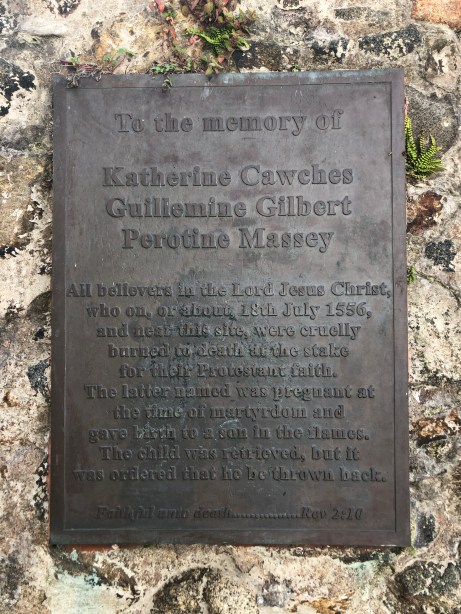
During one of our first self-guided tours around town we passed a plaque on Tower Hill. It was one of the most disturbing ones I’ve seen, for it marked the spot where a mother and her two daughters, one being pregnant, were burned to death for their Protestant belief under Bloody Queen Mary’s rule.

To make it even more horrifying the daughter gave birth during the burning, and the executioners decided to throw the baby back into the fire. Makes me sick just writing this even now.

When discussing this with the minister mentioned in my earlier Guernsey post he said people were horrified to hear this and determined the islanders needed to be educated. So, when reigns changed from Mary to Elizabeth I, the Elizabeth College for Boys was established by the Queen in 1563.

A much pleasanter walk took us to a peaceful oasis in the middle of town where stunning photographs serve as part of the flora.

Candie Garden, perched on a hillside in the north part of town, drew us to another spectacular piece of St. Peter Port. We didn’t visit the Guernsey Museum and Art Gallery there but did see a statue dedicated to its famous exile-er.

I had mentioned in Channel Islands: Part I the best-seller, THE GUERNSEY LITERARY AND POTATO PEEL PIE SOCIETY, as being one of my few sources of information prior to arriving here. Set during the Nazi Occupation 1940-45 the story features landmarks existing today.

I found reminders of this book scattered throughout the town, which isn’t surprising considering the tourism board has embraced this novel whole-heartedly. They’ve even created a ‘passport’ you can get stamped in various locations.

Adding to that, one of the walks promoted in their “Tasty Walks” guide book features a city trail dedicated to locales associated with the book’s characters.

That guide book turned out to be a great resource. We didn’t really do any of the 20 self-guided walks but wish we had, especially after circumnavigating the island on the public buses.

Halfway around we had to switch buses, and while waiting we noticed a wetsuit throng of little ones hoisting surfboards for a lesson. Whenever we come across surfers I always think of my Nags Head family who, for sure, would have been catching waves if they were here. Those wetsuits would come in handy as I believe the water is about the same invigorating temp as Maine’s.

We ended up taking a trail on the south side of the island, and the scenery was stunning.

Being a Bank Holiday Weekend plenty of other visitors were out and about strolling the streets. Especially the one fronting the harbor featuring an annual fair. A mushroom of tents had sprouted up over night and now offered a range of wares from ice cream to pet accessories.

IMG_4112

And, no surprise seeing dog collars and catnip for sale:  tThe Guernsey SPCA sponsored the fair. Which also accounted for the appropriately dressed folk playing ball.

IMG_2720

The day also offered one of our favorite activities:  sticking our heads out of head holes…

Being in a harbor where boats appeared to come and go as often as the tide we met some fabulous folk, both visiting cruisers and locals:  Karen and Jean-Luc; Elie, Jan and Mike; Sadie and Denis; and, the local port captain of the Cruising Association, Richard. And, being sailors, they kindly shared their knowledge of ports and anchorages assisting us in where to head next.

This port didn’t lack for boaters, especially with the number of regattas. We’d go to bed on an almost-empty pontoon only to wake up the next morning surrounded by a boat load of racers, some even rafting to us in the middle of the night. Definitely added a higher level of energy to the harbor.

Experiencing some of the Channel Islands I was amazed we hadn’t really thought of them as a vacation destination. The lovely outdoors combined with a distinct cultural experience felt similar to visiting the Azores, another European archipelago (albeit a bit further away from the mainland).  Although, we had heard more cruise ships were popping into the harbor here, which explained the American accents we heard when walking in town or riding the buses.

In speaking later with a resident, she said tourism had actually decreased since the heyday of the 1950s, 60s and 70s.

During those decades these islands served as an exotic destination for Brits who wanted sun and beaches (and there are some amazing ones here) while also enjoying the ease of an English-speaking country. Furthermore, frequent ferry runs between the mainland and islands ensured convenient transportation.

Yet, as the Brits began to venture further afield to Spain and other countries offering similar amenities, and sometimes for less money, the Channel Islands lost a lot of their visitors. Now an emphasis is on marketing these islands resulting in an increase in tourism, one of Guernsey’s main economic drivers. 

So, if you’re looking for a relaxing spot to stretch your legs and treat your eyes, consider the Channel Islands. And, if you do, please say hello to Mrs. Tiggy-Winkle for me :)