Author Archives: margaretlynnie

Island Escape

HARLINGEN

Thursday, June 16

Within 36 hours of Max arriving back in Enkhuizen (having extended his trip home to attend a funeral) we began staging for a passage to southern Norway. All winter we’d been planning to head into the Baltic (East Sweden and Denmark) and had studied those areas extensively.  But in the past few weeks, largely due to customs and immigration considerations, we changed our plans entirely and decided to head to southwest Norway instead. The change of plans forced us to do a crash course to figure out the tides, routes, harbors, and “harbors of refuge” (places to duck into in severe weather) for our new itinerary.

Our original plan of exiting to the North Sea via Den Helder changed after some excellent advice from Henk and Kiki, cruisers we had met in Hoorne. They suggested crossing the inland lake, the Ijseelmeer, for Harlingen, a port on the North Sea, then heading for Vlieland, one of the Frisian Islands. Not only did it make better sailing sense, it also provided the opportunity to explore another fun cruising destination in the Netherlands. Harlingen it was.

It felt great to be moving again even if it was via motor and even though there were tons of itsy bits gnats. Within an hour they covered JUANONA. Fortunately, they weren’t biters, just minor annoyances as we swatted them away from faces and necks and, in one instance, swallowed a few.

IMG 8003

We went through a lock at the eastern end of the enormous dike, called the Afsluitdijk, which ran across Northwest Holland and keeps the North Sea out. The 20-mile-long dike was built over five years from 1927 to 1932 and is an engineering marvel.

IMG 8005

We sailed on to Harlingen where a pair of bridges opened and led us into a narrow harbor full of cruisers, mainly from the Netherlands. And, was it packed! We wondered how on earth boats maneuver during the busy months of July and August if this was how the harbor looked in June; yet, the Dutch ability to navigate such crowded harbors never ceased to amaze me and, once again, I was in awe of their docking skills.

Spotting a good-size boat tied to the wall we asked if we could raft with them (a common event in this populous country). No problem as they took our lines then helped us spin JUANONA so our bow was facing the exit (we always try to position ourselves for the easiest exit as wind and current can play havoc when endeavoring to steer a 39’-long vessel with one propeller pushing from the last few feet).

Thanking them with a bottle of wine they asked where we were going, etc., and in discussing possible winter harbors they suggested their small club marina in Amsterdam (just east of the one we had used when moored in that city). Always wonderful to have fellow cruisers provide good advice, and we’ve found the Dutch to be extremely helpful in this regard.

With JUANONA tied off we went to the harbor office to pay our one-night fee. Here, we found another friendly helper in the form of the harbor master, and she smilingly filled us in on the details we always request:  shower block codes? garbage disposal? grocery store?

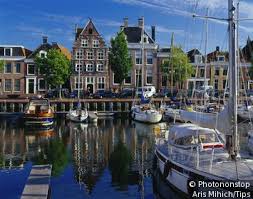
Hearing we had at least an hour before the store closed we strolled through Harlingen’s cobble-stone streets threaded by canals and bordered by stunningly well-kept, 16th- to 18th-century homes.
Unknown

This Frisian port gained fame and prosperity during the 1700s due to the whaling industry. Today the town maintains its connection to the sea as a transportation hub for ferries darting to and from the islands as well as a convenient harbor for cruise ships and recreational boats.

VLIELAND

Friday, June 17

Unfortunately, we didn’t have much time to explore the rich heritage of this lovely, mainland town because we wanted to reach Vlieland, one of the less-inhabited Frisian islands, on a favorable current. So, freshly showered and with a few more provisions we left with a flotilla of other boaters to head across the Wadden Sea (the south-eastern part of the North Sea).

IMG 8009

During our brief, 15-mile crossing we watched as boats, small and large, criss-crossed our wake or motored parallel to and from our heading.  Gazing around us we could truly see how these waters must have looked when covered with trading and military ships of yore. I finally understood that the centuries-old paintings depicting a bustling array of sailing vessels didn’t lie but were true representation of those times.

IMG 8025

IMG 8018

One magnificent boat, s/v ADELE, passed us with friendly waves. Max later discovered this yacht has sailed all over the world including South Georgia, Antarctica and Cape Horn. As a friend of his wrote even I might enjoy cruising the Southern Ocean on a boat like this :)

IMG 8011

Reaching the carefully buoyed entrance to Vlieland’s one harbor we exited from the main channel and entered into a marina chock full of sail and motor boats alike.

We were fairly confident we’d find a place to dock because we had heard from other boaters, including a friendly cruising couple, Ineke and Willem, whom I had met in Enkhuizen, that most weekenders were headed to the larger, more populated island, Terschelling, for its Oerol Festival. “Oerol” translates to “everywhere” due to farmers letting their cows go free one day each year (why, I don’t know). This annual, ten-day event sounded wonderful with live performances in dance, theater and art but not something we could manage this year. Which meant, hopefully, more space on Vlieland, Terschelling’s quieter neighbor.

Sure enough we located a convenient hammerhead where we quickly docked then did our usual pivoting of JUANONA for a future exit.

IMG 8084

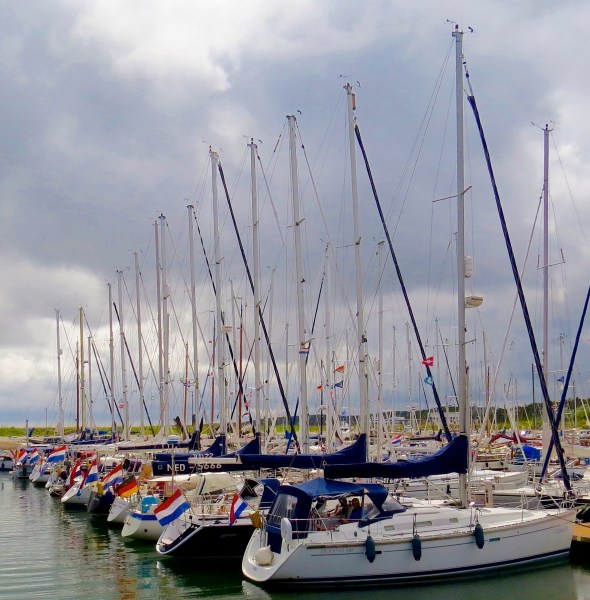
This marina was alive with weekenders enjoying the summery sun with kids crabbing, adults relaxing, and lots of people bike riding (the island doesn’t allow automobiles unless you’re one of the few 1,200 residents). And, if there was ever any doubt about where we were cruising one glance down a pontoon solved that as the Netherlands’ flag streamed off of majority of the sterns.
IMG 8093

Our friends Henk and Kiki, whom we had met in Hoorne and who have provided us with invaluable information along our most recent sails, mentioned their son Michiel, daughter-in-law Barbara and children were aboard their boat s/v POPCORN in Harlingen and also were headed to Vlieland. We managed to locate them and enjoyed meeting this sailing family who gave us tips on what to see and do. Renting bikes seemed to be a no-brainer, one echoed by POPCORN, which became our plan for the next day.

Saturday, June 18

In Vlieland we’d be waiting for a weather window to cross to southern Norway, and it appeared Sunday, June 19, would offer decent winds for the short 340-mile passage. Knowing we had a free day to enjoy this beautiful, wind-swept island we rented bikes and began our tour. Passing through the pretty, one-street town of Oost-Vlieland.

IMG 8078

Heading west I got a jolt of nostalgia, all brought on by seeing a dream house sitting atop a small hill and tucked into a verdant landscape. It reminded me so much of my Douglas Bruce cousins’ home in Corning, I had to take a photo. Boy, did that bring back wonderful and powerful memories.

IMG_8075

Continuing on our way we cycled along a beautiful (flat :) ) road with the wide-open sea on one side

IMG 8043

and forested dunes on the other.IMG 8042

Stopping to take in the sights such as the local horses

IMG 8036

IMG_8070

and clever counterweights on fence gates,

IMG 8052

we understood why this coastal area is part of the UNESCO Wadden Sea World Heritage Site, the world’s largest, unbroken system of intertidal sand and mud flats.

IMG 8053

On the north side of the island we climbed the dunes and spotted sailing dune buggies. I saw Max keenly eyeing these sand vessels and knew we’d be on them if we had had more time.

IMG 8058

But, prepping for Norway beckoned, and we returned back to JUANONA to finalize our passage planning.

Our Netherlands cruising was coming to an end. We knew we’d be back. How could we not return?

But, first, a return to another land whose people and natural beauty seduced us the first time we saw it…


AMSTERDAM

Monday, May 9

Rudy arrived and we introduce him to the quick ferry ride across to Sixhaven Marina then whisk him back across the river for a walk-about, which ended at the Van Gogh Museum covering this artist’s life (1853-90).

Vangogh

Renovated in 2014-15 this museum provides an easy to digest biography of this artist’s life, beginning with his childhood in the mid-1800s.

Vangoghmuseum0915

The space was crowded but not overwhelmingly, so it was easy to stroll from one floor to the next. Some of the most fascinating tidbits to me were how he interacted with his fellow artists, many of whom being his friends, and how much of a craftsman he was in relation to learning his art. I had always assumed he was an impulsive artist, splashing and coloring his canvases without much preparation. I quickly understood this guy practiced and practiced and honed his skill, experimenting with various techniques and subject matter, one being a japanese interest.

Vincent van gogh biography 6

What was truly wonderful was the love he had for his brother, Theodore, a successful art seller who supported Vincent financially and, even more importantly, emotionally.

Theo van gogh

With beautiful weather beckoning us we finished our fairly quick review of Van Gogh then strolled to our ferry and home to JUANONA.

HOORN

Tuesday, May 10

We had been keeping an eye on weather for heading to another historical site further north. Hoorn, once a port of the Dutch East India Company (the West India Company was created in 1621) , sits on the Markermeer, a lake due to the dyke built in 1932.

It was an easy sail involving an initial lock out of Amsterdam. Within six hours we were approaching the narrow opening to Hoorn’s 13th century harbor under the watchful gaze of the Hoofdtoren, dating from 1532. This tower served not only as one of Hoorn’s defenses but also as the home of the Northern Company (a cartel founded in 1614 and operated until 1642) focused on whaling.

IMG 7804

Entering this historical harbor was magical with a lovely park on one side and the old buildings on the other. We love tieing up to town walls because you simply step off the boat and immediately become part of the local landscape. Plus, it’s a wonderful way to meet people walking along the water’s edge.

We found the Tourist Information Office, purchased a walking tour map for the next day’s exploring, then settled into an easy night ending with the obligatory OH HELL game, something Max and I had been missing since the last time a third crew was aboard.

Wednesday, May 11

Another lovely day dawned and off we went matching our route with noted sites listed in two tourist brochures. With my two companions willing to dramatize the brochures’ descriptions I was thoroughly entertained as we traipsed through this beautiful town.

We walked to the oldest house in Hoorn constructed in 1593 only to read it burnt down in 1945 and was rebuilt two years later. Hmmm.

IMG 7759

As Max likes to recount, this falls in the same category as the sign we had heard about:  Antiques made to order.

You can’t walk down these streets without noticing the decidedly forward tilt to the buildings. Several theories have arisen for these ‘in flight’ houses, from rainwater drainage to gain more space above to presenting a more imposing appearance, the latter supposedly being one reason why they weren’t straightened.

IMG 7691

Then, a puzzling description about plaques like a ‘comic strip’ atop three joined houses or Bossuhuizen dating from the 17th century). Comic Strip? Well, that turned out to be a bas-relief frieze depicting the October 12th 1573 historic Battle on the Zuiderzee between the Dutch and the Spanish led by Count Bossu with the Dutch as victors. Not too comical. What was intriguing was identifying the harbor entrance (check out the second panel) that we passed through the day before.

IMG 7725IMG 7721IMG 7727

Another stop placed us in the main square opposite the Waag (Weigh House from 1609) and next to a statue of a prominent resident, J.P. Coen (1587-1629), a Dutch merchant and governor-general of the Dutch East India Company. Yet, then the brochure continued saying the guy wasn’t liked very much due to his use of violence to achieve his goal of a trade monopoly. Sounds like a great opportunity for replacement while stowing him in a museum.

Jan Pieterszoon Coen statue

Another historical building showcased a coat-and-arms facade,

IMG 7704

while an elaborate entrance provided the perfect spot for two men in repose:

IMG 7716

I mean how lucky can a women get?! :)

And, then there was the aviary we stumbled upon where my husband further endeared himself to me when he tried to get a little birdie to join him in whistling…

IMG 7740

while one nearby displayed her distaste in ruffled pink plumage.

IMG 7747

Of course, when in the Netherlands one must try on wooden shoes; and, my fellow walkers obliged me by doing just that.
IMG_7760.jpgIMG 7762

At times we felt the tourist bureau had been really searching for tourist sites such as listing the 18th century wallpaper one could see. This was hung in the antiquities room located at the Dutch Cape Horners Foundation. (Captain Willem Schouten who, with Jacob Le Maire, named that part of South America having sailed from here in 1615. We couldn’t help but think of our friends Rob and Shawn due to Rob having rounded the horn with Max in 1985).

We did end up seeing the wallpaper and, I must admit, it was pretty spectacular; plus, the two members who greeted us made us feel very welcomed. Definitely a return visit is warranted.

All antics aside, Hoorn is a lovely port to visit. We strolled by an old gate topped by a residence

IMG 7728

and a remnant (the 1508 defense tower called the Mary Tower due to the Mary Convent, which helped pay for the defense of the city) from when the city was rimmed by a wall.

IMG 7755

One of the most puzzling and sobering sites we saw was a sculpture depicting two hands in chains clasping one another. We tried to read the bronze plaque written in Dutch but to no avail.

IMG 7703

Later we inquired about this as well as similar sculptures we had seen around town. A local recounted the atrocity, which occurred during the Nazi occupation of the Netherlands. On January 4th, 1944, five POWs were taken from their prison, walked through the streets to the Grote Kerk (church) and executed. The killings were in retaliation for the assassination of a Nazi collaborator by the resistance. In 1990 four, hand sculptures representing departure, anger, despair, and support were placed along this route of remembrance where it ended at an earlier monument of a bound man mounted in 1947 at the place of execution.

Gazing at those held hands in chains one can only imagine the feeling of helplessness and the men’s poignant determination to share this tragic destiny as one. Astonishingly, neither of the two tourist brochure bothered to mention this event. Would be well worth adding.

We ended with asking our boat neighbors, Kiki and Henk, aboard and had another wonderful time sharing cockpit conversations. They also gave us some pointers regarding marinas and places to cruise.

IMG 7763

Friday, May 13

Tied to a town’s quay provides one of the best ways to become immersed in the local habitat, which is what occurred when Thijs, a local sailor, stopped by after spotting our American flag. He had cruised the South Pacific in the early 2000s and was eager to talk with fellow cruisers.

Thijs told us about his marina just on the other side of the park from us. Mentioning it could be a possible winter berth, he took us over there and kindly introduced us to the harbor master.

Wanting to spend more time with Thijs, we asked him and his family to join us after his wife returned from work; and, later that day Thijs, his wife Debra and young daughter Tika came aboard with some traditional Dutch fare and a lively exchange began.

IMG 7765

I have to say these conversations typically beginning with cruising then meandering through a range of topics become one of the gems of cruising. I can never get enough of hearing how others live their lives, many with fascinating episodes.

Saturday-Monday, May 14-16

The next morning we awoke anticipating a reunion long overdue. Our friends known to us as our Belgian family–Ta, Koen and their three children, Seppe, Frieke, and Wannes–were visiting for the weekend. Not having seen them since 2009 we eagerly awaited their arrival.

Because JUANONA couldn’t offer enough berths they had booked rooms on Oostreiland (Eastern Island), a short walk across a bridge to the main harbor. The hotel previously served as 17th-century residences and warehouses, which were converted to a poorhouse (1817-28) and later a prison until 2003 (Seppe’s basement-level room still had the bars on the window and original cell door.).

They arrived around noon, and the celebrations began after Max and I got over the shock of seeing now three teenagers who were small children the last time we had set eyes on them seven years ago…

Frieke Wannes Seppe NOV 2009

IMG 7797

After a walk around town we headed back to JUANONA for some card games and Max’s famous (and only) card trick.

IMG 7775

We discovered it was Ta and Koen’s wedding anniversary, which enhanced the festivities and toasts with the bottle of champagne brought by Koen. (FYI:  this is one of the few appearances Ta made below due to getting extremely seasick; she normally is perched on the top step of the hatchway.)

IMG 7779

A Belgian team hat was presented to Max who quickly donned it yet realized wearing it off the boat may not be appreciated by our Dutch hosts.

IMG 7780

The next day was cloudy but another stroll around town and through the park offered a chance to catch up. We learned about Seppe’s fascination with astronomy, Frieke’s interest in art and history, and Wannes’ eagerness to travel US Route 66. Ta was continuing her photography degree with an upcoming trip to Peru on a paid assignment while Koen was working towards a pilot’s license. To say we were thrilled to be with them doesn’t do their visit justice.

IMG 7800

Although there were many memories shared one anecdote does stand out:  this family has been traveling all over the world since Seppe was less than two months old; and, they were telling us about one of their more recent trips, this time to Sicily. One of the kids was flipping through a book in a museum shop and finally called Ta over. With a puzzled expression the child asked who was this guy? Followed by, ‘whoever he was he must have been really popular’ because he was featured in so many paintings. Ta peered over the shoulder, then quietly mentioned he was Jesus… Got to love it.

On Monday we were sailing up to Enkuizen (about 11 miles north of Hoorn) in order to leave JUANONA at a marina for an upcoming trip home. Steppe, Frieke, and Wannes joined us, and we arranged to meet Ta and Koen there after they made a quick trip to Amsterdam. We had just left the harbor when Seppe’s cell phone rang. It was his parents calling asking for the car keys. Good timing!

IMG 7807

A wind kicked up enough for a wonderful sail, and the six of us enjoyed a morning out on the water with some hot chocolate to take the chill out.

IMG 7819

Captain Max shared the helm with Rudy

IMG 7802

with the sail ending in a group portrait:

IMG 7814

A spectacular ending to a memorable visit with some Belgian chocolate labeled ‘Norway’  and ‘FOBF’ (from our Belgian family) (they had been a bit stunned when I told them I had separated our provisioning last summer between non-Norway & Norway)…   IMG_7995

and a thoughtful gift from Seppe as a reminder of time spent with our Belgian Family.

IMG 7833

ENKHUIZEN

Wednesday, May 18

We had heard from several other cruisers about Zuiderzee, a must-see, living museum located in Enkhuizen. We decided to visit this site while here, which we did under another warm blue sky.

First, just a bit of background on the history of the Zuiderzee… Enkuizen once sat on an inland sea due to salt water constantly breaching flimsy land barriers creating the Zuiderzee (literally ‘South Sea’). Today, this town straddles the waters of two, large lakes, the Ijseelmeer in the north and Markermeer in the south, created by two dykes: one in 1932 following a devastating flood in 1916;

IMG 7971

the other in 1976 to reclaim more arable land.

This immense watery engineering saved the Netherlands but at a price of the Zuider Zee fishing fleet; yet, these fresh water lakes provide a lovely playground for vessels and waterfowl alike.

A short stroll from the marina brought us to the entrance of the Binnenmuseum (indoor museum) housed in a former Dutch shipping merchant’s residence and warehouse and Peperhuis (where pepper was stored). The rooms featured customs and costumes of various fishing villages on the shores of the Zuiderzee.

IMG 7875

It was here I learned that the women’s stiff-winged bonnet symbolizing all of Holland to many actually is from just one small region whose village is Volendam (just south of Enkhuizen and next to Edam).

IMG 7880

Exhibits provided examples and information about residents’  lives and the various forms of commerce, such as herring fishing, harvesting of rush–documented by a short feature film, which I think could have used better editing,…

IMG 7868

tile factories, and merchant trading.

Like many small villages, prosperity ebbed and flowed with the times. Yet, the human spirit survived as witnessed by a poem, which captured both Rudy’s and my attention:

IMG 7869

Continuing in the spirit of levity, we took advantage of some exhibits begging for visitors’ particiipation, which Rudy and I jumped at:

IMG 7889

IMG 7893

Max, however, showed more reserve.

IMG 7887

Exiting the Bennenmuseum we headed to the Buitenmuseum. This outdoor site opened in 1983 and is composed of a collection of transported buildings placed in a re-created village to show life as it was from 1880-1932. Here, we could travel back in time as we walked along the streets stopping to explore various shops and homes.

It’s also where we found more ways to entertain ourselves, beginning with the display on the lifesaving crews…

IMG 7900

followed by an impressive demonstration on creating a fishing net…

IMG 7913

IMG 7912

obtaining sustenance in company of wandering ducks

IMG 7924

(where some patrons had yet to learn the danger of feeding spare crumbs to feathered friends)…

IMG 7921

mailing a card to Max’s mom from a former post office…

IMG 7932

and ending with my two manly cohorts trying their hand at bailing water the way windmills did,

IMG 7946

IMG 7940

One manly man tried to outdo the other manly man…

IMG 7945

I’d say it was a draw.

IMG 7948


Our tour of the Zuiderzee Museum had come to a close but not before one visual captured our attention by summing up the challenge facing the Netherlands. Here, truly, a picture is a 1,000 words:

IMG 7966 1


Next up:  Well, who knows? We keep adjusting our plans. Welcome to cruising life :) 

Further north to Amsterdam

AMSTERDAM

Wednesday, May 5

(Remembrance Day)

Our time in Haarlem ended as we untied under a bright sky and retraced our steps up to the Noordzeekanaal, only this time turning right towards Amsterdam versus left for IJmuiden and the North Sea.

Due to a timed bridge opening, we hurriedly went through the first lock only to be put on hold awhile for the second. For the latter we really didn’t have to tie up to wait because we discovered we were gently ‘resting’ on the bottom of the canal…

IMG 7503

Further up in Spaardnam that lock became a can of sardines (or herring, more appropriately here) with everyone jockeying for position as the Lock Keeper waved for the stragglers to hurry up. There was a bridge up ahead opening at 10:30am with the next one not until 2:15pm. We piled in amongst a plethora of motorboats, headed off on a rally together.

IMG 7513

IMG 7509

But, all of us did make it (note the traffic having to stop on this major highway crossing but the Dutch take it in stride),

IMG 7520

and we followed the canal to our destination.

IMG 7527

Since it’s difficult to tie up to a canal wall in Amsterdam this time we entered the Sixhaven Marina suggested by friends. With only a short (free) ferry ride to the center of town, docking here offered a perfect spot for exploring the city. Many others thought the same as we joined a herd of boats in this jammed marina. Although, we were once again stunned by how easily and comfortably the Dutch seem to pack in boats, such as waking up the next morning to find a sailboat docked behind the sterns of two other boats.

IMG 7529

We were welcomed by Joise and Hennie, who thankfully alerted us to a two-minute of silence at 8:00pm in honor of those who died during WWII. It would have been great to have experienced this in the city (where everyone and everything comes to a halt, and the popular King and Queen make an appearance) but we were a bit late in planning so we just observed this aboard. Tomorrow we’d begin our exploring.

Thursday, May 6

(Liberation Day)

Folks in Haarlem had warned us about the crowds in Amsterdam; yet, it was still surprising just how many people fit into this city space. Being another holiday leading into a beautiful spring weekend increased the flow of pedestrians and bikes and cars; but, we enjoyed the places we had mapped out:  Rembrandt’s home and studio after he moved from Leiden with two excellent demonstrations, one being how he mixed his paints, another how he created his prints (FYI: Anyone interested in the 17th century art business and bankruptcy should read about Rembrandt’s life from a commercial aspect. It would be a fascinating look into those times.)

IMG 0076

IMG 0069

the Resistance Museum, featuring some very brave souls, such as Hannie Schaft, known as ’The Girl with the Red Hair’.

IMG 0093

IMG 0091

and, the Gassan Diamond Tour (which was really a two-minute breeze-through of trying to watch some employees polishing the stones and a thirty-minute sales job… at least we managed to skip the Madame Trousseau ‘Museum’).

During our walk from one exhibit to the next we met a friendly pup who reminded us of our friend Sue H.’s Portuguese Water Dog. So, we had to stop and pet him while talking with his even friendlier owner.

IMG 0088

After a day of soaking up some of Amsterdam’s history we opted to grab a beer and glass of wine in the Waag’s square (because a lot of trade was conducted via bartering most municipalities had these Weigh Houses to ensure one was truly getting the correct of amount of cheese, butter, etc, bartered for). With trucks offering refreshments and picnic tables providing seating, we found a seat and then sat back to enjoy the partying going on around us.

IMG 0099

We had thought we’d only be there for one drink then head back to JUANONA, but, we were wrong, oh so very wrong. Within thirty minutes the table changed over and we found ourselves with a German Couple (Ilse and Werner) here for the weekend and three, thirty-year-old locals who had grown up together (Ditske, Koen, and Erik who’s taking the picture).

IMG 0781

We decided to participate as one of the table team’s in the trivia pop-quizzes (five rounds of ten questions each),

IMG 0112

and, well, one thing led to another,

IMG 0119

IMG 0788

ending with our strolling through the Red Light District to a local pub

IMG 0126

for one last beer.

IMG 0136

We made it home by 1:00 am along with other revelers enjoying Amsterdam’s night (and morning) life.


Friday, May 7

Well, we DID get up the next morning (Friday) and continued our sight-seeing with the focus being the impressive Rijksmuseum. A major, ten-year renovation meant the art housed here was splendidly showcased. In fact there is so much art and history (1100-present day) covered in this beautiful building that we limited our ogling to several centuries while casing the joint for hopefully a return visit.

Not wanting to overload you with tidbits I picked up, I will post one portrait painted by Theresa Schwartze (1851-1918) who, I believe is our artist friend Ellen’s ancestor. She was the go-to painter for the Dutch elite and one of the few, recognized females during that time. Below is one she painted of her niece, Lizzy Ansingh, also an artist.

IMG 0139

As you can imagine on a beautiful holiday weekend the galleries were wall-to-wall people with Rembrandt’s “Night Watch” painting drawing such a crowd I just peeped over some shoulders then moved on. After two hours we exited to the garden with its nearby water pool and walked through the park connecting the Rijks with the Van Gogh Museum, another extraordinary art feast,

IMG 0152

IMG 0162

IMG 0155

one we decided to save for another day.

Sunday, May 10

Having felt the elbow-to-elbow squeeze on the sidewalks as well as in museums, we opted out of Saturday sight-seeing and toured on Sunday. We ended up at one of Amsterdam’s House Churches, the Lord in the Attic House museum (love the name as it compliments what mom said we use to call the guy in Sunday School, “Jesus in the basement”, which basically was the end of my religious instruction). This site offers a fascinating view of how Catholics worshipped when they, along with some other non-Calvinist, religious groups, could practice their religions but just not in public. Consequently, some ‘secret’ churches were constructed in homes, this being one of them.

The self-guided tour takes you up three flights of narrow stairs, where you stop on each floor to walk around rooms furnished from the 1600s. On the top floor you step into a three-story-high ‘attic’ that features a beautiful altar. This house church was in use until the late 1800s when Catholics could again worship in public.

IMG 0182

I had also read about the World Press Photo Exhibition being held in the Nieuve Kerk, so we stopped in there for some eye-opening pictures. It made for a relaxed stroll surrounded by current events.

Then back to JUANONA while spotting a rather unique mode of transportation:  a centipede of beer guzzling partiers propelling a cart by pumping with their legs while enjoying some brew…

IMG 0202

IMG 0201

with women doing the same.

IMG 0203

Monday, May 11

Our brother-in-law Doug mentioned his brother John and wife Bette had toured the Flower Auction just outside of town. Saying that it had been the highlight of their trip we caught an early morning bus to Flora Holland.

Billboards provided background info and explained the process but it was enough just watching a beehive of buzzing human bees moving here and there.

Following a suspended walkway over the warehouse floor we landed outside the glass-enclosed auction room where buyers bid electronically on flowers from around the world (also possible to do remotely).

IMG 0220

IMG 0225

And, it’s complicated.

IMG 0218

IMG 0219

I tried following the little red dot but my eyes started spinning in my head alerting me it was time for a coffee break.

Outside we saw more evidence of the commercial trafficking of flowers as we watched truck after truck stream towards the highway loaded with freshly cut flowers. If only that natural floral scent could be bottled for JUANONA’s head.

IMG 7651

Back in town we met our crewmate Rudy, who had arrived from a two-week archaeological dig at Vindolanda, a Roman fortress town at Hadrian’s Wall.  We were fortunate to have him aboard in between his dig and visiting his Belgium Family (whom we also call our Belgium Family :) and were looking forward to some cruising, exploring, and games of OH HELL.

IMG 7662

To say life can be grand just doesn’t do it justice.

Pumping Holland Dry by Max


HAARLEM

Monday, May 2

Fascinated by Holland’s history with water, I walked 3 miles south from Haarlem to visit one of the 3 pump houses that drained a major area of Holland from 1849-52. The journey entailed taking a free ferry across what I later learned was part of the “Ring Canal” built to drain a lake.

IMG 0021

In prehistoric times, what is now the North Sea was largely land: one could walk from present day Holland to England. Rising ocean levels gradually covered the land, but even as recently as the Roman era, much of present day Holland was comprised of low lying land interspersed with lakes. However, the shoreline became an increasingly changing and dangerous landscape as the ocean continue to rise and storms battered the coast. Early inhabitants started living on mounds (whether natural or man made) called terps, to which they retreated when the inevitable floods occurred. The first known dike was constructed around the time of Christ.

Inland from the ocean were mounds of peat standing higher than the surrounding bogs. In the 10th century humans began moving from the coast into this area, and found that by digging trenches and draining water from the sodden peat domes, they could farm the land. The problem was that drying the peat causes it to lose its ability to hold back the rush of storm water; as it dries it shrinks, becomes fluffy, and the top layer oxidizes and turns sour. Once the old land becomes too sour for farming, the inhabitants looked to new peat mounds to drain.

Compounding the problem, peat became an important commodity: it was used for heating, to fire brick-making kilns, to dye cloth, to brew beer. The more the peat was harvested, the more the ground sank, and the less resistant to flooding it became. In response, towns that had ruined the land with their appetite for fuel, started to build dikes and dams to protect themselves; Amsterdam was one such town. Yet the peat harvesting continued.

(An aside to this story is described in an interesting recent book given to us by our friend Ginger, “The Edge of the World” by Michael Pye, describing the influence the North Sea has had on western civilization. After the peat became unsuitable for agriculture, it was used for cattle grazing. Families began keeping cows, and to eke out a living on the infertile land they produced butter for export. Butter requires immaculate conditions or it will spoil; it is far less forgiving than cheese. The Dutch reputation for cleanliness began with the requirement that the dairy barn, usually an extension of the house, be kept immaculate.)

With land that was now below sea level in many areas, Holland developed techniques to pump it out. In one of the most significant developments of the time, windmills previously used for grinding grain were set up to raise water over dikes and into drainage ditches. Windmills sprouted up everywhere, and enabled the inhabitants to keep their feet dry on land situated below sea level.

IMG 0026

Model of a ’tjasker’ which could pump water into a ditch, where a larger windmill would pump it into a canal to carry it to the ocean.

Nevertheless, terrible storms occurred from time to time over the centuries, causing catastrophic damage and destroying entire cities.In 1506 and 1509 there were terrible storm surges which broke through ditches and canals and formed a huge new lake south of Amsterdam, called the Haarlemmer (you can seethe beige expanse of the “Groote Haarlemmer” in the middle of the map below). By 1647 this lake had grown to 66 square miles, swallowing towns as it expanded.

IMG 0055

Map of Haarlemmer Lake

Pumping out the Haarlemermeer was originally proposed in the 1600s, but there was widespread public resistance, especially by the fishermen. But in 1836 massive storms devastated the region. In November a hurricane drove water to the gates of Amsterdam, and on Christmas Day the water was driven in the opposite direction, flooding the streets of Leiden. It became clear something had to be done: The lake needed to be pumped out. There was natural sentiment to do the job by traditional windmills, but it would have taken 160 windmills 30 years to do the job. King Willem I pushed The Netherlands to advance its technology and insisted that steam engines be used.

The first step was to build a 61 km (38 mile) elevated ring canal to carry the pumped water away, and to carry ship traffic which previously would cross the lake. It took 8 years to build, as the work was done entirely  by hand. The earth that was removed was used to build a 120 ft wide dike around the entire lake.

Three pumping stations were built. The pump at De Cruquius, with a cylinder diameter of 12 feet, was the largest Watt style steam engine ever built.

IMG 0033

IMG 0058

IMG 0041

Each stroke raises 8,000 liters 5 meters high. There are 8 levers. They run at 5 strokes per minute. The water is raised to the ring canal, from which it flows to the Spaarn River and eventually to the Zuider Zee and out to the ocean.

IMG 0040

One of the valves which let water enter the chamber on the downward stroke and closed on the upward stroke:

IMG 0060

They were paid by the stroke. A meter counted them out:

IMG 0047

Pumping began in 1848 and the lake was dry by July 1852. In the end, 800 million tons of water were removed.

Holland carefully monitors water levels to this day. Using more modern pumps, they pump out the lowlands when it rains through a vast network of drainage ditches and canals. Since there is still salt in the land left over from prehistoric times, they intentionally flood areas of land occasionally to freshen the soil. Massive dikes and dams have been built in recent decades, some of which have been designated amongst the most impressive modern engineering wonders if the world. I felt fortunate to visit this one and look forward to seeing others.

Tiptoeing through the tulips and then some

Haarlem

Saturday, April 23

We had landed in the Netherlands when festivals and holidays seemed to spring up all around us, one being the annual flower parade. As the twilight began, folks started gathering down a main street to peer at the flotilla of floral vehicles, and we decided to join them in spite of the definitely unspring-like temps.

IMG 6825IMG 6828IMG 6848IMG 6838

After watching a few we called it quits knowing we’d be able to peruse them all under, hopefully, sunny skies the next day.

Sunday, April 24

And, we did :)  but only after a quick morning shower of hail.

IMG 6850

When the gray turned to blue we headed out and became part of the people river

IMG 6895

as we wandered from one float to the next, all the time thinking of our friend Ellen who’s created floral peacocks as table centerpieces.

IMG 6854 1

IMG_6859.jpg

IMG_6862.jpg

IMG_6909.jpg

IMG_6871.jpg

IMG_6855

IMG_6923.jpg

Roller-blading blossoms handed out individual stalks

IMG 6931

while others just preferred more formal attire.

IMG 6886

Some street musicians added their tunes to the festival ambiance, one of them who could have been Robin Williams’ twin.

IMG 6916

Even the “Angry Birds” appeared.

IMG 6902

IMG 6908

At the end a mini-carnival offered kids opportunities to expend unused energy, and I couldn’t help but wish they had an adult size. What a great way to celebrate Spring:  literally, Jumping for joy :)

IMG 6924

Wednesday, April 24

We had heard that King’s Day (formerly Queen’s Day before Queen Beatrix abdicated 2013) was the best street party ever, so we took a break from exploring southern towns to join in the revelry.

It wasn’t the best weather but we couldn’t be here and not join in. Most partyers huddled under umbrellas venturing out when the rain took a break.

IMG_0012

We stopped at a lunch truck for Max’s new favorite food, kibbeling, which is fish fried in batter with a tartar-like sauce.

IMG_0002

IMG_0007

Not being much of a fried fish fan, I hesitated when he offered me some; but, after one bite, I was sold and proceeded to scarf down a good half share.

IMG_0009

When another rain storm started its drenching of revelers, we headed back to JUANONA passing by evidence of the day’s fun (evidence which quickly disappears by the next morning).

IMG_0005

Settling back aboard we heard some loud music coming closer and closer. Poking our heads out we saw the source and shared a ‘Cheers!’ to a boatload of King’s Day well-wishers. A perfect ending to the National Holiday :)

IMG_7044.jpg

LISSE

Sunday, May 1

Our first cycling on this cruise, and where else to go but Keukenhof Gardens. Unlike the last time I rode a bike, I actually made it there and back and loved it. It did help being flat. Plus, you really do feel like you’re the elite with traffic signs such as these:

IMG_7267

After about an hour+ toodling along a canal and through villages we arrived. We had purchased tickets online so joined the long line and wheeled our bikes to the entrance only to be told no bikes allowed. Once we entered and saw the crowd, we realized no wonder they’re not permitted. People and flowers everywhere. The scenery looked like someone had taken equal parts of both and strewn them across this former kitchen garden (‘keukenhof’ translated).

IMG_7283

The origins for this massive undertaking began back in the 15th century when Countess Jacqueline of Bavaria (1401-36) used this area to collect fruits and vegetables for Teylingen Castle. In 1641 Keukenhof Castle was built and the estate grew to over 200 hectares (almost 500 acres).

In 1857 the estate’s gardens were redesigned into an English style by two landscape architects (who also designed Amsterdam’s Vondelpark). Fortunately, these grounds didn’t remain in the view of private eyes only. As of 1950 the public is now able to tour the expansive flowering hub after 20 flower bulb exporters developed a plan in 1949 to use the estate for a spring-flowering exhibition.

Annually over 800,000 visitors wander through the grounds during the two months Keukenhof is open; and, today we joined them picture-taking, portrait-making, and just slowly stepping along the numerous flower paths.

Locating a convenient lunch spot, we noticed even the carts are on bikes.

IMG_7284

Instead of being too crowded I loved how everyone was milling around enjoying a beautiful spring day amidst flora, flora everywhere.

IMG_7300 (1)

IMG_7309 (1)

IMG_7414

You could visit a variety of pavilions each with its own theme, from tulips (of course)…

IMG_7312

to orchids…

IMG_7432

to kids entertainment,

IMG_7395

even some fauna: the little pig pic is for my cousin Cathy and the peacock and peahen for our friend Ellen.

IMG_7372IMG_7375IMG_7389

After two hours of strolling we wanted to head back through the fields which bordered these gardens.

IMG_7359

Even saw someone trying out his drone.

IMG_7462

We traded portrait shots with some other tulip-ers

IMG_7486

before riding back to Harlem.

Dropping our bikes off with Tara at a great hostel-inn, HELLO I AM LOCAL,

IMG_7498

we walked back to JUANONA knowing we had really, truly experienced Spring in Holland and it was SPECTACULAR and REAL :)

IMG_7399

On the road again…

LEIDEN

Thursday, April 28

Well, actually on the track again where we pass the train stations’  parking lots of bikes coming. One of these days we’ll have to use that mode of transportation. But, for now, to the train.

IMG 7047

With Max’s ancestors in mind we zipped down to a town just 30 miles south, purported to be Holland’s largest city in 1500. We wanted to check out the site where many of the pilgrims who later sailed to America gathered after escaping religious persecution in England.

Knowing that trains left almost every 15 minutes for southern stops, we only had to wait five minutes to hop a ride to Leiden. A short walk took us into the old part of the city where we passed some unfortunate boaters pumping out their half-submerged craft with the help of a crane.

IMG 7051

Since the pilgrim museum didn’t open until later, we opted to visit the Museum de Lakenhal, which obtains its name (“Laken”) from a light woolen fabric woven in Leiden. Picking up our audio guides the woman behind the desk told us they would be closed for renovations for two years, starting at the end of May. Good timing on our part because it would have been a shame to have missed this museum.

The renovation will maintain the old part of the building, constructed in 1640, which was fascinating to tour. From the 13th to the 17th century Leiden’s wealth and prominence grew from exporting cloth to the Baltic and Hanseatic Cities (a group of city alliances formed for the purpose of economic growth in the middle ages; the Hanseatic League in northern Europe was a powerhouse). After 1577 thousands had fled to this city to escape religious persecution, bringing with them textile skills with which they expanded the types of fabric manufactured here. With a supply of laborers (who, unfortunately, weren’t paid much at all), the city’s cloth business thrived.

Weaving was a home-industry based on the ‘putting out’ system where by merchants supplied the raw materials to laborers who then are paid by the finished piece. To ensure consistent quality the city’s administration established inspection centers, one per type of fabric. Lakenhall became the most significant of the seven neringen (trades) or cloth halls in Leiden. Walking into a huge room we read that thousands of woolens had been inspected here, each bolt being 44m long by 2.5m wide (145 ft x 8 ft). Between 200 and 300 weavers brought their cloth to be inspected. Three times the cloth was stretched out and carefully scrutinized.

In this room also stood a 17th-century loom used continuously for 250 years.

IMG 7057

A table stood in another room. On either side were brass bands for measuring using the Rhineland yard (approximately 68.5cm (27 in) based on an average length of a man’s arm).

IMG 7063

If the cloth passed inspection it was stamped with a lead seal and shipped to Amsterdam. We even saw one of theses seals from an earlier time (circa 1275) found in Amsterdam and marked “Leyden”.

IMG 7061

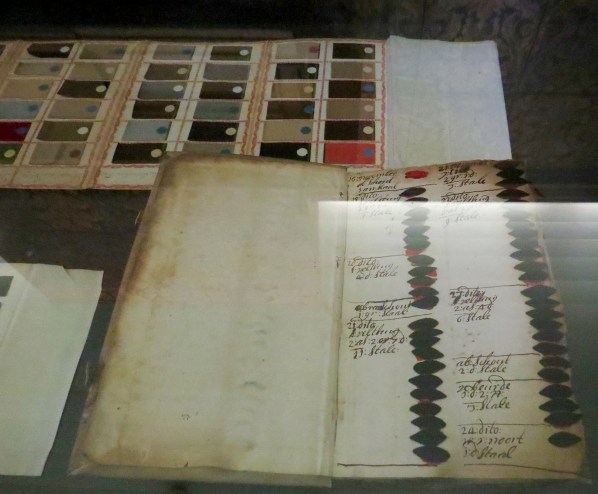
One of the most impressive rooms displayed sample books from the second half of the 17th ce. up to the 20th century. Here consistency of color was recorded foreach inspected bolt. Black cloth was even cooked to ensure the fabric maintained its color.

IMG 7065

In addition to the sample books the room decor was startling with its walls covered in embossed leather panels, a type of wall covering used by the wealthy.

IMG 7067

This museum also had several art galleries. I won’t go into all the detail but will mention they had several Rembrandt (1606-69) paintings. This famous painter was born here and spent 26 years of his life in Leiden, later moving to Amsterdam. Known for his use of chiaroscuro (strong contrasts between light and dark), the museum contains several of his early paintings.

Rooms flowed from one century to another, displaying a variety of Dutch artists, including Rembrandt’s first pupil, Gerrit Dou (1613-75) who became a virtuoso in rendering light in gradual tones and reflection. With his highly detailed painting style in small formats he became so popular and gained such international fame that England’s king Charles II tried to hire him as a court painter – but Dou said ‘no thanks’ and remained in Leiden.

Two other notable pieces were:  an elaborate Catholic Altar found in an old ‘house church’ where Catholics were allowed to practice their religion, just not in public.; and a fascinating, 1587 propaganda tapestry displaying almost a wall-size map of Willem van Oranje’s first successful battle against the Spanish (with help from the English ‘Sea Beggars’, i.e., pirates) on October 3, 1574.

Tapestry map

By this time the pilgrim museum was open. Located in the oldest house in the city we joined a group of five other tourists interested in the pilgrims’ history in Leiden.

IMG 7087

(And, Gracie, you may recognize who’s sitting on the window sill of this old house :)

IMG 7089

The museum turned out to be a 15-minute tour of two tiny rooms crammed with period pieces. It helped that the building’s owners were in the antique business; and, when someone asked how much a fireplace mantle would go for, our guide said he didn’t know but was aware that some of the pieces had sold for over 20,000 euros. Humph… No souvenirs for JUANONA here.

IMG 7075

IMG 7084

After the others left Max and I stayed to talk with the laconic curator who had an extremely dry wit. We discovered he happened to be from Oregon. His posting at the museum came about because the city administrators thought he’d know a lot about the subject matter since he ‘was from America.’ Fortunately for us he had learned a lot since then.

Our last exchange went something like this:

me:  What’s that against the wall?

him:  It’s a screw.

me:  A screw?

him:  Yes. Interestingly the pilgrims actually had a screw on the MAYFLOWER.

me:  The pilgrims had a screw on the MAYFLOWER…

him:  Yes, and it was lucky they did because the mast cracked at one point so they needed a screw.

IMG 7094

At this point I knew it was time to leave because now I had a vision in my head that didn’t tally with anything I had ever assoiciated with the Pilgrims. And, so we left.

We had several other pilgrim sites left to explore, primarily the neighborhood, then called the English Gate, where the pilgrims eventually congregated.

In 1609 approximately 300 pilgrims arrived from England with their leaders William Bradford and John Robinson, a minister. Robinson subsequently built 21 houses surrounding the 15th-ce., St. Pancraskerk Church. On the way we passed the old town hall where civil marriages were performed,

IMG 7098

and walked by buildings where surely the pilgrims had also trod:

IMG 7100

Using directions from the curator we located the lane where Max’s ancestor, Wiliam Brewster, had lived. Near by he printed religions books and pamphlets promoting the pilgrims’ beliefs.

IMG 7101

The house was discernable only by the older brick incorporated into a newer structure.

IMG 7104

We then entered the church where the pilgrims worshipped, no longer in use except as a historical site.

IMG 7115

It did have a memorial to John Robinson (he died in Leiden in 1625) given by MAYFLOWER descendants 1926.

IMG 7111

Our final stop was the oldest university in the Netherlands, founded in 1575 by Willem van Oranje in appreciation of Leiden being the first city to not fall to the Spanish (hence, the map tapestry mentioned earlier). Here, the Netherland’s famous botanist, Carolus Clusius (1526-1609), cultivated a flower soon to become ubiquitous in his country. He became the first director of the Hortus botanicus Leiden, founded 1590. The grounds are lovely with the tulip featured in abundance. A perfect way to end our day in Leiden.

IMG 7125

DEN HAAG (The Hague)

Friday, April 29

The next morning we hit the track again, this time to zoom down to Den Haag, the center of the Netherlands government and home to the royal family. This city had been the capital up to 1609, when Napoleon enthroned his baby brother Louis – the little emperor was populating Europe’s kingdoms with nepotism. Louis moved the seat of his government to Amsterdam while ruling for eight years. Upon his ouster, the government hightailed it back to Den Haag but Amsterdam remained the capital. Now, you’ll find this city hosting other global entities, such as the UN’s International Court of Justice.

Although there’s plenty to see here, we focused on two museums:  Mauritshuis, a beautiful, 1640 mansion now housing enough Dutch artists to provide a very thorough history lesson through oil paintings throughout its 16 rooms; and, Escher in Het Paleis Museum, the former winter residence of Queen Emma (1858-1934) and subsequent working palace for her queenly descendants, Wilhelmina, Juliana, and Beatrix up to 1984.

Because I believe I’ve inundated you with art, I’ll simply say, If you’re ever in Den Haag, GO. These museums are gems. The first requires more time than the two hours we dedicated and the last is an eye-opening view into the 20th century artist M.C Escher (1898-1972).

If you do end up at Mauritshuis, some of the artists you’ll see are Flemish, German, and French with the majority being Dutch.

It was crowded so at times I just waited for a group to pass then step as closely as I could to peer intensely at the details, colors, and forms. What a wonderful way to learn about art, even if my study of it is pretty superficial. I can only imagine what it would be to follow an Art Historian around. I’d be hanging on her/his every word.

Some of the artists whose work caused me to pause were:

Anthony van Dyke, Willem van Hecht, Peter Paul Ruebens, Jan Bruegel the Elder, Hans Holbein, William Claesz Heddan, Roeland Savy, Rembrandt, Willem van Mieris, Jan Steen, Frans Hals, Frans van Mieris, Johannees Vermeer (whose “View of Delft” hangs here), and many others.

IMG 7176

And, yes, there were stunning flower arrangements strategically placed in entrance halls and the reception area, many sporting the tulip.

IMG 7194

The Escher museum provided background on his early years and his honing of his exquisite disorienting graphics, including his tessellation art (I needed a definition of that:  “any pattern made of repeating shapes completely covering a surface without overlapping or leaving any gaps.” http://www.exploratorium.edu/geometryplayground/activities). His approach to art and his work brought to mind one of my favorite authors, Dr. Seuss, if the latter desired to take a sophisticated tack in his illustrations.

IMG 7254

So, our day in Den Haag ended in a blur of art but all memorable.

Next, flowers galore…

A wandering we go

DELFT

Tuesday, April 26

With JUANONA comfortably settled in Haarlem we took advantage of the reliable and inexpensive train service to explore several towns further south, the first being Delft.

Identified by many guide books as a quintessential Dutch canal town, we knew we’d enjoy strolling Delft’s winding streets ribboned by small canals (added in the 15th century to connect the river Maas) and lined with medieval Gothic and Renaissance homes.

IMG 7020

We easily spotted the leaning spire of the Gothic Oude Kerk (old church). With the land being a bit soggy, many of these buildings can’t support a big load such as this one currently leaning out at 2 meters (4+ feet). Due to the precariousness of this tower, the bells they only dare toll for extremely special occasions.

IMG 6934

Close to the Oude Kerk is the former house Jan de Huyter constructed around 1500. Emperor Charles V slept here during his 1540 visit to this fair city and later the daughter of Willem van Oranje also visited. The stone is gorgeous and well-maintained. Wooden coats of arms decorate the main door, which you can just make out below.

IMG 6935

IMG 6977

Currently the Delfland higher water board is based here, responsible for keeping the water level of a boezem (outlet/drainage system of a polder, aka, drained field) at or below its maximum level. And, believe me, from the looks of the houses whose backyard is the canal this seems to be measured in inches, not feet.

IMG 7023

You read about how the royal family likes to mix in with their citizens, and here’s some evidence of that:  Just down the street from the huge stone house was the less-grand townhouse where the second son of Queen Beatrix lived during his engineering studies at the local university (he died in a tragic skiing accident in 2013).

IMG 6974

We also passed the smallest house in town with its bronze head of the municipal doctor who was also Willem van Oranje’s physician.

IMG 6971

IMG 6973

I had only associated the city’s name with its famous pottery.  With all the blue-and-white souvenirs, including this huge cabinet on the street, it was easy to be reminded of this connection.

IMG 6944

Ironically, many of the early ones were manufactured in China, the country whose famous porcelain inspired the Dutch to create knock-offs beginning in the 1600s. (As opposed to being made of porcelain clay, Delft potters used clay coated with a tin glaze after firing.) Over 20 factories popped up during the 17th and 18th centuries to satisfy demand for this earthenware pottery. Today, one factory still exists with several shops in town demonstrating the technique.

IMG 6957

IMG 6958

We resisted the numerous blue-and-white tchotchkes (for beautiful pottery, check out our friend Rebecca Esty’s) and headed for the other famous name associated with Delft:  Johannes Vermeer (1632-75), one of the great Dutch masters. Although he lived his entire life here with his wife and 11 children, there are very few, if any, of his 35 authenticated paintings in Delft. However, banners heralding ”Vermeer is coming home” broadcast an exhibit featuring one of his famous paintings, “The Little Street”.

IMG 6987

The reason for all of the hype was due to art historians over several centuries trying to identify the exact location featured in Vermeer’s painting.  In 2015 a new theory was published by a professor of art history who claims he found the street based on the two arched passageways (only one of which exists today).

IMG 6988

I’m sure it was an exciting discovery but for us it was just pleasant seeing the real painting on loan.

The more interesting tour down the street showcases Vermeer’s studio (replica), life-sized copies of his paintings, pigments he would have used for paints, his use of light and brush strokes, and a short film on restoring “The Milkmaid”. I definitely could have stayed here for several more hours. I find the technical details fascinating and only wish I could have had one of my godsons, who studied art restoration, explain it all as we peered at Vermeer’s work.

UnknownMilkmaid

Another famous personage connected to this small town is the man considered the founder of the Netherlands, Willem van Oranje (1533-84) (aka Willem the Silent due to his considered approach to matters).

WilliamOfOrange1580

This is the gentleman who joined rebels fighting the son of the Holy Roman Emperor Charles V, King Philip II of Spain. The Eighty Years’ War began with stadtholders’ protests of feeling excluded from governing their own lands to one of outright rebellion due to the persecution of Protestants by the Catholic King and his followers (i.e., Inquisition and other delights all in the name of religion).

A former, dignitary-hosting convent (now the Municipal Museum het Prinsenhof) where Willem and his family kept court also features the staircase and bullet holes where he was assassinated July 10th 1584 by a fanatical Catholic, Bathasar Gerards.

IMG 6998

The assassin may have also been motivated by a bounty on Willem’s head:  25,000 gold coins (which Philip II did pay to Gerard’s family) and elevation to nobility. However, not only was it a bad end for this founder of Dutch independence, but also for Gerards. The latter was caught, subjected to daily tortures, and finalized with a public execution involving red-hot irons, pincers, swords, and chopping. Definitely not a pleasant way to go.

Along with the site of the assassination, the museum provides information about the rebellion and all the players, including portraits of Willem’s four wives. One interesting tidbit:  his second wife had an affair with Jan Rubens, the future dad of Peter Paul Rubens. Again, more hours could have been spent absorbing more of the Netherlands’ history.

Two other notable sons of Delft were Anthony van Leeuwenhoek (1632-18723), said to be the “Father of Microbiology”,

IMG 6970

and Hugo Grotius (1583-1645), “Father of International Law”, whose statue stands in middle of the market square.

Hugo-de-Groot-Monument-in-Delft

A child prodigy and later a rebel, Grotius is also known for his escape in 1621 in a book chest after being imprisoned for treason two years earlier. There’s not much left of his Delft home but  I still wanted a snapshot.

IMG 6955

We wandered into the Nieuwe Kerk (new church), which was open to the public (the old one was closed for an event). (FYI:  what they’re labeling “new” still means medieval ages.) Here, more tributes to Willem van Oranje…

a stained glass window

IMG_6953

and his mausoleum (even in this place there’s tippiness as one of the bronze statues keeps falling over),

IMG 6945

IMG 6947

Hugo Grotius’ memorial is also here.

IMG 6951

Facing the New Church across the Markt (the market) stood the town hall. Burnt down in 1618, a new one quickly replaced it two years later in the Renaissance style. Today the view was partially blocked by a stage being erected for tomorrow’s annual royal Day celebration (currently called King’s Day since Queen Beatrix abdicated 2013 in favor of her son Willem-Alexander).

IMG 6960

Part of the town hall encompasses a medieval prison tower, which is located at the back of the main building.

IMG 6965

Walking down another brick-laid street with Max playing the pied piper to a couple of ducks

IMG 7028

we came to the only remaining city gate (the East gate) from the 1400s, now a private residence (lucky folk!).

IMG 7035

IMG 7037

Our last stop was one of the six Dutch offices of the VOC (Vereenigde Oost-Indische Compagnie) or Dutch East India Company founded in 1602.

Formed from small, independent trading companies, the VOC is considered to be the world’s first multi-national company. Granted the right to protect the Dutch trading routes in the Indian Ocean, this consortium brought immense wealth to the Dutch Republic during the 17th and 18th centuries thanks to a monopoly on all trade east of the Cape of Good Hope. But, all ‘good’ things come to pass, and the VOC filed bankruptcy in 1798 due to corruption, lack of capital, overly high dividends (18% for its shareholders), and competition.

IMG 7039

And, yes, it was still cold.

IMG_7038.jpg

With that we walked back to the train station and a warm ride home to Haarlem.


Another day in Haarlem

HAARLEM

Saturday, April 23

Before we toured another museum we opted to visit some sites generally only open on the weekends. Called “hofjes,” these former monastery gardens evolved into hospitals, inns, and refuges for orphans, widows and the elderly beginning in the 15th century with one of them still operating as such. One of the most beautiful was directly opposite JUANONA on the other side of the canal. Entering this tranquil sanctuary was a bit like stepping into a storybook courtyard. We owed the pleasure of this experience to one of Haarlem’s wealthy citizens, Pieter Teyler van der Hulst (1702-78), a Haarlem banker and a manufacturer of linens.

IMG 6704

IMG 6707

We also perused others, one of which was located next to a WWII memorial honoring Haarlem citizens who were persecuted by the Nazis. It was haunting to read the list with most names accompanied by the internment center or concentration camp where they were murdered.

IMG 6712

IMG 6713

With some time to explore further we stepped into the major attraction in the town center. Named after Haarlem’s patron saint, St. Bavo’s church known as Grote Kerk or Great Church. Built in the 1200s and later rebuilt after a fire in 1328, this late Gothic structure has seen a lot of history, all noted in a self-guided brochure. (It’s Grote Kerk’s wooden spire which serves as our primary navigational marker in Haarlem.)

One of the more interesting features of this grand church is its impressive organ. Even more interesting were some of the guest organists:  a child of age ten named Mozart in (1756- 91) and Handel (1685-1759), the latter at an older age.

IMG 6719

IMG 6743

We wandered around the building thinking again how chilly it must have been for worshippers way back when as we were freezing, and that’s with unfreezing temps outside.

Surprisingly three old ships hung from an arch, donated by the Shipbuilder’s Guild and modeled on ships of the day. My husband, naturally, stopped to study them.

IMG 6727

IMG 6728

Not surprisingly, my husband also noted an old map where he happily pinpointed JUANONA’s current mooring site along the side of the ancient canal.

IMG 6724

This church also carried scars from the horrific siege of Haarlem in 1573 when the Spanish Duke of Alba under Philip II’s orders conquered the city and executed its inhabitants.

IMG 6741

By now it was lunch time and a wonderful Saturday market offered tempting offers hard to resist as see passed cheese vendors with their samples.

IMG 6749

We chose the Turkish Doner route, one of our favorite sandwiches, and proceeded to simultaneously enjoy some people-watching and filling out bellies.

IMG 6745

Next, back to the river canal, which brought us to Teylers Museum, the oldest public museum in the Netherlands.

IMG 6816

This museum carries the name of its benefactor, Pieter Teyler van der Hulst, whose hofje we visited that morning. He left his large and diverse collection to a foundation for promoting the study of science and the arts.

IMG 6809

Within six years of his death, the Oval Room specifically designed for optimal display, had been built behind Teyler’s former residence and opened to the public. Since then three extensions have been built resulting in a maze of rooms for visitors to wander through.

Each section enveloped us in its own time period. The architecture surrounding each exhibit was as intriguing as some of the odd collections. We walked through some spaces whose wooden, glass-framed cases and artifact arrangements seemed cast from an Indiana Jones movie while others were the height of modernity with white space sunlit by walls of glass. It was like stepping back in time then rushing forward into the 21st century. A bit surreal but definitely entertaining.

Stepping from the high-domed reception hall into the first exhibit room we found ourselves amidst an array of fossils, looking like they’d come out of a mad paleontologist’s world. But, with selective items explained by the audio guide, my attention was easily captured. At times I was amazed to read of the historical significance of one lone fossil thanks to Teyler’s avid interest and scientific funding.

IMG 6758

The two rooms of fossils then flowed into one of diverse instruments used for various physics and chemistry experiments, more in tune with Max’s interests than mine, followed by a tiny closet-size area housing conjurers’ and magicians’ use of science for their parlor tricks (not as interesting as it sounds…) and the Luminescence Room created in 1938 to demonstrate fluorescence (material continues to emit light in spite of the external light source being turned off), phosphorescence (conversion of invisible ultraviolet light into visible light by fossils and minerals), and electroluminescence (an electrical charge in tubes filled with a specific gas) (at least I paid attention to the descriptions here)…

to one of the highlights of the entire museum:  the Oval Room whose purpose was to exhibit the initial collection when it opened in 1784.

IMG 6761

A specific display, that of the minerals, is in itself historical because they’re laid out according to the 18th-century French cleric and mineralogist Rene-Just Hauy.

IMG 6768

Why this is so important, I don’t know but I did find that tidbit fascinating. Plus, I liked the colors.

IMG 6772

IMG 6773

Our exploration wound its way to the world of art and numismatics and medals. Two coins caught our attention in the latter room, one from 65 C.E. with an effigy of the Roman Emperor Nero and one featuring a portrait of Michelangelo (1475-1564) created by a contemporary of his, most likely Leone Leoni who served Emperor Charles V of Germany and Holland.

IMG 6810

The two art galleries featured primarily oil paintings from the past 300 years. Here, too, the format of the display mirrored  the time period in which the room was added. Built during the 1800s Gallery I had paintings symmetrically hung in rows top and bottom. Constructed later, Gallery II, however, showcased its art in a singular line along its walls, more like one sees today in art exhibits.

IMG 6784

IMG 6795

Here we were introduced to some of the most prominent Dutch landscape artists of the 19th Century, such as Andreas Schelfhout (1787-1870).

IMG 6785

I couldn’t ignore “En Plein Air” by Constant Gabriel (1828-1903) due to artist friends whom I know enjoy this activity.

IMG 6794

And, opened pages with exquisite water colors of flora and fauna, such as this 1758 book, couldn’t help but catch one’s eyes.

IMG 6804 1

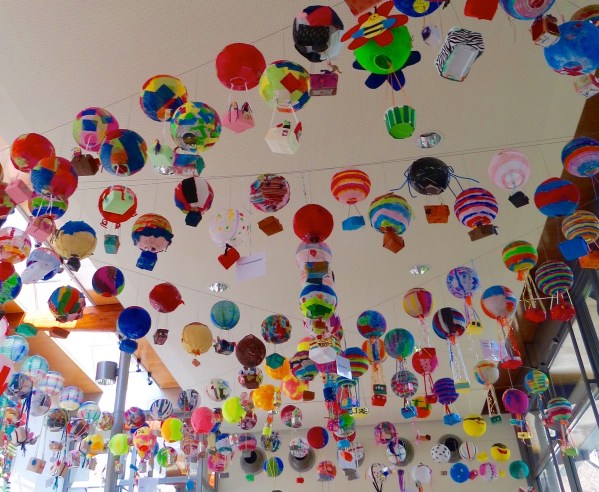
We also poked our head into a cafe whose ceiling and a wall were festooned with children’s artwork. I couldn’t resist snapping a shot of the myriad colors seemingly dangling outside the large glass windows due to the reflection.

IMG 6803

IMG 6801

IMG 6798

Haarlem, I think you’ve put a spell upon us two sailors.

The start of our Netherlands exploration

HAARLEM

Friday, April 22

This historic city offers a lot of interesting sites, one being the Frans Hals Museum, which boasts the best collection by, whom else, Frans Hals. We spent over two hours wandering rooms hung with a variety of pictures and decorated with floral arrangements, which are works of art themselves.

Thanks to the recommendation by other cruisers we obtained the national museum card providing admittance to over 400 museums during one year. Having purchased the card at one of the larger museums in town, we subsequently discovered the person selling us our cards didn’t really provide all the information we needed to take advantage of this annual membership (this has rarely been our experience with the Netherlanders so it was a bit of a surprise when it occurred). 

We later corrected this misunderstanding with the help of a great couple running a local cafe, the Downtown Coffee shop. The owner kindly translated the Dutch website letting us use their business address to register the cards. It wasn’t until I got to the end that I noticed they’d be mailing us our annual cards (our temporary ones only lasted 31 days) to this business. Not a problem he said. They’d just email us when they received them. And, this is the typical type of interactions we’ve had in this country!

Back to Frans Hals… the woman behind this museum counter couldn’t have been nicer (I seem to use that description a lot around here) giving us more complete information about our museum cards. She also mentioned we were fortunate to visit during this time of year due to the flowers complementing the artwork. She was right about that as a large and elegant array greeted us as we rounded the corner towards the exhibits.

IMG 6585

With a map and audio guide we stepped back into the 17th century noted as the Golden Age of Dutch Painting. Art flourished during this time period due to the strong economy in the Low Lands. Even with the strife of the civil war (battles lasted until the signing of the Treaty of Westphalia 1648) and no local patronage by royalty or the Catholic Church (the late 16th-century rebels up north formed the Union of Utrecht promising unheard of religious freedom and a switch to less elaborate church decor), a growing middle class grew into a new purchasing power.

Art became a business, and many took up the brush to cash in on this thriving industry. So many tried their hand at painting the increasing competition meant a large group of highly skilled artisans rose to the top of their craft. They did so by focusing on what the merchants, shopkeepers and other buyers wanted. Now landscapes and still lifes hung alongside the traditional portraits and religious scenes.

By the amount and quality of artwork it was a spectacular time to paint, and we’re fortunate to see so many of these original artworks during our visit in The Netherlands. Not only am I learning more about art than ever before but also appreciating the various styles each artist represents including some of the Dutch painters exemplifying this Golden Age:  Frans Hals (1581-1666); Rembrandt van Rijn (1606-69); Johannes Vermeer (1632-75); and, Jan Steen (1626-79). And, since we’re in the Frans Hals Museum I’ll start with him. (FYI:  I apologize for the poor reproduction due to no flash allowed.)

Frans Hals is best known for his relaxed style and virtuoso realism. He was the first to paint people gazing at and laughing with one another in these officers’ portraits. A highly-desired commission by the town resulted in five large group portraits of the Civic Guard. At the age of 18 all males were required to serve a three-year term. Frankly, it seemed to be a glorified old boys’ club from the look of their portraits since the painted topic was the Leaving Banquet toasting the end of terms… 

IMG 6656

Other famous works by Hals were the portraits of Regents and Lady-governors. Comprised of prominent men and female spouses of wealthy citizens, these appointees by the local magistrates oversaw what we’d call today non-profit organizations offering social services for the less-fortunate. These paintings reflect the communal caring orchestrated by each city’s magistrates who felt both a Christian and a civic duty to take care of their poor. These lay administrators (aka Holy Ghost Masters) to manage outside relief agencies (distribution of food and clothes to those who had homes but needed fundamentals) and almshouses (those requiring shelter as well). Thus, this country created a de-centralized social safety net city by city, based on a Christian principle of charity but evolving into a municipal responsibility as early as the 1400s. 

One of Hals last group portrait featured “Regents from the Old Men’s Home” (1664). Later in the 19th century his imprecise style was criticized; however, with the rise of Impressionism, Monet and Manet actually visited Haarlem to study Hals Regents painting. Ironically, Hals became a recipient of the city’s charity becoming a pensioner in the last years of his life, a sad fate, which befell many talented individuals.

IMG 6664


Those large-scale works were impressive but so, too, were the individual portraits Hals painted, such as the one of Haarlem’s mayor in 1630, Pieter Jacobs Olycan. Also, note the wall, which is hung with leather embossed panels.

IMG 6646

An earlier painter who obtained valuable commissions from town leaders was Cornelis van Haarlem (1562-1638 ). In 1590 he became famous overnight thanks to the town council asking him to paint four scenes for the Prinsenhof, a guest house for visiting Dutch stadholder (stadholders were basically the aristocracy of the Low Countries). He painted himself in, too (top row, second from left). Not an uncommon trait to find artists making a cameo appearances in one of their works.

IMG 6651

Frans Hals children also contributed to the art scene. One by the third son, Jan Fransz Hals, is “Children at Play” (1635).

IMG 6699 1

Personally, I think he would have been better off holding something other than a paint brush


Daily life events also featured in artists’ paintings. Jan Steen, another local artist, depicted peasants in various activities. Although his art carried a humorous and sardonic tone, the overarching theme was to amuse and yet warn upper classes away from temptations as shown by His “Village Fair” (1665). This painting speaks to the dangers of drunkeness and licentious behavior. Looks more like a good party to me.

IMG 6678 1

Haarlem was known for its fine linen, and one oil painting showed hundreds of feet of cloth stretched out to dry in the sun. Interestingly there was an ongoing feud between the city’s beer industry and the linen one because both needed clean water. The breweries won and the linen producers were forced to find other sources further out of town to create their bright white cloth. 

IMG 6616

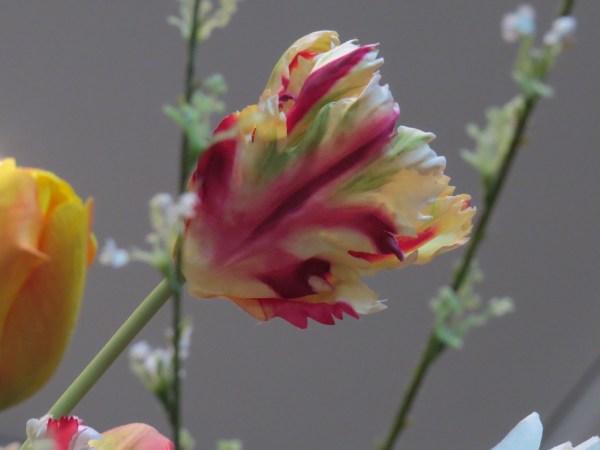
Another topic reflected by artists was Tulipmania. The tulip, whose name is derived from its country of origin: Turkish for turban, was introduced in the 16th century and later propagated by the scientist and botanist Carolus Clusius in Leiden, roughly twenty miles south of here. Haarlem became the main center for cultivating these desired flowers. The tulip became a commercial entity with speculators vying for the most exotic bulbs, ones they could display as proof of their wealth. One example:  a bulb was purchased in 1623 for 1,000 guilders. Within two years it doubled in price, and then rose to five times the original price in 1637 (the cost of a canal-side home or $90,000 in today’s currency). 

IMG 6624

When the demand all of a sudden fell in 1637 (probably someone woke up and realized it really was just a flower) many wealthy and not-so-wealthy speculators fell into bankruptcy. Satirical paintings sprouted up as a result of artists poking fun at this frenzy all in the name of a bulb, and this museum featured a few. The picture below painted in 1640 portrays the flower goddess Flora accompanied by three men in fool’s caps. The cart is heading towards the sea and a certain sinking followed by some investors,  Haarlem weavers. 

IMG 6626


In addition to the Golden Age painters the Frans Hals Museum had a Hieronymus Bosch 1450-1516 (we wish we had tickets for an extraorinary exhibit in Bosch’s hometown from whence he took his name but not surprisingly it sold out quickly)…

IMG 6589

a fascinating Pieter Brueghel the Younger’s copy of his father’s (the Elder’s) “Dutch Proverbs” (1625)…

IMG 6680

a still Life displaying perfectionist details such one by Willem Heda (1594-1680) in 1658 (below is a cropped view I did of a larger picture)…


IMG 6669

and some landscapes featuring local architecture with the “View of the Town Hall on the Market Square” (1671) by Gerrit Berckheyde (1638-98)

IMG 6691

[Pretty wonderful to see this in a museum, then walk ten minutes to the physical site]

IMG_6511.jpg


Not all were paintings. One exhibit was an elaborate doll house from the mid-1700s. Evidently, doll houses began as a collector’s object with prosperous homes showcasing miniature furniture and accessories. 

IMG 6628

The owner of this doll house, the wife of Jacob Ploos van Amstel, sewed some of the items herself. She, her husband and mother-in-law are featured in the portrait below. The same artist actually painted some of the pictures hanging in these miniature rooms. That alone illustrates how valued these doll houses were.

IMG 6632

As promised by the woman who checked our card flowers brought spring inside as we toured the various rooms. I gazed at these almost as much as I did the paintings.

IMG 6666

IMG 6676

IMG 6687


Then, of course, there’s a favorite in every show, one which compliments JUANONA perfectly

IMG 6586

And, with that, we closed our tour of the Frans Hals Museum. Fortunately, many more historical visits were coming our way :)   


Early Days in Haarlem

HAARLEM

Wednesday, April 20

Leaving mid-morning we continued cruising down the river to Haarlem, once the most important port after Amsterdam. From here we planned on using public transportation for some day tripping to towns further south. Like in Norway we had notes from our cruising friends, Ginger & Dick of s/v ALCHEMY and Helen & Gus, s/v WINGS; and, all of them had spoken highly of the charms of this historic city.

Just so you get an idea of how the Dutch have adapted to living on the water, check out these condos. Looks like their sailboats serve as their cars :)

IMG 6483

Reaching the harbor master office located alongside a double bridge we paid for a week’s mooring and once again were kindly provided a city map with the locations of boating necessities (public showers, a laundromat, grocery store).

While waiting for the first bridge to open, the lady who had helped us in the office came down to the pontoon to tell us one of the bridges was broken; but, as she said we weren’t in any hurry since we were on holiday, which couldn’t have been truer. With the sun shining, a bright blue sky, and the promise of a berth in the midst of this old city, we felt lucky just to be on a boat gazing at a windmill in the distance.

IMG 6490

Within an hour the bridge was repaired

IMG 6491

and we continued down to a spot on the east bank of the river wall. Although located on the more residential side it was reputed to be quieter and still within easy walking distance of all the major attractions.

IMG 6497

Once JUANONA was secured we hopped off and strolled along the canal dodging cyclists. I have to say we thought it was a bit harrowing in SE Asia when crossing lanes; yet, there at least there seemed to be a constant flow in one or two directions. Here, traffic resembled a whirlpool of two-wheeled cyclists, four-wheeled vehicles, and two-legged pedestrians. Consequently our heads swiveled like owls’ every time we started to cross a pathway. We sigh with relief when we’ve reached the other side without a potential near-swipe of a passing vessel, be it mechanical or human.

In spite of every-which-way traffic historic Haarlem is easy to navigate as the Grote Markt or main square hosts one of the city’s oldest churches, Grote Kerk van St Bravo . We headed in that direction with the church’s towering wooden spire (a replica of its initial stone one, which was replaced due to the weight of the sandstone ) as our beacon.

IMG 6501

The architecture is stunning with facades featuring elaborate gables, which I found out served as an identification prior to the introduction of street numbers by the French. The building below looks like something that’d cause the sky to yell ‘Ouch’. We see these stepped lines a lot around here although this is the most elaborate so far.

IMG 6500

Landing in the plaza we found ourselves with the surround-sound of amusement park rides including a ferris wheel.

IMG 6512

IMG 6509

And bordering this modern funtime was the 14th-century town hall,

IMG 6511

the statue of Laurens Coster whom they claim invented movable type along with Gutenberg,

Lauren coster

the 17th-century beef market and fish house all within a cobblestone throw from the church.  

For some reason I had thought of The Netherlands not as a cruising ground but as a transiting point. I believe this arose from (a) knowing it was fairly early to begin our summer voyaging and (b) thinking ahead to a trip home for our nephew Thomas’ and Renee’s wedding. In any event it meant we had left Ipswich without a handy guide book; so, off we went to the local tourist office who directed us to a book store. 

Once there the enthusiastic owner offered us free coffee, wifi access, and proudly showed us the largest book I’ve ever seen and the most expensive for sale (over 6,000 euros) I’ve gazed upon.

IMG 6513


His store had one of only 15 located in the country and he’d already sold five out of limited press run. Gorgeous prints of paintings covered the pages, sized in various percentages to show exquisite details. 

IMG 6516

 We told him one couldn’t fit it aboard JUANONA, which is when he mentioned a nice little table stand came with your purchase. Did I say he was also a salesmen?

 With all of this history flooding around us seems like a good time to do my usual history jaunt through time. There’s no straight line through this country’s history, so bear with me if you’d like…

Who else but the Romans in 59 BC began documenting the Netherlands people. Caesar basically just followed the Rhine to its mouth, which empties into what’s now known as the North Sea. Following the Romans, Franks from the east began their conquering of the Low Lands bringing with them Christianity and the start of the Holy Roman Empire (HRE) under Charlemagne in the 8th and 9th centuries.

Adding to the mix Vikings attacked from the west constructing fortified towns and ruling became localized. As individual rulers’ power grew they squabbled among each other while bartering various freedoms in exchange for support from their townsfolk. 

By the 12th century seaport trade led to Dutch towns with sea access joining to from a powerful trading organization, the Hanseatic League, [define]. Meanwhile the first attempt to prevent the sea overrunning the land occurred when dams were built between Haarlem and the Zuiderzee, although disastrous floods still occurred.

Also during this time the powerful Dukes of Burgundy, French princes, took control of the area culminating with Philip the Good in the 15th century.

In spite of losing some of their freedoms towns switched into prosperity mode now that the local rulers stopped their spats under the domination of this Duke. Shipbuilding and trading of tapestries, paintings, chic clothing, beer, and salted herring flourished.

But all good things seem to come to pass, and such was the case of the Low Lands when Charles V, a Burgundian Duke, Head of the Spanish Empire and the Holy Roman Emperor, granted his son Philip II the Low Lands in 1555. The age-old ugliness of religious intolerance reared its head under this staunch Catholic. Prior to his rule Protestantism had taken hold with an array of sects allowed to practice. Eventually the largest group were the Calvinists. Believing all non-Catholics were heretics, Philip introduced his subjects to the Inquisition. In 1566 the Calvinists went on a rampage destroying Catholic churches symbols of idolatry. To combat this form of rebellion, Philip sent the Duke of Alba who took revenge of these unruly subjects by destroying towns and executing the inhabitants. Haarlem was one of the unfortunate victims when it surrendered after a seven-month siege in 1572, whereupon most of its inhabitants were executed.

This led to the War of Independence and the recognition of the country’s founder:  Willem van Oranje (count in the House of Nassau, later becoming a Prince of Orange in 1544).  

As a prince raised in the Hapsburg court as Philip II, Willem, too, was Catholic, but unlike Philip II, Willem believed in tolerance. Philip’s brutality caused Willem to revolt, and so began 80 years of war beginning in 1566.

In spite of the strife and ongoing battles the 15th and 16th centuries created a lot of wealth for the area thanks to the merchant cities. Once the war ended businesses really prospered and so, too, religious freedom. The northern Union of Utrecht, formed in the late 1500s by Protestants, offered religious tolerance unheard of in most European countries. It’s where the Pilgrims came and organized a sailing trip to the New World. In 1648 the War ended with the independence of the country called the United Provinces.

Trading continued to expand with the forming of the Dutch East Indies Company and Dutch West Indies Company in the 17th century. Colonizing of some of the Caribbean Islands and Indonesia occurred and the residents of theses United Provinces just got wealthier and wealthier. 

Dutch Ships In Front Of The Danish Coast 1612

Then wars with France in the 18th century interrupted lucrative trade, dykes fell into disrepair, and the country floundered. A civil war in 1785 between the House of Orange and its democratic opponents eventually led to Napoleon’s rule; but his Russian mistake created an opening for Prince Willem VI who in 1813 took over and sired a monarchy whose descendants still reign. He also formed the Kingdom of the Netherlands between the Netherlands in the North and Belgium. But, it was a bumpy ride with the country truly not becoming a unit until 1848 under Willem II’s more liberal constitution.

FYI: Inhabitants of The Netherlands refer to themselves as Nederlanders, not Dutch. The latter comes from Old English for ‘people or nation’ and was used to refer to people from the Holy Roman Empire way back when. “High Dutch” meant those living in the mountainous regions (Germany) while “Low Dutch” was used for those living in the flat lands (Netherlands). However, like Holland, which is really just two of the 12 country’s provinces but were the two most foreigners knew due to trading, Dutch is the word used by non-Nederlanders when talking about this country’s folk. Habits die hard!

The country avoided WWI and tried to stay neutral during WWII but Hitler’s invasion in 1940 created a Dutch resistance, which is where I take you back to Haarlem and to our wanderings on the following day.  

Thursday, April 21

I remember hearing about Corrie ten Boom but had forgotten the specifics of her heroism. She didn’t want to be called a heroine but the title fits; and, her selfless acts began right here in Haarlem at her home on Barteljorisstraat number 19. 

We arrived mid-morning thinking we’d just stroll right in and walk through not realizing reservations were taken online. Fortunately, the tour guide kindly let us join the group of 20, which increased by 24 by the time we all squeezed through the door and up the narrow staircase.

Corrie grew up in a very Christian household and one that truly lived by the code “do unto others as you would have them do unto you”. Theirs was an ‘open house’, which eventually became an underground railroad when the war broke out. To indicate it was safe to knock and enter, the ten Booms would place a wooden sign advertising a Swiss watch brand in the dining room window (her father was a watchmaker, and, interestingly, Carrie became the first female licensed watchmaker in Holland).

IMG 6543

Corrie, her sister, and her father saved over 800 people, many of them Jewish including up to 100 orphans, from the Germans’ clutches. The majority were fed and provided with temporary shelter during their escape route. Six, however, stayed in the house with Corrie’s family.

After a thirty-minute talk our guide took us upstairs to Corrie’s bedroom where the hiding place was located. 

IMG 6544

IMG 6545

An architect had the foresight to use brick instead of wood to create a phony wall. Thus, it sounded solid when hunting Nazis thumped on it during their house searches. The two men, two women, and two boys who lived with Ten Booms were able to get themselves into this hiding place within 70 seconds of a warning by one of the family members (a system of buzzers had been installed in strategic areas around he house) There, with some bread, a little water and a bucket, they remained hardly breathing until an all-clear signal was given. 

On February 28, 1944, the Ten Booms were betrayed. Corrie, her sister and father were taken prisoner. Her 84-year-old father died in custody while his two daughters were shipped to concentration camps. The six in hiding weren’t found by the Germans; and, after two days of not daring to exit, two Dutch policemen who were part of the resistance found them and helped them all escape. Our guide said they knew what had happened to all of six them, except for one of the young boys. However, they found out in the mid-80s when a visitor on one of their tours quietly announced he was that young boy when the group was being shown the hiding place. Can you imagine?! 

Our guide also pointed out where extra food ration stamps were hidden under a riser in the staircase. Discovery of this  was the proof the Germans used to charge the family, since they had been unable to find anyone in hiding. 

IMG 6547

Corrie was the sole survivor of her family, and she continued to share her faith with others by preaching love of others around the world. Eventually she moved to California where she died in 1983 on her birtthday, April 15, at age 91. Pretty powerful story.

I can’t leave this house without saying how absolutely wonderful our tour guide was. She was very efficient (and fast-talking) in relating Corrie’s life. She mentioned at the very end when we were all saying good-bye she had been a child during the war and remembered eating tulip bulbs but not hyacinths because the latter were poisonous. But, what was more memorable was her aura of gentleness and kindness. When I come into contact with such a spirit all I want to do is bask in their warmth. 

IMG 6548


Later that afternoon we headed back to our boat and ended up at another Dutch symbol, the windmill.

IMG 6561

Our host was just as eager as the morning one. He threaded us up to the top where outside he showed us the blades holding the sails and how they stop the sails with a brake.

IMG 6558

He also pointed out a large dome, which he said had been a jail and was now housing a recent group of immigrants.

IMG 6562

Then, indoors he explained how this particular windmill was used to grind grains and nuts,

IMG 6569

including cocoa beans for the local chocolate company, Droste. I recognized the packaging but had no idea it featured a nurse because chocolate was touted to be good for you. Smart messaging :)

IMG 6578

The impressive structure was pinned together with pegs, and numbered, so that the windmill could be moved to another location if necessary. Giant wooden cogs converted wind into power.

IMG 6567

A brake allowed the operator to stop the grinding and another lever adjusted how fine one ground the raw ingredients by raising or lowering the stones. (We did stop by the next day to see how noisy it was, and surprisingly it was extremely quiet with the blades turning, although no grinding was being done.)

The next floor down displayed several models of the different types of windmills and a map depicting all of the Netherland’s reclaimed land (light blue).

IMG 6575

Originally created to pump water out of the low-lying lands, these mills were used for sawing wood, supplying clay for pottery, even grinding pigments for artists. By mid-19th century there were more than 100,000 windmills; yet, they fell into disuse with the invention of the steam engine – only 1,000 are in operation today.

Fortunately, the government recognizes the windmill as a Dutch heritage and have created a three-year training program for someone to obtain a license to operate these windblown mills. 

During our tour we met two British cyclists who had taken the ferry from Harwich (just south of Ipswich) and were riding to Prague! Yes, they were fit; and, yes, they could probably eat all the cheese they desired and drink all the beer they wanted and still be fitter than when they started. It’s almost enough to make me want to take up cycling; and, I have several friends, such as Kathryn Y., Andrea, Cindy, and Jane G., who could mentor me.

We invited Paul and John back to JUANONA for some wine and cheese and had a wonderful late afternoon discussing a range of topics with the inevitable one of Trump arising.

IMG 6579

In addition to this cycling trip (which would take roughly 3-1/2 weeks), they were also traveling to France in the Fall to tour some WWI sites. One of their field hockey teammates is an expert on WWI history and provides an amazing experience, such as researching John’s ancestor who died on the battlefields. Paul mentioned he was asked to recite a poem during this trip, and he kindly obliged us by reading John McCrae’s haunting “In Flanders Fields”.

Tomorrow more explorations of Haarlem’s offerings…

IMG 6557